Archive for the ‘Photography’ Category

Redentore 2011

Wednesday, July 20th, 2011

The Redentore Feast is one of the major annual celebrations in Venice, and one with a massive local participation. It takes place on the third Sunday of July, and on the evening before there is a huge display of fireworks just before midnight. It usually last around 45 minutes.

I went there with a bunch of friends in an old verigola belonging to the Arcobaleno association, and we got a place in front row, just in front of the Punta della Dogana, with only a few gondolas and sandolos in front of us, which proved a very nice spot for getting some photos of the fireworks.

More photos after the fold ..

(more…)

Spooky Venice

Sunday, October 25th, 2009

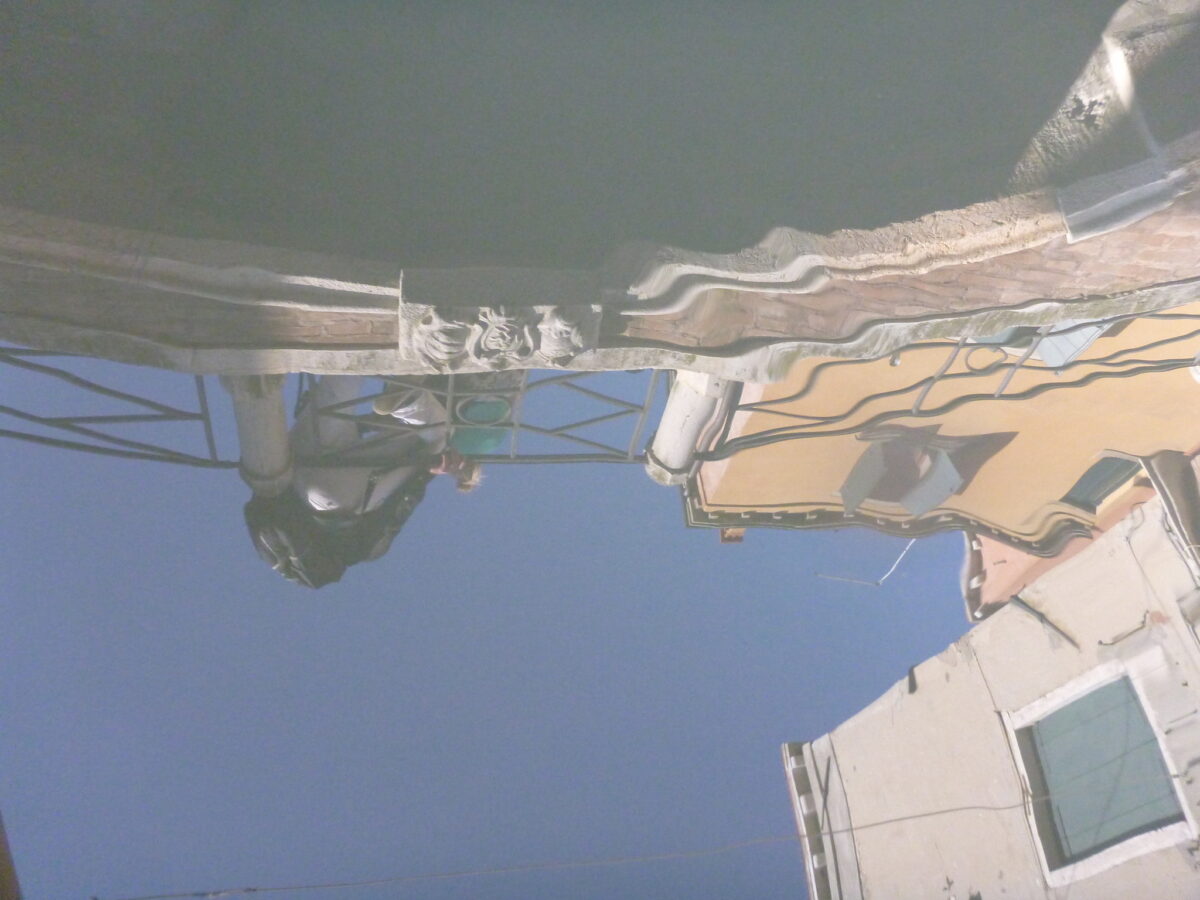
Spooky Venice

Photo from evening paddle on October 24th, 2009, taken in Rio di S.Giovanni Laterano.

High Water Gondola Rowing

Saturday, October 10th, 2009

Rowing a gondola at high tide requires some special skills. The higher water makes for lower bridges, and a gondola is not a low profile boat that’ll just go under anyway. The gondoliere have to do all sorts of weird manoeuvres to get the boat under the lowest of the bridges.

Crouching

The simplest way of lowering the height of the gondola is for the gondoliere to crouch on the back deck, while he keeps the oar straight backwards, propelling the boat with a sculling movement. The forcola, or oarlock, has a bend exactly to allow the operation where the oar is almost parallel to the boat.

High Water Gondola Rowing - Lying down 1 - 1329

High Water Gondola Rowing - Lying down 1 - 1330

High Water Gondola Rowing - Lying down 1 - 1331

Another example of the crouching gondoliere, same place near Santa Maria Formosa:

High Water Gondola Rowing - Crouching - 1

High Water Gondola Rowing - Crouching - 2

High Water Gondola Rowing - Crouching - 3

High Water Gondola Rowing - Crouching - 4

Edging

If the bridge is very low, the gondoliere might have to edge to boat to lower the stern ferro, which is the highest point of a gondola. He will do so by stepping over to the right side of the boat, in front of the forcola. From that position he will scull the boat forwards. On many gondolas the stern ferro is on hinges, so it can be flipped down. If the bridge is too low for even the bow ferro the pass, he will have to edge the boat even more, by telling the passengers to all sit on the right side of the boat.

From Rio del Mondo Nuovo, near Santa Maria Formosa:

High Water Gondola Rowing - Edging - 1

High Water Gondola Rowing - Edging - 2

High Water Gondola Rowing - Edging - 3

Lying down

At times the gondoliere will have to pass a bridge where there’s just only enough space to squeeze through, and to make sure that he will not get stuck, with ferri scraping the underside of the bridge, he will lie down on the back deck of the gondola, and push it along with his hands until the stern ferro is well through the passage.

From Rio San Provolo, S.Marco:

High Water Gondola Rowing - Lying down 1 - 1334

High Water Gondola Rowing - Lying down 1 - 1335

High Water Gondola Rowing - Lying down 1 - 1336

High Water Gondola Rowing - Lying down 1 - 1337

High Water Gondola Rowing - Lying down 1 - 1338

High Water Gondola Rowing - Lying down 1 - 1339

High Water Gondola Rowing - Lying down 1 - 1340

High Water Gondola Rowing - Lying down 1 - 1341

High Water Gondola Rowing - Lying down 1 - 1342

High Water Gondola Rowing - Lying down 1 - 1343

High Water Gondola Rowing - Lying down 1 - 1344

High Water Gondola Rowing - Lying down 1 - 1345

High Water Gondola Rowing - Lying down 1 - 1346

High Water Gondola Rowing - Lying down 1 - 1347

And another case from Rio della Maddalena, Cannaregio:

High Water Gondola Rowing - Lying down 2 - 1382

High Water Gondola Rowing - Lying down 2 - 1383

High Water Gondola Rowing - Lying down 2 - 1384

High Water Gondola Rowing - Lying down 2 - 1385

The Angry Elagoonephant

Monday, October 5th, 2009

The local above average size lagoon mammal can have a bad day. If the weather is foul, he is foul too.

Angry lagoon elephant - 1

Angry lagoon elephant - 2

Rainy Day in Gondola

Sunday, October 4th, 2009

Some people won’t renounce their gondola ride, not even if its raining cats, dogs and medium sized lagoon elephants.

Gondola under the rain - 1

Gondola under the rain - 2

Gondola under the rain - 3

Photos from Rio di Santa Marina, on September 14th, 2009 – a fairly humid day in Venice.

Fire Brigade on the Canalazzo

Friday, September 25th, 2009

There are strict speed limits on the Canal Grande, and its under constant surveillance, but the speed limits don’t apply to the fire brigade, as can be seen from these photos.

Fire Brigade on the Canalazzo - 1

Fire Brigade on the Canalazzo - 2

Fire Brigade on the Canalazzo - 3

Fire Brigade on the Canalazzo - 4

When you hear the siren you better move – or even better – keep to the sides always, as any rowed boat is expected to do in the Canalazzo.

The photos were taken on September 5 on the Canal Grande just in front of the City Hall, Ca’ Farsetti, very close to the Rialto Bridge.

This is not a regular occurrence. I have only seen it twice this year, and I do spend a good deal of time around the Canal Grande.

The Elagoonephant

Thursday, September 24th, 2009

The Elagoonephant in all its tyresome glory

There has been a larger than usual mammal on the loose in the lagoon this summer.

The life size elephant stands on a shallow island near the Certosa island, just east of Venice, on the canal that leads to the airport. Most boats pass at a distance, but we can paddle right up under its trunk. It doesn’t seem to mind, though.

It appeared there in early June, just at the opening time of the Biennale, so it probably has something to do with that. If that’s the case, it will likely disappear in November when the Biennale closes.

Seen up close it looks like its made from old car tyres, heated and moulded into shape, and some pieces of drift wood.

Paddling with the elephant

Some have suggested that the little red ball is like a key stone on an arch. Remove that, and it’ll all come apart :-)

Pied a terre – Venetian style

Saturday, August 8th, 2009

One day as I was paddling through some of the smaller canals in the sestiere S.Marco, close to the Fenice, I spotted this little sign in a window directly on the canal:

Pied a terre - sign

The sign reads: “Pied a terre of 50 mq, completely restored with high quality details”.

Even though I was looking for a place to live at the time, it probably wasn’t just that pied a terre I was looking for :-)

Pied a terra

Pied a terre or pied dans l’eau ?

The spot is on the Rio de Verona on a little used stretch between the Fenice and the Rio Malatin / Rio  Sant’Angelo.

Jump

Monday, August 3rd, 2009

At high tide the water in the canals at Murano is clean enough for the local children to swin and play in the water. The kids were jumping from the bridge in front of the medieval church SS. Marie e Donato.

p1030529

p1030528

p1030526

Vogalonga 2009

Sunday, June 14th, 2009

The 35th Vogalonga was held on May 31st, on the Sunday following Ascension as tradition dictates.

The Vogalonga is a 30km non-competitive “race” through the city of Venice and the lagoon. It starts a 9 from St. Mark’s with a cannon shot, and proceeds around Sant’Elena, past the islands of Certosa, Le Vignole, Sant’Erasmo, San Francesco in Deserto, Burano, Mazzorba, San Giacomo in Palude, Murano back to Venice for a final trip down the Canal Grande back to the finish at St. Mark’s.

Vogalonga 2009 - Caorlina at St.Mark's

Vogalonga 2009 - Gondola and kayak at St.Mark's

As an exception to an otherwise firm rule, Venice Kayak rents kayaks for the day of the Vogalonga, so we were a bunch of people launching from the camp site, in addition to the maybe 50 or more other kayaks, canoes, inflatables and other boats starting from there too.

Marco and I had to get everybody off safely, so we launched last, at about 8.30, with the prospect of not getting to the start on time, as the paddle to St. Mark’s normally takes about 40 minutes.

The weather gave us a hand, though, for which we paid dearly later. The forecast was for a NE wind, turning ENE later, of force 4 to 5 for most of the day. The sky was ominous, dark and menacing, but we were spared any rain during the day. The only trial would be the wind.

With a F4-5 tail wind and waves of ½m we half paddled, half surfed down the Canale San Nicolò and around Sant’Elena to St. Mark’s, where we arrived in less the 20 minutes, well before the cannon blast and the start of the Vogalonga.

Vogalonga 2009 - Rowing boat at St.Mark's

Vogalonga 2009 - Gondolone and dragonboat at S.Giorgio Maggiore

Vogalonga 2009 - Dragonboat at S.Giorgio Maggiore

The start was as chaotic as ever. One thousand five hundred boats or more, assembled without any order or system, all starting at the same time, is bound to create some disorder. Being in a small vessel you need to be careful and look over your shoulder every once in a while. A gondolone with twelve, fourteen or eighteen oarsmen cannot turn or stop in a jiffy, and the many backwards rowers often have little idea of where they’re going or what they’re hitting.

The first critical point was when we turned left at Sant’Elena, straight into the wind. Many rowers weren’t prepared for the wind that suddenly hit them, and had difficulties turning the corner. A caorlina just in front of me completely cost control and veered to the right, straight across the path of many other boats struggling to turn left. Much shouting ensued, but being behind and left of the fight I didn’t get involved.

The next 15km was one long hard slug into the headwind. Initially, the canals there were narrow and the field still close together, so there was little choice but to keep up with the speed of the others. The average speed of the many Venetian boats with four, six, eight or more oarsmen was around 5km/h in spite of the headwind, so we just had to push harder and keep up with them.

Vogalonga 2009 - Gondolone S.Marco from C/C Diadora

Vogalonga 2009 - Gondolone S.Marco from C/C Diadora

After a while I spotted Marco maybe 200m ahead of me, paddling in a leisurely pace just in the wake of an eight oarsmen gondolone, shielded from the wind by the much higher Venetian boat, and I started paddling even harder to catch up with him. I didn’t gain one metre on him, but I did succeed in geting very tired way too soon during the Vogalonga. After a while I gave up and found a similar place in the wake of a caorlina, where I could relax a bit. There were still over 20km left of the trip, and I had no intention of pushing myself out of the race.

Vogalonga 2009 - Caorlina rossa

Vogalonga 2009 - Caorlina viola with flag

I followed other boats like that for a good part of the northward part of the itinerary, breaking away every once in a while to try to take some photos. It was almost impossible to photograph anything. As soon as I stopped paddling, even for the few seconds it took to pull the camera out of the pocket to turn it on and drop it on the spraydeck, the wind would cause me to lose speed and turn sideways across the path of the others. The few photos I did manage to take were almost all shaken because I had to lower the camera before the autofocus has finished.

As we turned left around San Francesco del Desterto towards Burano I made a small mistake. Most other boats kept a course more to the left, downwind, which seemed to take them south of Burano, not north of the island as the official itinerary said. I assumed they had been blown a bit off course by the strong winds, so I kept more to the right towards the northern side of Burano. As a consequence I ended in secca, in shallow waters due to the low tide, and for about 1-2km I had to fight the winds from my right with only 10-15cm under the keel. Had the tide been just a little bit lower, I would have been stuck.

Vogalonga 2009 - Burano in view

As I approached Burano and finally got enough water under the boat to paddle faster, a completely devastated Marco pulled up besides me. He had ended up behind me earlier because he wanted to take some pictures, and had had to paddle like a madman to catch up.

We agreed on taking a break after we had rounded Burano, in the canal at Mazzorba, where the wind would be in our favour. We picked up some drinks and bananas at a service boat in the canal, and as I ate my bananas and drank the sugary greenish stuff they had give us, Marco paddled across the canal to say hello to a friend. I drifted along, leaving Mazzorba towards the island of Madonna del Monte, while I took photos of the passing boats.

Vogalonga 2009 - Gondola dodesona

Vogalonga 2009 - Gondola dodesona

Vogalonga 2009 - Marco at Mazzorba

Vogalonga 2009 - Caorlina from the Giudecca

Each year in the Vogalonga there seems  to be a boat that attracts more attention than the others, and it usually involves female rowers for some unknown reason. Last year it was a beautiful wooden sandolo with a couple dress in white with golden scarfs, and this year it was a smaller sandolo or mascareta rowed by four women from the Remiera Querini in Venice.  The boat was adorned with blue flowers and the girls dressed in matching colours.

Vogalonga 2009 - Belle donne in sandolo

Vogalogna 2009 - Belle donne in sandolo

Most rowers were relieved of having turned the corner and now having a good strong tail wind, but for some the problems seemed to get worse. Many of the backwards rowers seemed to have problems with the following waves, and many went way off course. A black gondola, the only one I saw doing the Vogalonga, also went off course at times, but they definitely made it, as I saw them later in the city.

The strong winds and the open landscape in the middle of the lagoon gave more and larger waves than I have ever seen in the lagoon. As I approached Murano, especially after I had passed the island of San Giacomo in Palude, the waves were between ½m and 1m, which is a lot in a shallow lagoon. It was definitely enough for me to catch a wave and surf a little. I had loads of fun, until a backwards boat almost rammed me from behind as I was waiting for a wave.

Vogalonga 2009 - Dragonboat

Vogalonga 2009 - Rowing boat

Vogalonga 2009 - Kayak

Vogalonga 2009 - outrigger canoe

Vogalonga 2009 - rowing boat

Vogalonga 2009 - kayaking with umbrella as sail

Vogalonga 2009 - black gondola at Murano

I was full of energy as I entered Murano and continued towards S. Alvise on the NW side of Venice. The official route was towards S. Alvise then right to the start if the Canale Cannaregio where we were to enter the city canals.

The waves were building up as I came closer to S. Alvise, and they were now mostly around 1m from the back slightly on the right side. When I was almost at the Canale Cannaregio, I had to do a detour because a large area was closed off by a floating barrier. As I paddled around the area, I noticed a sunk dragonboat and two or more backwards boats in the water, in a mess of oars and other stuff from the capsized and sunken boats. A couple of persons were swimming inside the area, apparently trying to collect oars and other floating items.

Vogalonga sunk and capsized boats at Cannaregio (press photo)
(Press photo)

The Canale Cannaregio, especially at the Ponte Tre Archi, is another critical point where boats often pile up. This time is wasn’t that bad, but the backwards people still caused problems as they had problems getting through, even hitting the central arch with getting too close to the sides.

Vogalonga 2009 - Ponte Tre Archi

Once I was through the Canale Cannaregio and into the Canal Grande everything eased up and traffic flowed without problems. There were no vaporetti or taxis, and very few gondolas. It was a fantastic experience paddling slowly down the completely quiet Canal Grande which hardly had a ripple on the surface.

Vogalonga 2009 - Gondola with felze - a rare sight

Vogalonga 2009 - rowdy youngsters in a gondolone di Remiera Casteo

Vogalonga 2009 - Belle donne in buona salute

At the finish I got my diploma and medal, and moved over to the side to watch the others coming in. Marco arrived soon after, as did the gondolone from the rowing club Diadora (where I’m a member now) with Lino Farnea a poppa, and the splendid red peata from the Remiera del Brenta.

Vogalonga 2009 - the finish

Vogalonga 2009 - Marco at the finish

Vogalonga 2009 - The peata del Brenta at the finish

Vogalonga 2009 - the finish, the peata and the salute

Tony from the UK was the only one of ‘our’ paddlers who came in at that time, and the three of us started our return paddle towards the Lido. To avoid having to fight the wind again around Sant’Elena, we went through the inner city canals until we came out at San Pietro in Castello, which is little more then 1 km from the camp site.

Vogalonga 2009 - paddling home through the sestiere Castello

We returned very tired, with the expectation of finding several of our guests there, as it was clear that a substantial number of participants had dropped out of this year’s Vogalonga. To our surprise there was nobody.

They all came back in ones and twos during the afternoon, and everybody who started made it through to the finish. Most were completely exhausted after many hours fighting the headwind, but also content.

According to what I’ve heard and read afterwards, the Vogalonga 2009 was the hardest ever. Over 100 boats left the race shortly after the start when they got hit by the headwinds at Sant’Elena, many others were blown on ground in too shallow waters, and some 30 boats sank or capsized at the Canale Cannaregio. About 80 rowers ended in the water there, and 20 in hospital with minor injuries.

Press coverage: