On a late Tuesday evening Fabio shouldn’t even be in his trattoria, which is only ever open for lunch. Yet here he was, sitting with his face in his hands behind the counter, while the water was pouring copiously inside. The barrier he had put in the front door was of little help keeping the high tide out. The water overflowed, and the water pressure such that it entered inside through underground passages used for gas tubes, water mains, electricity and phone lines, and even through cracks in the ancient walls. Three electrical pumps poured water out of the trattoria, but more came in. There was well over a foot of water inside.
When the high tide receded hours later, Fabio and his wife Stefania spent hours pumping out the water before they went to sleep, exhausted.
They were far from the only ones. All the shopkeepers were there all night, trying to save what they could.

High tide in Venice – Fondamenta under water with boats slipping off the moorings 
High tide in Venice – flooded courtyard 
High tide in Venice – trying in vain to keep the trattoria dry 
High tide in Venice – record high tide at night
Early next morning the Via Garibaldi, normally buzzing with shops, bars, locals getting about their businesses, and tourists, was deserted and lifeless.
The only place open was the newspaper stand, but nobody cared about the news. That morning they were the news, and that is almost never a good thing.
The tide had been forecast the previous day at 140-145cm (a normal high tide is at 80-90cm) but it just continued up and up, and hit 187cm at 11pm. It was the second highest tide ever measured, almost matching the record level of 194cm in 1966.
All the front windows on the Via Garibaldi was covered on the inside with moisture from the water that had soaked walls, furniture, carpets, goods.
Slowly people reappeared, doors of shops and storage rooms opened, and the full scale of the devastation was revealed.
Tables, chairs, shelves, fridges, freezers, dishwashers were pulled out in the street, and huge black garbage bags starting piling up with merchandise and foodstuffs ruined by the mixture of lagoon water and sewage that had submerged everything.
Most places had had two to three feet of foul water inside.

High tide in Venice – debris in the streets after the tide 
High tide in Venice 
High tide in Venice – shopkeepers trying to clean up 
High tide in Venice – humidity all over

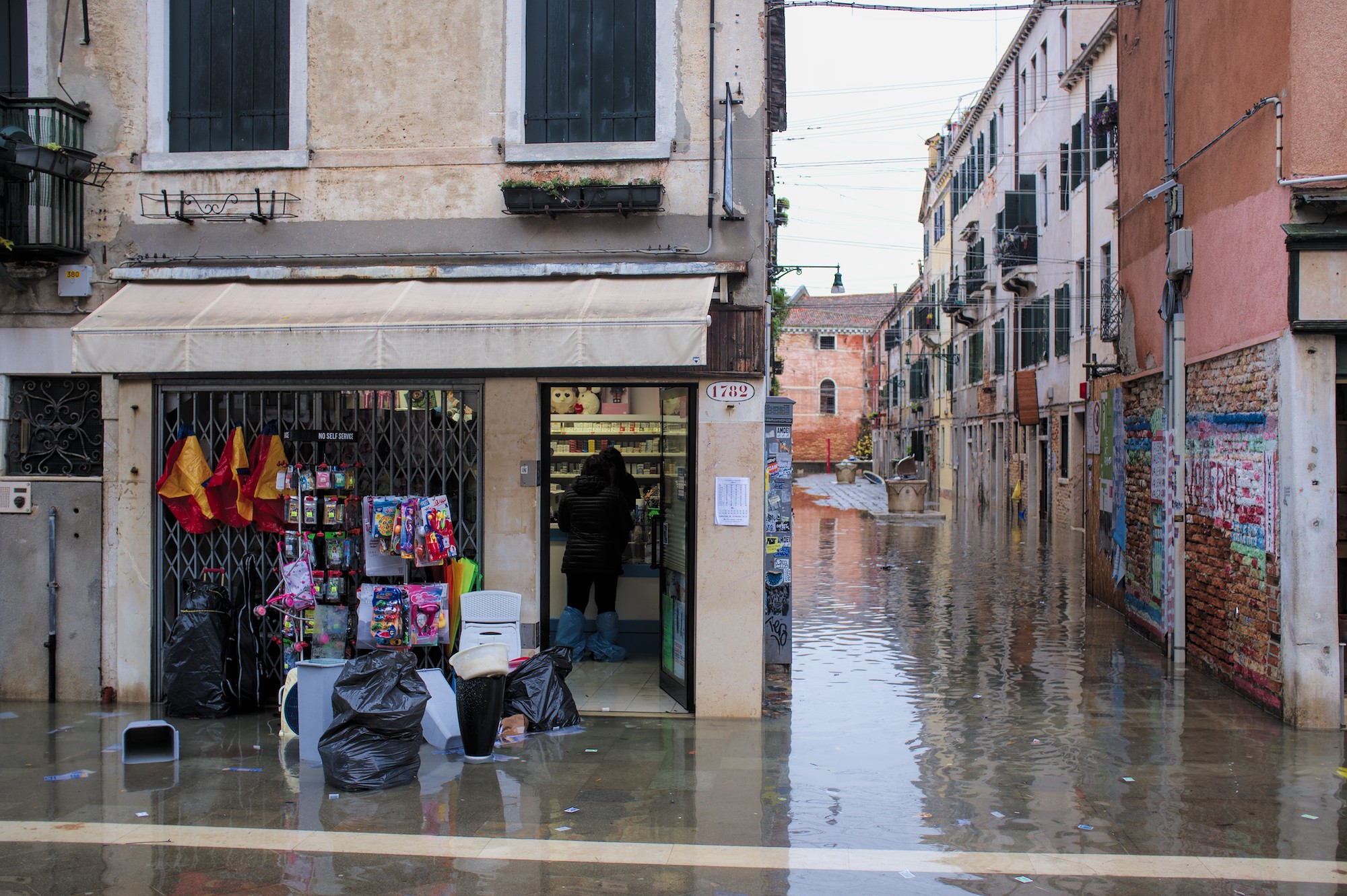

Laura, from the shop selling detergents and perfumes, was sitting outside sobbing, repeating “We’ve lost everything. We’re ruined, ruined.”
From inside the bakery you could here loud crying, but nobody came outside.
Fabio was more up-beat: “We’ll clean it up and get back to work. We’re not giving up.”
A single bakery opened later in the day, selling only thawed frozen buns. No ovens or machinery were working, and most like neither was the freezer.
The schools were all closed.
Soaked and smelly mattresses and ruined furniture appeared in front of the ground floor apartments in the side alleyways.
The cleanup work on Wednesday was impeded by the tide which again went above the normal level for a high tide, so there was 10-15cm of water in front of most shops while the shopkeepers tried to pull out everything to assess the damages.

High tide in Venice – wrecked vaporetto in Venice 
High tide in Venice – taxi on land after record tide 
High tide in Venice – wrecked taxi 
High tide in Venice – gondolas on land after record high tide
Via Garibaldi is not among the lowest parts of Venice, but everybody put in their barriers and attached their pumps at the end of the day, just in case. In any case, it went OK but few people slept well.
On Thursday most shopkeepers were still cleaning and throwing things out, and the garbage collectors started digging into the mountains of black bags and ruined merchandise which were piled up here and there.
The first few bars opened up again, so there was somewhere to grab a bite to eat between the constant cleaning.
The atmosphere was still one of sorrow and desolation. The normally lively street was like a funeral, and had the appearance of a war zone, with debris and destroyed objects lying all over.
The Friday morning tide was initially forecast to 130cm, then 140-145cm again, but it was clear to everybody that it would go higher. Then, in the last hour, the forecast was changed to 160cm and everybody starting bracing for the worst to repeat for the second in one week.
In the end the tide stopped at 154cm (the 7th highest measured), but it stayed at that level for far longer than expected, due to strong SE winds. A meter and a half of tide is still enough for water to enter shops and ground floor apartments, but in most cases not to overflow the barriers.
In any case, most of the work done to clean up was undone.

High tide in Venice – floating garbage 
High tide in Venice – ruined furniture piled up 
High tide in Venice – ruined fridge waiting for the garbage collectors 
High tide in Venice – Via Garibaldi flooded
Saturday was nice, even with a bit of sun, and the water didn’t get up to problematic levels. A few shops were open for a while, and we managed to do a bit of shopping for basic foodstuffs and get rid of some of the household garbage, for the first time since Tuesday.
It almost gave a kind of semblance of normality, even if the talk on the street was only about the high water and the damages it had caused.
We helped some friends getting rid of waterlogged mattresses, a broken fridge and a printer that was leaking ink all over. The piles of garbage and broken things kept growing, as the garbage collectors couldn’t keep up.
Sunday hasn’t been very nice. Horrible weather, lots of rain, strong winds and the tide was back. Again a forecast for 145cm, which was then augmented to 160cm a few hours earlier, and in the end we had a period of 150cm from before noon to after 2pm. All the shops and bars flooded again, for the third time in a week, and all the cleaning had to start all over.

High tide in Venice – bar owner trying to fight the tide 
High tide in Venice – floating plants tied down 
High tide in Venice – Via Garibaldi under water for the third time in a week 
High tide in Venice – water entering throug the ancient walls
By now we’re all tired, and I can’t even imagine how bad it has been for the directly involved, those working and living on the ground floor.
We’re the lucky ones. We’re out of water’s reach, we’ve had food and drinking water, electricity and gas for heating and cooking. Large parts of Venice have been with intermittent electricity, or entirely without, and many people living on the ground floors have lost most of their furniture and appliances.
To a large extent this week has brought out a lot of good things too. The schools and universities have been closed since Tuesday, and students and other volunteers, also from out of town, have gotten organised to help the worst hit residents. In their hundreds, they’ve set up meeting points around the city as soon as the tide has receded, to go and help clean up, and others have donated wellies, gloves and other things needed. Many have donated mattresses, fridges, furniture, linen and much more, to those left without.
The tide forecast for the next few days gives hope that the worst is over. The tide will still come up to around 110cm each day, but that is far more manageable, and in our part of town it won’t cause many problems. Hopefully, we’ll get back to some kind of normality in a few days time.