Yesterday the Venetian lagoon was under a dense fog. I had an appointment at the Lazzaretto Nuovo at 10am, so I went down to our boat at 9am, hoping the fog would lift before I really got anywhere.
It didn’t.
I went anyway, and luckily I brought my camera.
Briccola with altar close to Sant’AndreaThe Fortress of Sant’AndreaSant’Andrea in unusual solitudeA cormorant resting on a briccolaI scared a cormorantThe quiet made for interesting reflectionsA broken briccola makes it harder to keep trackThe Venetian lagoon on the fog – motonaveThe Venetian lagoon on the fog – Sant’ErasmoThe Venetian lagoon on the fog – fisherman
Navigating the Venetian lagoon in a small boat in dense fog means moving slowly from briccola to briccola (the wooden canals markers in the lagoon). Otherwise you might get stuck in the mud in the shallow areas and or get run over by bigger boats in the middle of the canals.
There are normally 25m between the briccole so visibility on these photos are about 50m.
In an hour I met two other boats, a motonave from Punta Sabbioni and a garbage collection vessel near Sant’Erasmo.
For many years, certainly all the years I’ve lived in Venice, the Venetian Carnival has been a very touristy and commercial affair, with huge crowds flooding the city and many paid actors in fancy but a-historical costumes vying for the attention of photographers.
This year has been a different carnival.
There are very few tourists in the city, and the remaining residents are coming back to the places they have mostly avoided for years, like St. Mark’s square during the Carnival.
This last Saturday of the carnival saw our square full of families and children, many dressed up and playing in the square.
The main attraction was a group of teenagers who had dressed up in home made giraffe costumes, posing for photos with the children.
There were a handful of tourists, but they were few.
It does say something about the extent of tourism in Venice in the last decades, that seeing children play in the square at carnival is something special and unique.
Buses in Venice are boats, like so much else. The Venetians call them vaporetti (sing. vaporetto), and they’re almost as iconic as the gondolas, and much more used, by tourists and residents alike.
Besides being the easiest way of getting around the city, the vaporetti can also make for nice photography subjects or locations.
The vaporetto as subject
The first approach to vaporetto photography is often the boat itself, but since it’s rather obvious it easily becomes banal.
Vaporetti in VeniceA vaporetto in front of St. Mark’s under a dramatic sky
The token vaporetto to say ‘Venice’
You can use the vaporetto, like the gondola, to show that you’ve taken a photograph in Venice, even when it is not otherwise obvious from the context.
Vaporetto, cruise ship and Venus (Steve Jobs’ yacht)Lots of photographers out after the tide Fairground bumber cars with vaporetto
The vaporetto as location
The vaporetti are an integral of Venetian daily life, and both the boats and the boarding platforms can be great locations for street photography.
When the platforms and boats are crowded it is not easy. However, when there are fewer people around, the results can be interesting.
People on the vaporettiPeople on the vaporetti
Searching for the odd angle
Sometimes it can be fruitful to look for a different angle, say, when the vaporetti are so crowded that any photo taken at eye level will be a mess.
One day I took photos at a lower level, trying to imaging how the place would look from a dog’s perspective.
A dog’s view on a vaporettoA dog’s view on a vaporettoA childrens bicycle in a vaporetto from a dog’s point of view
Another day I noticed the metal mesh that covers the windows so advertising on the outside can cover everything, and I experimented with how that mesh changed the view from the inside. It’s mostly invisible if not in focus, but by focusing on the mesh itself, the outside looked different.
Venice through the gridVenice through the grid
Wait for disaster to happen
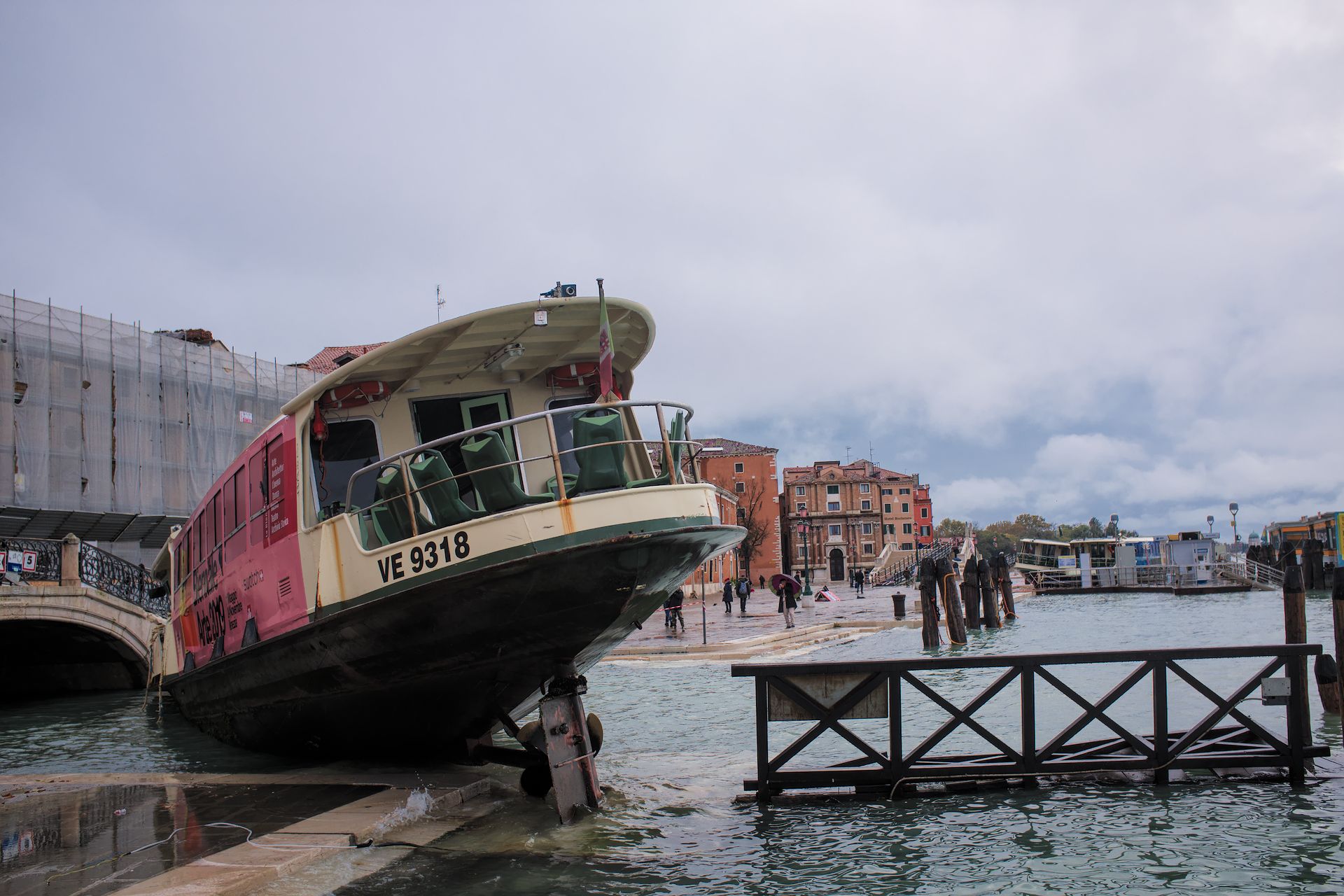
You can search for good photo opportunities, or you can wait for them to come to you. In November 2019 some unique opportunities appeared in the form of a violent storm with some very high water. Several vaporetti crashed on the queyside in central Venice, which offered some one-in-a-lifetime chances.
Wrecked vaporetto Wrecked vaporetto in central Venice
The island of Poveglia is located in the Venetian lagoon about ten km south of Venice. It guards one of the main entries from the sea towards Venice, and the island therefore has a long and rich history.
Today the abandoned buildings of a hospital dominate the island. The hospital originated in the 1780s as the Lazzaretto Nuovissimo, a quarantine station for ships and crews afflicted by the bubonic plague or other contagious deceases. The structure developed into a general navy hospital in the second half of the 1800s, and later on, to a general hospital for contagious and respiratory deceases.
Most of the buildings on the island date from the late 1800s, while the internal structures are mostly from before the second world war. The church steeple is the only part left of the church that once dominated the island.
The hospital housed patients with tuberculosis and other lung- and respiratory deceases, so contrary many legends there were no operating theatres in the hospital nor crazy doctors performing lobotomies.
Around Christmas 1969 the hospital ran into a problem with the water supply, and as a consequence the patients were evacuated to other Venetian hospitals just before the end of the year.
Everything was left behind as it was, awaiting the return of the doctors and their patients, but they never returned. As time passed, nature, vandals and thieves have done their parts, and now the buildings present themselves as eerie ruins.
Magic light in the abandoned hospital on Poveglia
Ghosts and legends
This well developed eeriness of the island, together with the discovery of an old marble slab with a Latin inscription mentioning victims of the black plague, is the basis for a lot of legends and ghost stories.
An American TV programm invented the stories exclusively to gain audience ratings. Lots of web sites then picked up the inventions, for the clicks on online articles. There is no basis whatsoever for any of it.
In spite of the desolation of the abandonment, the island is a very nice place, and definitely worth a visit.
Visiting Poveglia
We can organise bespoke tours to Poveglia on request, including boat rental to get there. Our contact details are at the foot of this page.
Photos from past visits to Poveglia
The only way to get to Poveglia is having a boatThe façade of the abandoned hospital on PovegliaCollapsed walls in the abandoned hospital on PovegliaPoveglia – the remains on the main entrance hallThe collapsing upper floor of the central buildingDetails of window shutters in the abandoned hospital on PovegliaPoveglia – a view of the laundry from the heating centralThe remains of the laundry of the abandoned hospital on PovegliaThe vandalised central kitchen of the abandoned hospital on PovegliaMagic light in the abandoned hospital on PovegliaDetails of furniture and a collapsed ceiling in the abandoned hospital on PovegliaMagic light in the abandoned hospital on Poveglia
High tide is a common phenomenon in Venice, and on some parts of the city it has a noticeable visual impact.
A normal high tide will usually reach a level of 80-90cm on the official scale, which will cause a few percent of the city to flood a bit, mostly around San Marco and the Rialto bridge.
Gondolas left on land by the tide
Extraordinary high tides up to 110cm are by now reasonably common, and they happen practically every year, and often many times during a winter. At 110cm about 12% of the city floods, but in most places a pair of wellies will be sufficient to get around.
Exceptionally high tides of 140cm or more are rarer, but they do happen, and with ever higher frequency. At 140cm over 50% of the city floods. In most cases of exceptionally high tides you’ll need a pair of thigh high waders to move around the city.
Recently, from the 12th to the 17th of November 2019, Venice had four exceptional tides, one of which at 187cm the second highest ever measured. In that case many places were under two to three feet of water.
Photographing during high tides
High water above the normal levels almost always happen when the weather is really foul. Strong winds and rain is practically a given, with all the problems that gives.
Lagoon water has a salinity of about 3%, and during high water sewage tanks around the city will often overflow, so the water is not particularly clean and definitely not safe for photographic gear. Salt water is high corrosive and can destroy electronics in no time.
Lots of photographers out after the tide
The city is full stairs and canal sides, and when walking it only takes one wrong step to end up in the water, or worse, in a canal.
The Venetians are not happy when the water comes up too high. Water will enter shops and homes, causing at best inconveniences, at worst substantial material damage. People under duress are more likely to take offence if photographed without consent, so my advise is to always ask if you want to take a photo of somebody, and to accept a no.
Planning for high tide in Venice
It might be tempting to plan a photo tour in Venice for the high water, but it is not that easy. The astronomical component of the tide can be calculated years in advance, and tables are readily available. However, the astronomical tide will only go as high as 80-90cm.
Local photographer at work
Meteorological factors, such as wind direction and force, air pressure and rainfall, are responsible for everything above 80-90cm. The impact of weather factors on the tide can only be forecast with some precision two to three days in advance.
Just as the weather can cause a tide to go higher, it can also make it go lower.
So there aren’t really any guarantees, and planning a visit in Venice for the high water is not really feasible.
High tide photos
A few photos from after the record tide of November 12th, 2019
Debris left behind by the tide Wandering plant moved by the tide Overturned tree and statue in a park Wrecked vaporetto Lots of debris was scattered all over Venice Wrecked vaporetto in central Venice Wrecked taxi in central Venice Disaster zone Venice Wrecked taxi ignored by walker-by Gondolas left on land by the receding tide Tourists taking photos of gondolas on land Gondolas left on land by the tide Local photographer at work Lots of photographers out after the tide Abandoned chairs on the quayside- High tide in VeniceCalm after the storm Wrecked vaporetto Local photographer Shopkeepers cleaning up the day after Cleaning up after the tide with water in the streets Water entering a shop throug the wall Water being pumped out of a bar Ruined furniture caught in the next high tide
Burano is a small island town some 10km north of Venice in the middle of the Venetian Lagoon. It is as ancient as Venice, and famous for lace production, great seafood and it’s coloured houses.
In fact, it must be one of the most colourful towns in the world. If you’re looking for a house that’s pink, orange, lime green, violet, turquoise, or just plain blue, Burano will have something for you.
All the bright colours opens op a plethora of possibilities: matching colours, complimentary colours, saturated colours vs pastel colours, and the classic Burano colour game: find people and houses in matching colours.
A common question we get is: who decides the colours of the houses? We have asked a few of the locals, and generally they just pick a colour they like. There is no regulation or planning of the colours of Burano. They just happen.
There are still remnants of the ancient lace industry on the island. A few of the many lace shops have professional lace makers working inside, often elderly ladies who learned the craft where they were young.
People on Burano in front of a purple hourseColour matched curtains and umbrella on Burano with people chatting in the backgroundThe people on Burano hang their laundry between the trees
Getting to Burano
The easiest way of getting to Burano is to take the vaporetto like 13 from Fondamente Nove. The tickets are the same as for public transport in Venice, and the journey takes about forty minutes past Murano through the lagoon.
For a photo walk or a photo session on the island of a thousand colours, you’d meet your guide at Fondamente Nove.
Burano – a photographer’s paradiseWorkers unloading a topetta on BuranoA pair of trousers drying on a line in front of an orange house on BuranoUmbrellas drying on a line on Burano
It’s carnival time in Venice again, and one the main events is the procession of the “Twelve Marys”, which starts from San Pietro di Castello and ends at Piazza San Marco.
The Festa delle Marie is a re-enactment of a medieval annual celebration where some of the wealthy families of the city offered the dowry for twelve of the poorest girls of marrying age.
The celebration lasted for two weeks in early February, with processions on boats down the Canal Grande and numerous feasts and events.
In 973 a pirate attack on Venice (which wasn’t yet a powerful state) led to the abduction of the girls, but they were saved and brought back to Venice.
Later, as the rich families resented the expense of clothes and dowries for poor girls, the girls were replaced by statues, and after some time the entire event was discontinued.
The current event is a kind of re-enactment of the medieval celebration. It is part beauty pageant and part historical re-enactment with groups from many places around the Veneto.
The event lasts a few hours. It starts at the ancient church of San Pietro di Castello, then moves down the Via Garibaldi to the shore, and from there to St. Mark’s.
Here are a handful of photos from the procession in 2019.
Historical pageant in VeniceMedieval beaus during the Festa delle Marie in VeniceCarnival time in VeniceMedieval knights during the Festa delle Marie in Venice
There’s a lot more going on than the official procession. We also had a group of Austrian musicians on full costume gatecrash our lunch at the local feeding hole:
Carnival time in Venice
In the Via Garibaldi
And there is usually no scarcity of other carnival participants who’ve dressed up for the party, as it should be.
Carnival time in VeniceCarnival time in VeniceCarnival time in Venice
Venice was born as a harbour, and she has always been a harbour. Venice, the Venetians and boats cannot be separated.
Water is omnipresent in Venice, which offers infinite possibilities to photograph gondolas, vaporettos, working boats, super yachts and even cruise ships up close.
Several of our guides are passionate about traditional Venetian boats. They’ll be happy to teach you the difference between a s-ciopon, a sanpierota and buranello, besides how to photograph they at their best.
Two sailors occupied with maintenance and cleaning work on a yacht moored in Riva dei 7 martiri in Venice, Italy.Boat moored in central Venice in front of ancient palaceTall ship Amerigo Vespucci in the morning fog in Venice, with man stepping down from mooring bitt in the foreground.Gondola in VeniceElderly lady trying not to watch criuse ship passingCruise ship, vaporetto and the reflection of the street in the bow a yacht
Garbage collection in Venice is unique in that it is almost entirely done by hand, door to door.
Both the carts and the workers are ubiquitous in the morning hours around Venice, and so is also, unfortunately, the garbage. It is often left outside for hours before being picked up, to the immense joy of seagulls and pantegane (rats).
Garbage collector in the Via Garibaldi with his hand drawn cart.Garbage collection by hand pushed cart in the winter in Via Garibaldi in Venice
Sometimes in autumn and winter Venice becomes enveloped in dense fog, and it becomes a mysterious and haunting place.
To fully enjoy the photo opportunities of the fog, it is necessary to get out early, because the fog lifts as the sun gets stronger during the day.
Corte Nova (Castello) in Venice with the ancient well head on a foggy morning.The local bakery doing an early delivery of bread in the Via Garibaldi in Venice, on a very foggy morning.Tall ship Amerigo Vespucci in the morning fog in Venice, with man stepping down from mooring bitt in the foreground.Man walking down the Via Garibaldi in Venice into the mistTall ship Amerigo Vespucci in Venice on a foggy day, with people in the foreground
Winter in Venice rarely includes snow, but we’ve had a few days with snow recently. It doesn’t happen very often. Last time with lots of snow was in 2012.
People walking huddling together under an umbrella in the snow in Via Garibaldi.Garbage collection by hand pushed cart in the winter in Via Garibaldi in VeniceWoman walking in Via Garibaldi in Venice in the snow
Photo Walks Venice is here all year, summer and winter, so get in touch and we’ll organise a unique photo experience for you.