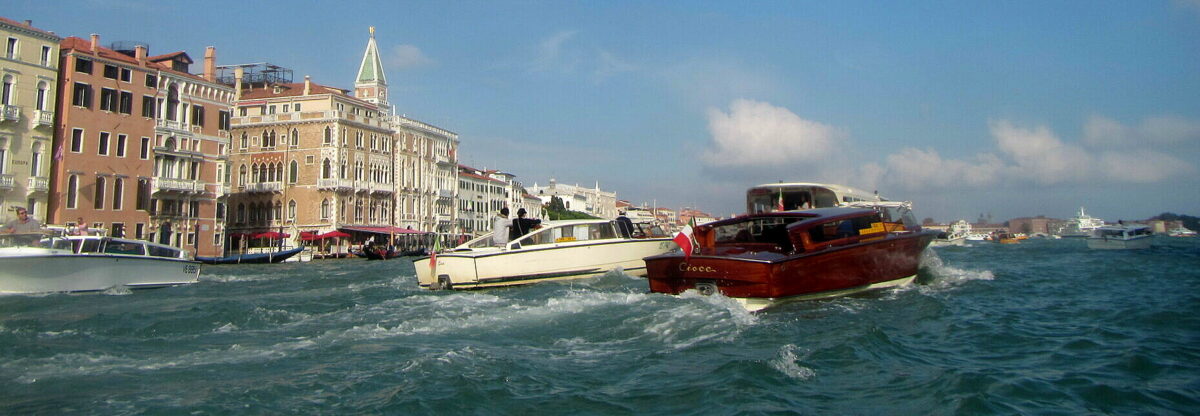
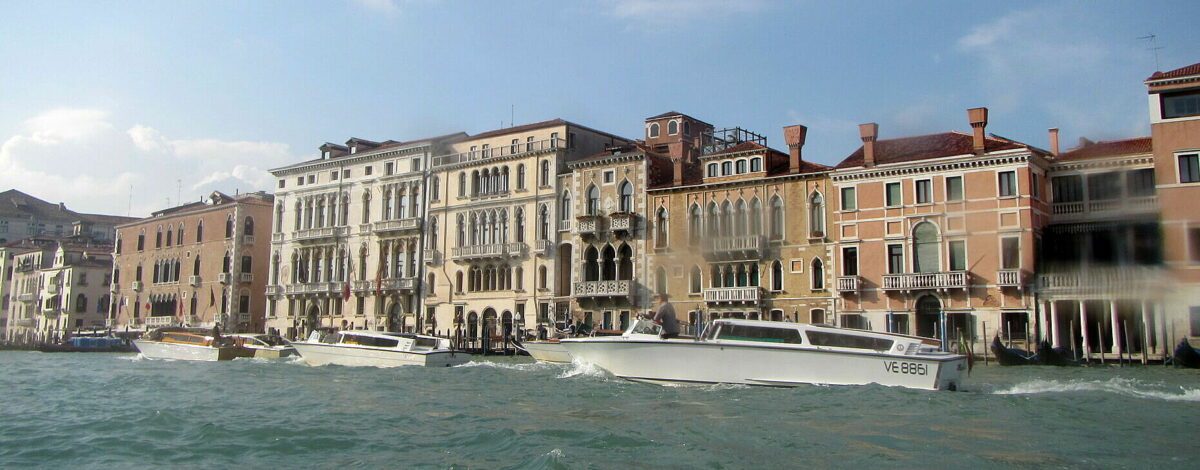
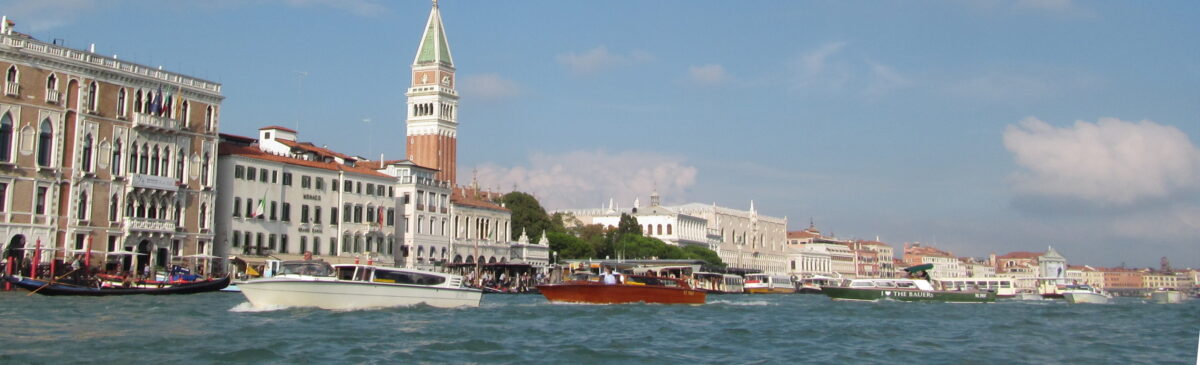
One of the main environmental problems in Venice is the moto ondoso – wave movement.
It is mostly caused by taxis and tourist boats, to a lesser extent by vaporetti (water buses) and private boats.
The constant churning of the water causes erosion of walls, side walks and quays, slowly but surely demolishing the city. You just have to row around the city at low tide to see the damage.
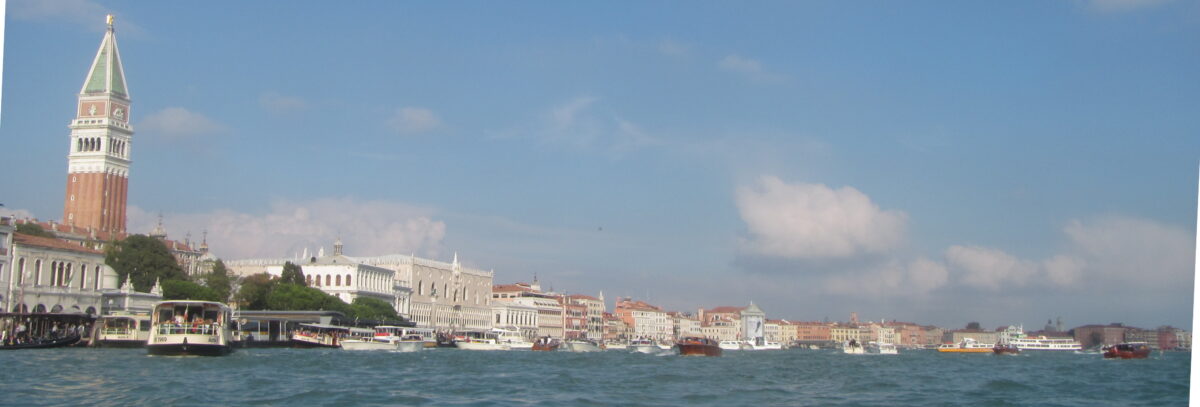
This is how the city appeared on October 3rd, 2015. See if you can spot the gondola.
Who’d want a gondola in Venice anyway, if you can race down the Grand Canal causing waves of 2-3ft.
Venice has issued a ban on kayaks, canoes, dragon boats and more, which is effective from Sunday, March 1st.
Currently it is illegal to go by kayak, canoe or dragon boat on the Grand Canal and several other canals in the city.
As a consequence, the city’s canal network has been cut to pieces, from a kayaker’s point of view, where it is not longer possible to go from one part to another.
Today I have had a meeting with the city official who have signed the new regulations, and it was not as bad as I had anticipated.
As things stand now, the ban is there and it is an offence to even paddle across the no-go canals.
However, the city administrators have finally understood that they have made a mistake by issuing a blanket ban like they have. Being unable to turn back, there will be a modification to the new rules, which will give kayaks, canoes and dragon boats more room so it will be possible to move around the city in a reasonably rational way.
In short, there will be some points on the no-go canals where passage will be allowed, most notably on the Grand Canal. There will be some limits on when you can pass, it’ll be mostly in the afternoon, and maybe even on who can pass, for example a requirement that there is a qualified coach in a group of kayaks.
It is my hope that they will also allow passage, at least in the afternoon, on parts of the lower Canal Grande, so we can still visit the ancient gondola shipyards in the Dorsoduro area, which will otherwise be unreachable.
While this will not be a perfect solution, it will be a marked improvement on the no-exceptions-allowed ban they have made for now.
Bureaucracy
The current rules banning kayaks etc from the Grand Canal and more, are not made by the city administration alone, and the city administration cannot therefore change them alone.
The changes from February 11th were published after a meeting of what they call a conferenza dei servizi, where all the different public bodies meet to coordinate.
A change to the new rules will have to pass the same way. This means that there will be a meeting on March 12th, where a commission will meet to prepare everything for the next meeting of the conferenza dei servizi, where a change can be formally decided.
Once we get there, we’ll know what they’ll come up with.
I do not know the date of the next meeting of the conferenza dei servizi, but I’ve been told that they’re normally held once a month.
Legal Challenge
The legal challenge to the kayaking ban in Venice will not stop before the city administration publishes what exactly they intend to do, and they cannot do that before the meeting of the conferenza dei servizi has met, and at than point they have also decided.
There will be no public hearing, beside the kind of privately requested meetings with city officials, like the one I had today.
The Arcobaleno association has no intend of backing down before they know what the new rules will be, so the process will go forward.
The collection of funds in support of the legal challenge continues.
The meeting
My appointment today was on behalf of my company Venice Kayak, so I did not represent anybody else there.
Besides explanations about what we’re doing — kayaking excursions in Venice lead by qualified guides, and not any kind of rental to whoever shows up — the discussion was mostly about what kind of modifications we would need to be able to continue our work.
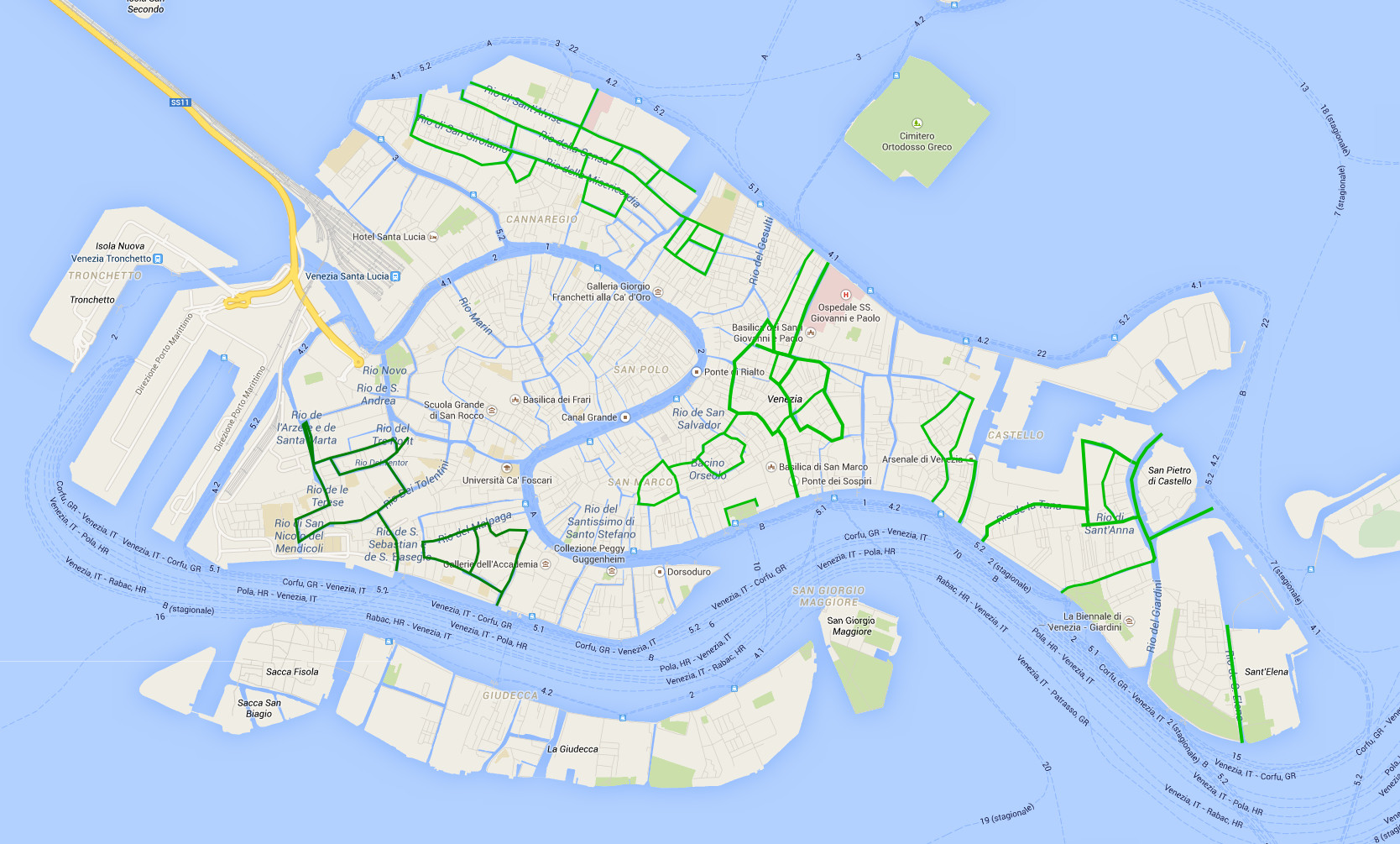
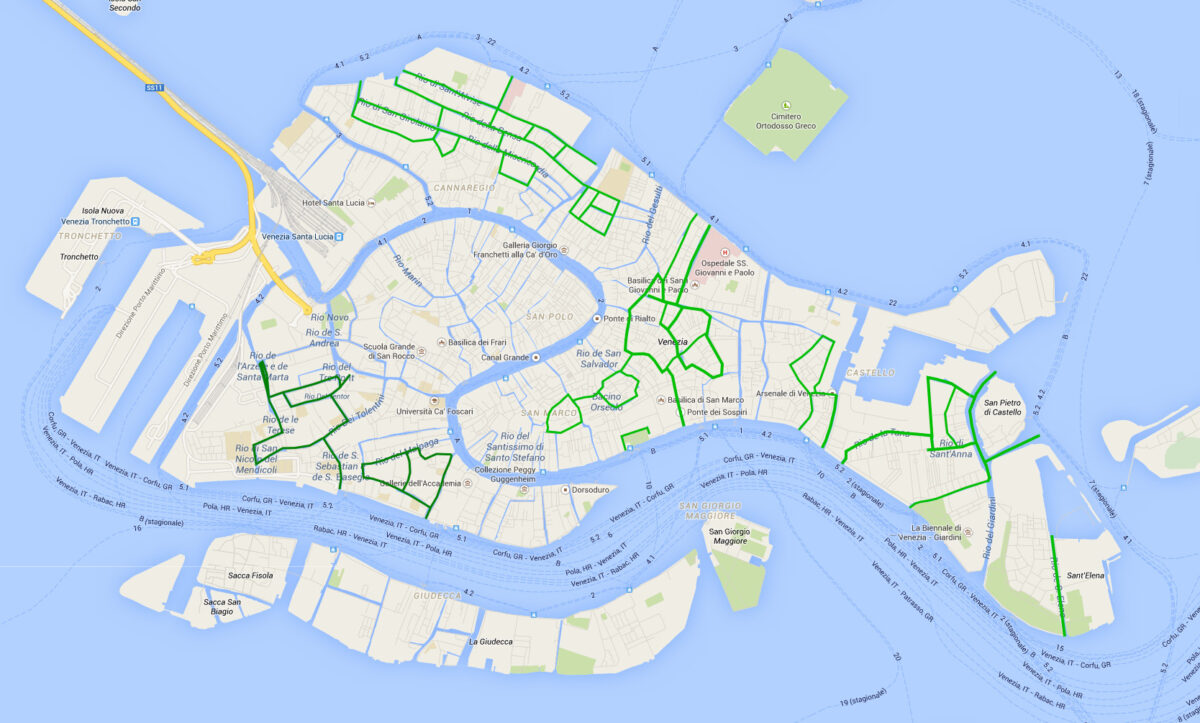
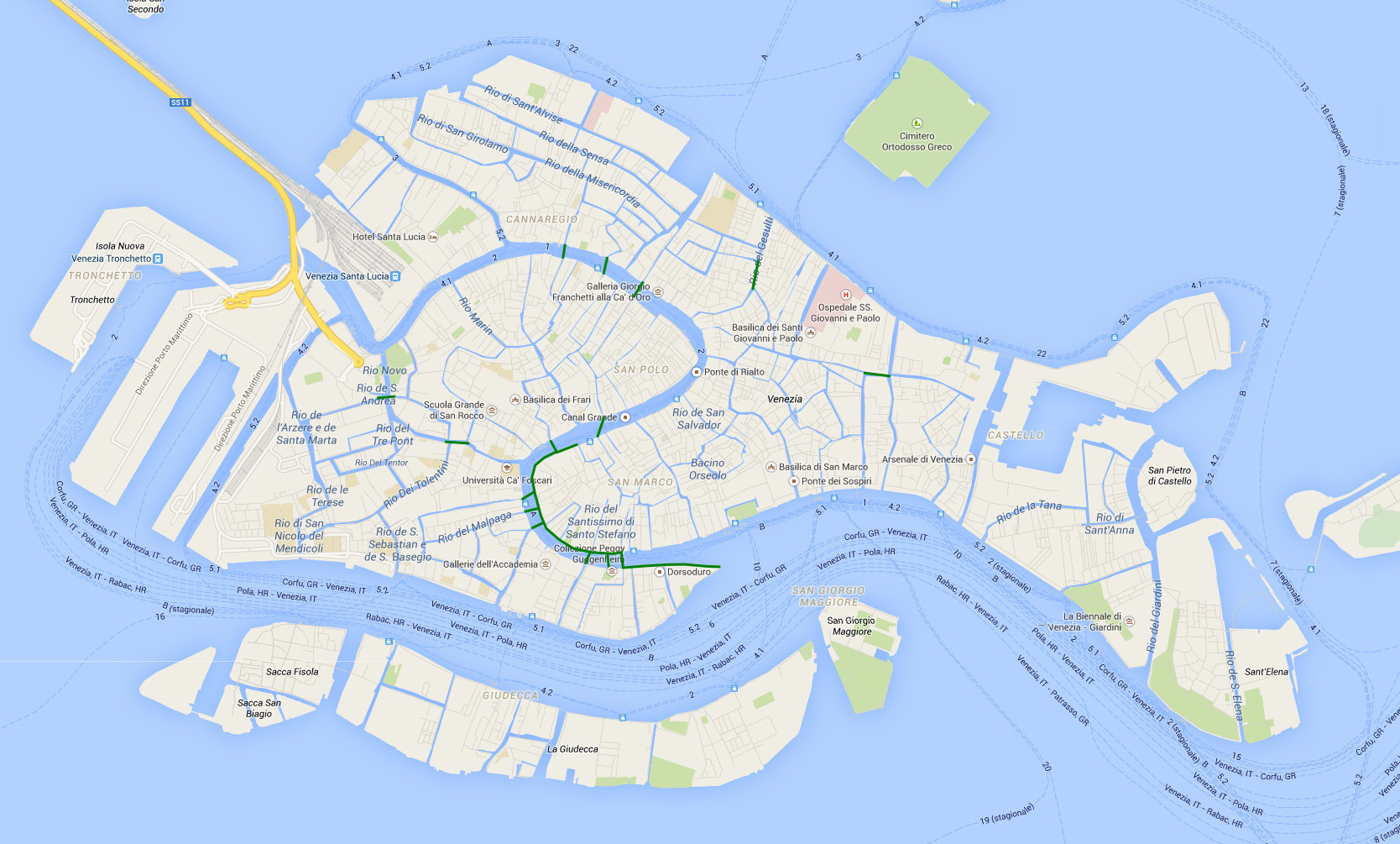
This maps shows the ‘dispensations’ we’ll need to be able to carry on in the way we have done now in seven years, without accidents or conflicts.
Summarised we need
a few passages on inner city canals to connect the otherwise detached segments of the city’s canal network,
some predetermined points where we can cross the Grand Canal, on each of the three parts of the canal, and
the possibility of transiting on a part of the lower Grand Canal to reach otherwise unreachable areas.
For now we’re crossing our fingers, hoping for the best.
If the city administration cannot come up with a working solution for us and the other paddlers in Venice, we will have no choice but the throw all our effort at the legal challenge the Arcobaleno association is preparing.
All of these groups, together with the Italian Federation for Canoe and Kayak (FICK) and other organisations, are trying in various ways to counter this blanket bans of most paddle crafts in Venice.
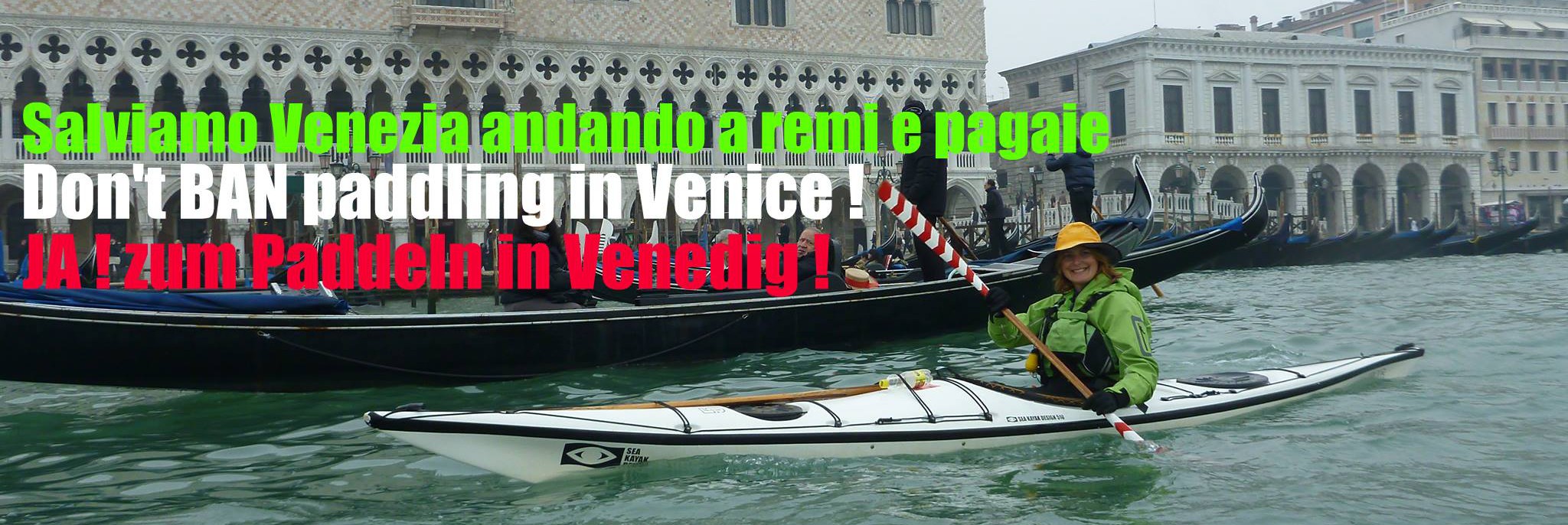
A lot of discussion is going on the Facebook group called Salviamo Venezia andando a remi e pagaie.
Most of the discussion is in Italian, but it is open for all interested parties. I try to put in something in English every once in a while, but I’m neither the creator nor an administrator of the group.
Arcobaleno is one of the oldest kayaking clubs in the wider Venice area, and they have been active for many years.
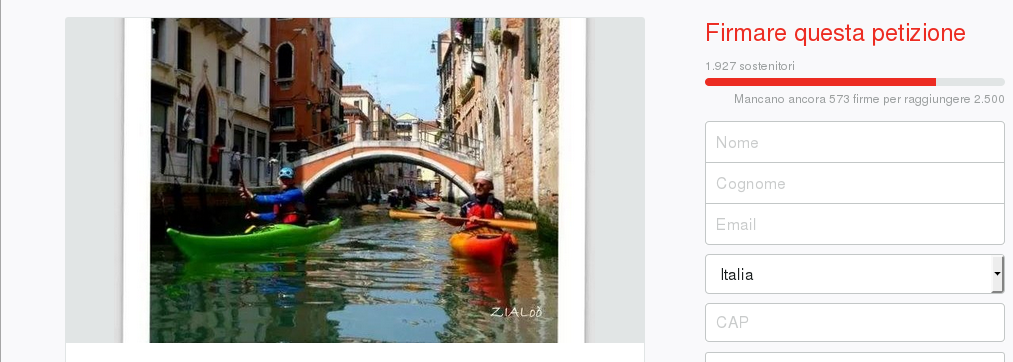
A PayPal account, ricorso@arcocanoa.org, has been set up to collect funds for the legal battle ahead. The needs aren’t huge, all in all, around €3000 will be needed, but it is more than the club and its supporters have.
Even contributions of €5, €10 or €20 will be a help in the fight to keep Venice open for paddlers.
The new regulations banning kayaks, canoes and dragon boats will affect quite a few clubs and activities in Venice.
The association Venice Canoe & Dragon takes (or rather, has taken) school kids in dragon boats through the city. Until now they have done so for 9000 kids, but that is a thing of the past now. Now the kids cannot experience the city on water from the water any more, unless they take a taxi.
The Pink Lionesses of Venice is an association for women who are survivors of breast cancer. Their pink dragon boat was once a common sight on the Grand Canal, but they too will have to paddle elsewhere.
Several of the rowing clubs based on the mainland will no longer be able to row or paddle in the Grand Canal. This also seems to apply to Venetian rowing, if the club is not based in Venice city or on the lagoon islands. This will affect the Società Canottieri Mestre and, I believe, the Voga Veneta Mestre, both well respected members of the Venetian rowing community.
All the individuals, clubs, associations and companies from outside Venice, that used to do the occasional tour to Venice in kayak, canoe or dragon boat will now face a fine if they venture onto the Grand Canal or any of the no-go canals in the future.
Due to the massive exodus from Venice towards the mainland during the last decades, there are actually more Venetians living in Mestre and Marghera than in Venice proper, and they will now be excluded from experiencing their native city as it was always intended, in a rowed by from the water.
At a cultural level, this new ban in a blow to the heart of everything that is Venetian.
My company Venice Kayak will at least be impeded by the published ban on kayaking on the Grand Canal, but we will probably be less hurt than the others, since we can still use some of the smaller canals in the city, where dragon boats cannot go.
The City of Venice has published a modification to the city traffic rules, which bans kayaks, canoes, dragon boats and others from navigating certain canals.
The relevant text is this:
Nei Rii principali interni di collegamento: Canal Grande, Cannaregio, Giardini, Greci – San Lorenzo, Santa Giustina – Sant’Antonin – Pietà, Noale, Novo, Ca’ Foscari, Santi Apostoli – Gesuiti, è vietata la navigazione dei natanti denominati jole, dragon boat, pattini, pedalò, canoe, kayak e tavole a vela e/o a remi.
It lists a series of city canals where “navigation is prohibited” for a series of paddled and rowed types of boats.
Navigation is prohibited
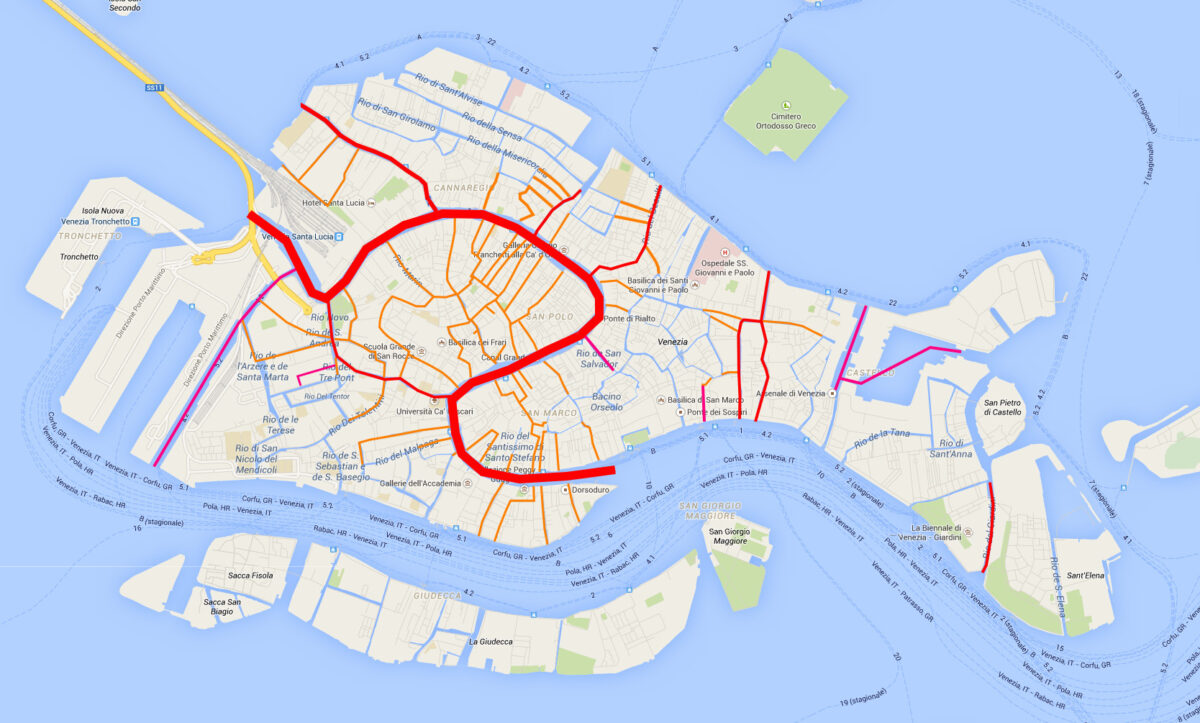
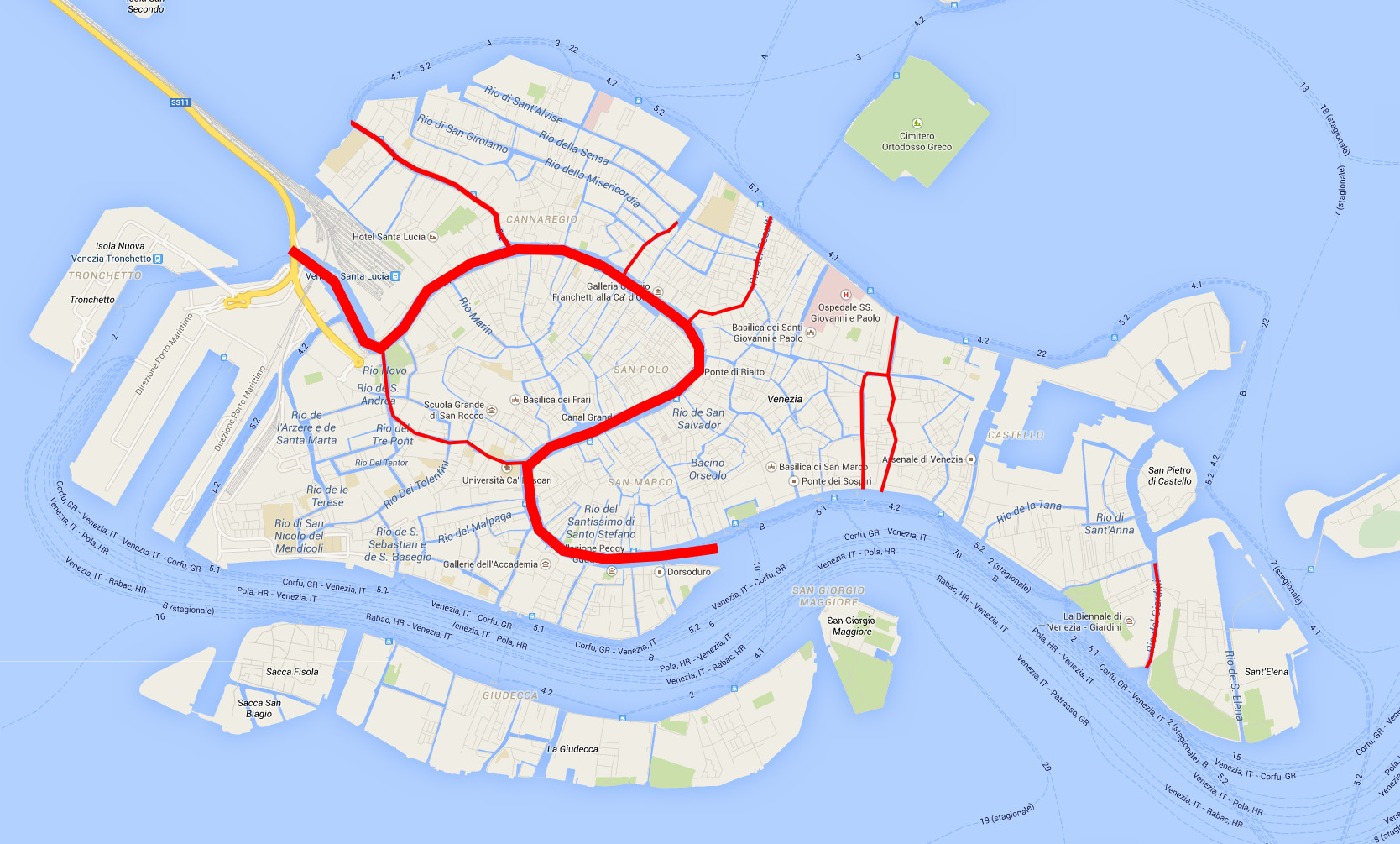
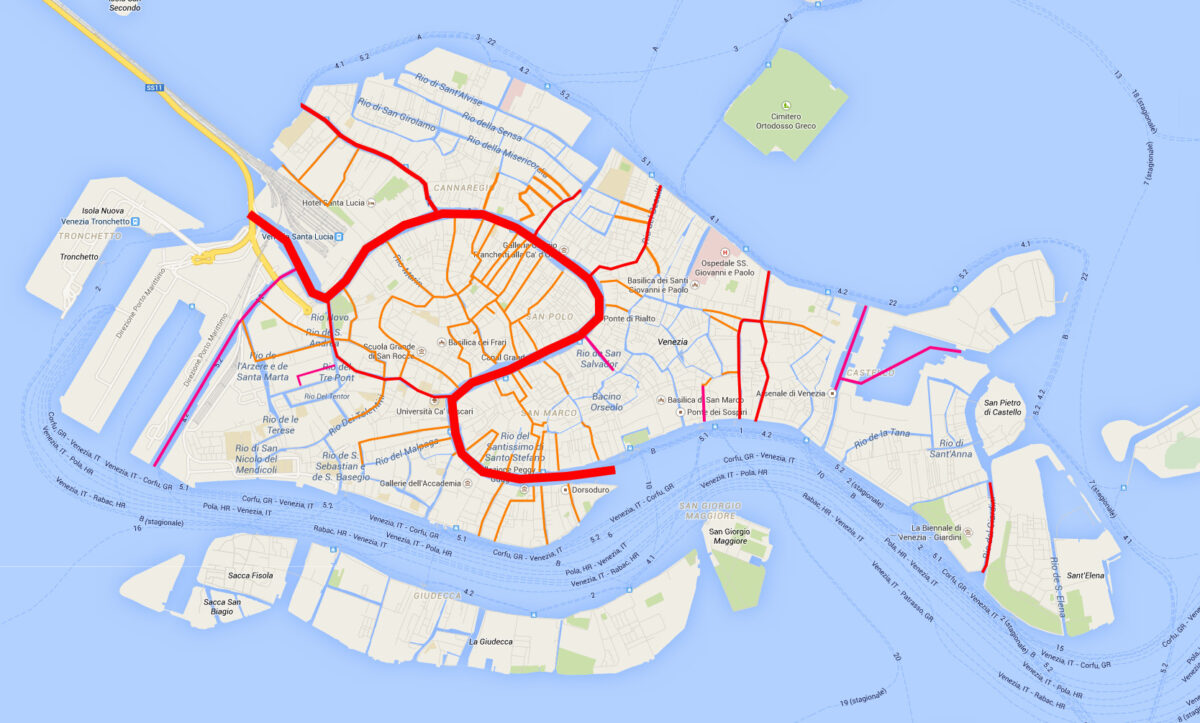
The canals in question are these, coloured red.
Now, besides the Grand Canal it doesn’t look excessive. There are a few other restrictions on traffic, not specifically targeted at kayaks and the like, for military areas, heavy traffic, or dedicated areas for the gondolas.
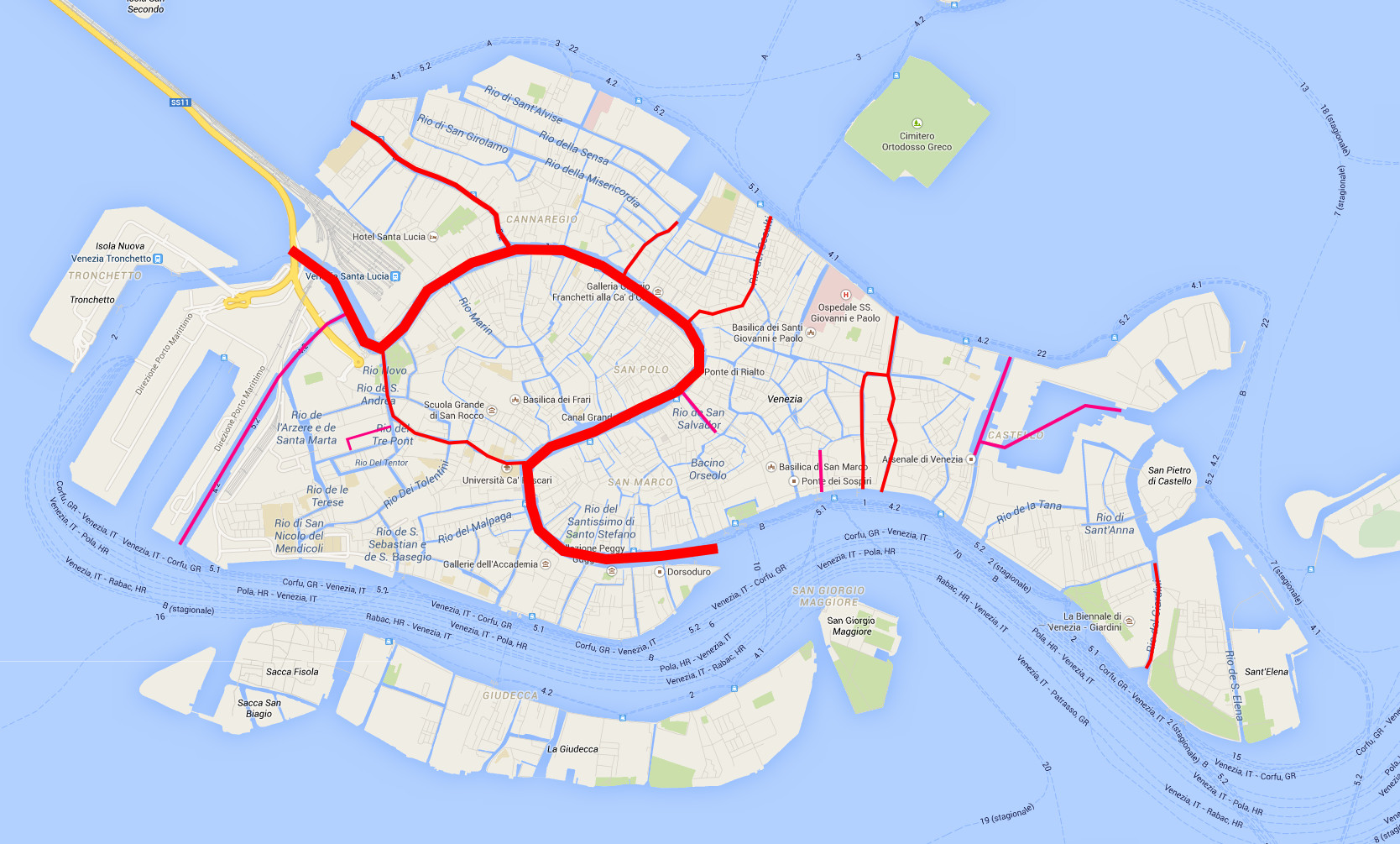
With these added (in violet) the map of the no-go canals become:
The canal network in Venice is Medieval in origin, and anything but regular. Some are very interconnected, others are detached from most others. A lot of very narrow canals lead down to some of the no-go canals, so if you went down there in a kayak, you wouldn’t be able to get out legally.
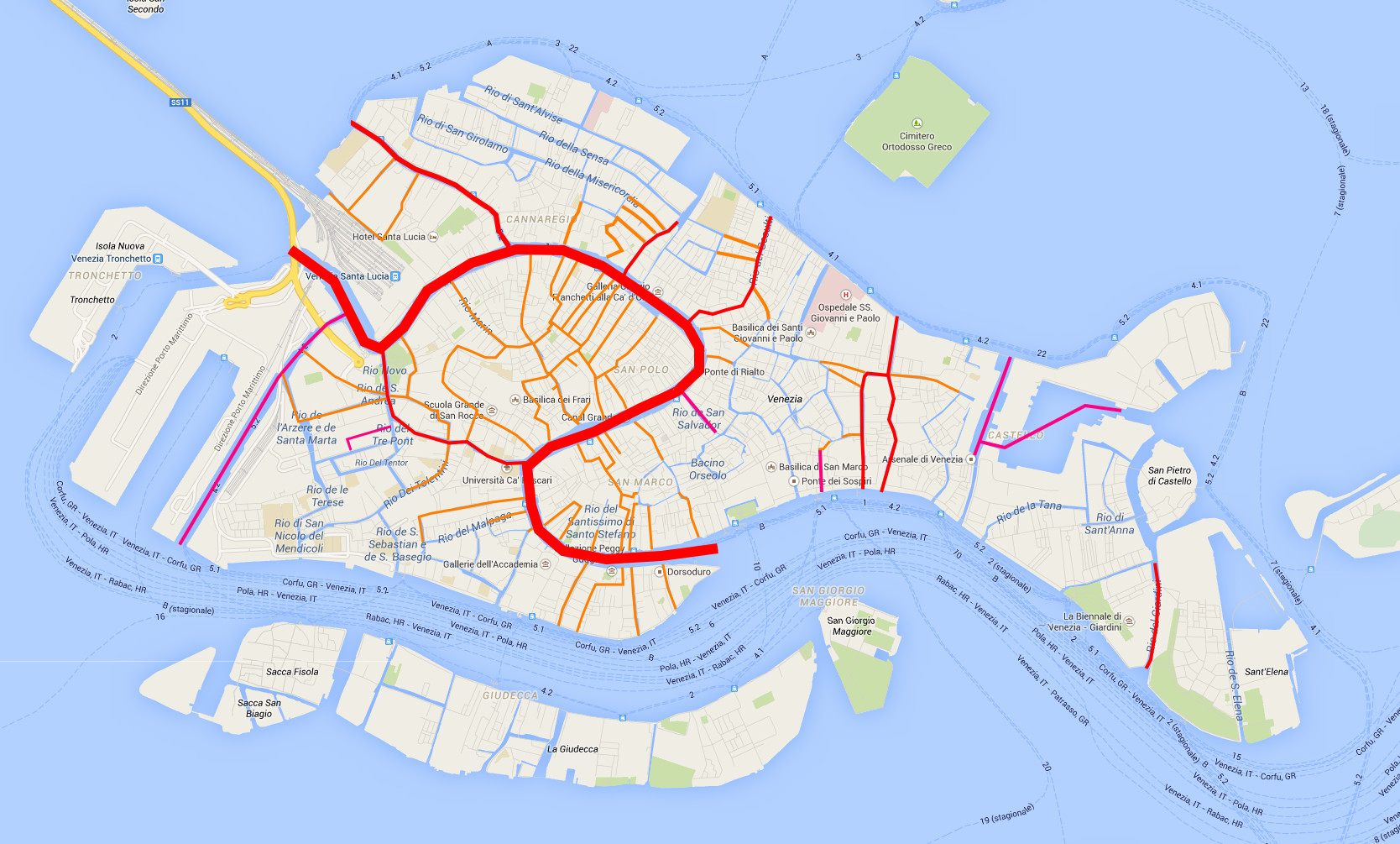
Therefore, the ban is for more than just the listed canals. The de facto banned canals are added to this map in orange.
Now, that’s a good deal more.
If you enter one of these nominally ‘legal’ canals, you won’t be able to get out again, unless you paddled backwards through a narrow, winding and possible busy canal.
The above map is made under the assumption that “navigation is prohibited” in the canals marked in red, which would mean that you can’t even paddle across.
If the city were to allow crossing of some of the no-go canals in some places, the map above would have to be changed, but with the current wording of the regulation, it will not be possible to go in kayak in any of the canals on the map above, which are marked in red, violet or orange.
I realise that it is hard to see from that map where you can actually go, so I have made the reverse map which shows in green the canals where you can go in a kayak and still have a legal way out.
As is apparent, after the introduction of the new regulations you can only paddle in a few separate and non contiguous areas of the city.
As before, this map relies on a strict interpretation of the wording of the new regulations, where we’re not allowed to traverse any of the no-go canals.
There are six distinct zones, where you’ll need to get out of the city canals, potentially in some very busy waters, to get from one area to another.
Safety issues
The two areas in Dorsoduro (marked in a darker green) are only accessible through the Canale Giudecca, which is where the big cruise ships pass. It is a very busy canal, and not safe for even intermediary level kayakers.
To move from the eastern part (Castello basso) to the central part around San Marco, it will be necessary to cross the Bacino San Marco, which is likewise very busy. Besides a large number of water buses and taxis, this area is also full of large tourist tour boats, which moor there for boarding and disembarking. Paddling through there will too require a good deal of skill and nerves.
And let’s remember the new rules are introduced for safety reasons.
To keep us and everybody else safe, they send us out in the middle of the busiest parts of the city. And not just busy, but busy with far larger boats that are ever allowed inside the city, even on the Grand Canal.
Curious as to why they have decide this? Look here.
Ever since the fatal accident in August 2013 there has been a lot of debates about what to do to make boat traffic safer in Venice.
There has been little change in the year and a half since the accident. All changes have been blocked or sabotaged by the various vested interests in the city: the taxi cooperatives, the transporters, the gondolieri and the city administration itself, through the public transport company ACTV.
In short, nobody has wanted to give any concessions to make the city’s waterways safer for everybody.
Traffic today is more chaotic than ever.
Change is on the way, it seems. Articles in local papers refer to new regulations, which has not, however, been published on the city web site.
This might be a thing of the past
The new rules would (it seems) prohibit the passage of kayaks, canoes, SUPs, water cycles, dragon boats, yole and even some types of traditional Venetian boats (‘sandolini’), in the Grand Canal and about a dozen of other unspecified city canals.
Already published changes include limitations of the movement of all kinds of rowing boats on the Grand Canal, including the traditional Venetian boats from the local rowing clubs.
Venice is selling its soul for short term profit.
Now, how come such draconian changes come just now?
The thing is that Venice has no elected city administration. The former mayor fell on a corruption charge, and the entire city council sent in their resignation. Without a city council, the city is governed by a state appointed official until the next local elections in May this year.
The city is therefore run by people who have no knowledge of local affairs and traditions, and it seems they just try to manage by finding compromises acceptable to the most powerful lobbies.
When changing the rules, the city administrators have heard the taxi cooperatives, the transporters and the gondolieri, but they have failed to communicate with the local rowing clubs or any other with interests in how the city traffic operates.
Venice is ruled by the lobbies now.
We all know how it’ll end when decisions are taken exclusively based on short term economic interests. This does not bode well for Venice.
Having made a living out of kayaking in Venice, whenever accidents happen on the water it always leaves an impression. This time so much more as the accident left an innocent tourist dead.
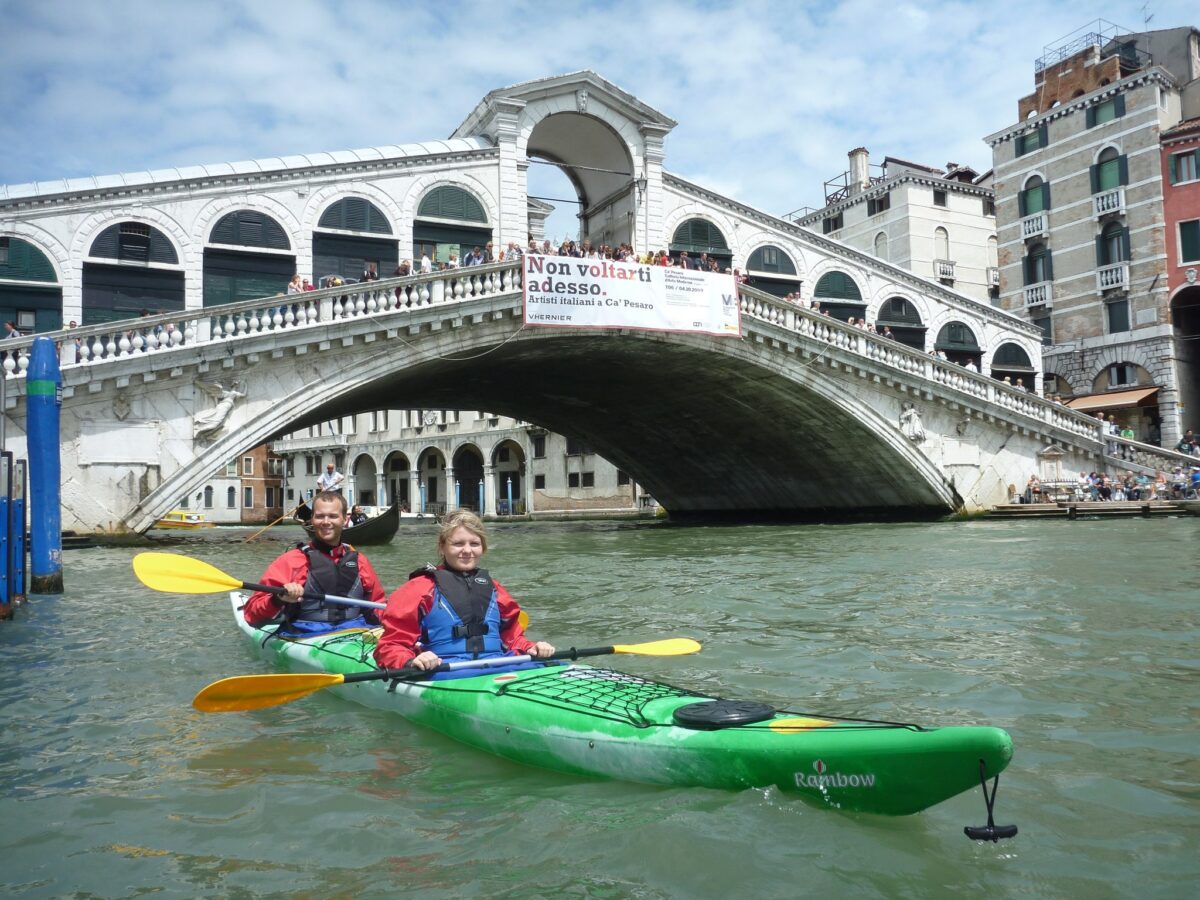
The accident happened on August 17th just before noon, at the Rialto bridge, in a spot we very often use to take photos of the participants of our kayaking tour in the city.
One of our tours had passed the exact spot half an hour earlier.
The accident
The precise dynamics of the event is not totally clear, but it most likely went like this. A vaporetto (water bus) came upstream towards the bridge in the direction of the station, on the left side of the canal as if should (of you’re facing downstream). Something, allegedly a gondola, caused it to divert towards the middle of the canal just before it reached the Rialto bridge.
Another vaporetto which had just passed the bridge moving downstream, was consequently forced to move further to the right, even if it had to stop at a platform on the left, where the other vaporetto was. It therefore ended up too far down the canal and had to back up to get back in position to moor at its designated platform. There might have been other boats involved here too.
Backing up the vaporetto hit a gondola that was waiting at a blue platform just at the foot of the bridge on the right. Apparently the gondolier had stopped there waiting for traffic to ease up a bit before continuing downstream.
The vaporetto squeezed the gondola against the platform, the passengers fell over and the gondolier was either pushed off the gondola (he’s higher up than the others) or he jumped ship.
The passengers were a German family, parents and three children. The youngest, a girl of three years, were badly hurt in the face, and her father, in some desperate attempt to help his blood covered daughter, got squeezed between the gondola and the vaporetto.
The vaporetto moved forward once it’s path had cleared, apparently without the conductor noticing anything unusual.
The area is usually crowded, lots of people standing on the Rialto bridge and along the shores of the Grand Canal saw everything, and some rushed to help and others called 112.
Ambulances, fire brigade and police were there in minutes, but for Joachim Reinhardt Vogel, 50 years, university professor from Thüringen, there was no help possible. He died in the gondola, a few metres from the Rialto bridge.
The aftermath
This should never have happened. Talking a gondola ride should be perfectly safe for children and adults alike.
From what I hear it has been at least twenty years since the last fatal accident involving a gondola. There have been a handful of gondola capsizes in the last few years but nobody has been hurt.
Naturally the blame game started immediately. Its always somebody else’s fault.
First three conductors of vaporettos were formally informed that they we’re under investigating.
Initially the gondolier was seen as a victim, after all he was hit by a backing vaporetto, and had seemingly done the right thing, trying to wait for the heavy traffic to sort itself out.
He disappeared from view and the Ente Gondola, the organisation representing the gondoliers, spoke on his behalf. He is 25 years old, has a gondola licence for a couple of years, which he acquired from his father, and he was described as an expert oarsman. Basically a hard working young man, who was so deeply chocked that he wouldn’t and couldn’t appear in public.
However, soon witnesses said that he had jumped off the gondola even before the impact, abandoning his passengers to their fate, and worse, he tested positive for hashish and cocaine, taken the same morning or at most, the evening before.
So, the gondolier also ended up under investigation. Likewise did another gondolier, who by doing a reckless manoeuvre might have caused the first vaporetto to get in the way of the second which then backed into the gondola.
Even if no taxis were involved directly in the accident, there were several in the area, and as everybody who moves around Venice in a boat will know, they’re the worst offenders with regard to reckless manoeuvres, speeding and making waves. Consequently, a lot of fingers were pointed in that direction.
The association of taxi conductors wisely kept their mouths shut.
A favourite pastime of most Venetians is to blame the municipal administration for everything, and in this case they’ve been blamed for not enforcing the already existing speed limits of 5 km/h, and for favouring public transport when regulating traffic, since the vaporettos are run by a municipal company.
Just to add a bit of flavour to the whole affair, it appeared that the blue platform that the gondola got squeezed against, belonging to the Magistrato alle Acque, a state institution managing water resources, didn’t have the necessary legal permit to be there.
That caused the debate to extend to the multitude of docks and platforms and various moorings along the Canal Grande, which cause it to narrow by a much as 25m in places.
What to do
Something will have to be done.
The city council have come up with a plan that will somehow take something away from everybody, so nobody have any excuses.
Nobody really wants to give up anything.
The 26 point plan includes among other things a separation of traffic, so garbage collection and goods deliveries to shop and hotels will have to be made between 4am and mid-morning, while the gondolas will be disallowed circulating in that same period.
Taxis will not be allowed to run empty on the middle part of the Canal Grande, around the Rialto Bridge, and they will not be allowed to run caravans with large groups of tourists in the same area.
The two vaporetto lines running the Canal Grande (one fast and one slow) will be united into one line with a frequency of every 4-5 minutes, compared with every 6 minutes now for the slower line 1 and every 10 minutes for the faster line 2. This should reduce congestion and dangerous manoeuvres around the platforms, and remove the situations where one vaporetto overtakes another.
Vaporetto don’t have bow thrusters or rear cameras, but its only recommended that it’ll be examined if something can be done.
Platforms used by gondolas, taxis and vaporettos will be physically separated by moving sometimes one of them, sometimes another. The danger spots are here a canal close to the Rialto, much used by gondolas, but entering the Canal Grande just between two vaporetto platforms, often leading to dangerous situations; and a similar situation neat the Hotel Danieli close to San Marco, again with gondolas moving about inbetween vaporetto stops.
The concessions for private docks and moorings in the Canal Grande will all be reviewed and retracted if there is no benefit to the public good from the docks and moorings.
Private motor boats will be disallowed between 6am and noon.
Obligatory test for use of drugs and alcohol by all people working with passenger transportation by boat. This is already done for the vaporetto personnel, since they’re employees, but not for taxi drivers and gondoliers, as they’re self-employed. The Italian laws presently doesn’t allow for such enforced tests of self-employed persons.
There will be two fixed points of presence by the municipal police at Rialto and at the Punto della Dogana.
Surveillance
One of the main elements of proof for the investigation into the causes of the accident is video footage from a system called Argo.
The entire Canal Grande has been under complete real-time video surveillance since 2009. For a while there was even a web site where you could follow traffic on the Canal Grande, with little red and green arrows for the boats, depending on whether they were speeding or not.
This system has been out of order in periods, and due to privacy reasons it is been mostly unused for regulation of traffic. The city tried to use it against some taxis caught speeding some time ago, but its use as proof was refused by the court.
Still, the images and videos exist, and they’ve been used to analyse the situation on the Canal Grande running up to the accident, which is what got the second gondolier in trouble.
From the surveillance it appears that some 4000 vessels pass under the Rialto bridge every day. As traffic is not evenly spread out over the 24 hours, it means that there can be a dozen or more boats just around the bend of the canal under the Rialto, which is also the narrowest part of the Canal Grande.
Recently the city has held a meeting with the ombudsman for privacy protection, to make sure that the Argo system can be used to regulate traffic and enforce rules in the future.
What will likely be done
The city administration tries to negotiate with the different groups, but leaving out some, like the private boat users who have no collective representation. This, of course, just fuels the pointing fingers.
The Ente Gondola representing the gondoliers, insist that they’re the weak ones in traffic, and also one of them the victim of the accident, so they don’t see any need to make compromises. Their claim is that the existing rules, most notably the speed limit of 5 km/h, just need to be stricter enforced.
The taxi drivers mostly keep their mouths shut, which is probably wise as they’re the number one problem of water traffic in the city, even if they weren’t directly involved in the accident.
The public transport company and the vaporetto personnel claim that they’re the only agents actually delivering a real public service, and that any cut in services will cause a deterioration of the quality of life for the real Venetians, and also for the tourists.
The goods haulers claim that prices will go up by at least 30% if they’re forced to do deliveries in the very early morning.
The garbage collection company also announced that garbage collection by night would cost at least 30% more, and the city administration changed the plan before going public.
The private boat users have been up in arms, but as they lack a collective representations, its mostly just roaring on Facebook.
Its going to be a hot autumn for boating people in Venice, but most likely very little will ever change.


 The association