I bought an old retired gondola from Roberto Tramontin back in 2013. We’ve had some good experienced with it, but we never got to use it as much as it deserved. It is now been retired. Goodbye Gondola!
Pulling the gondola out of the water
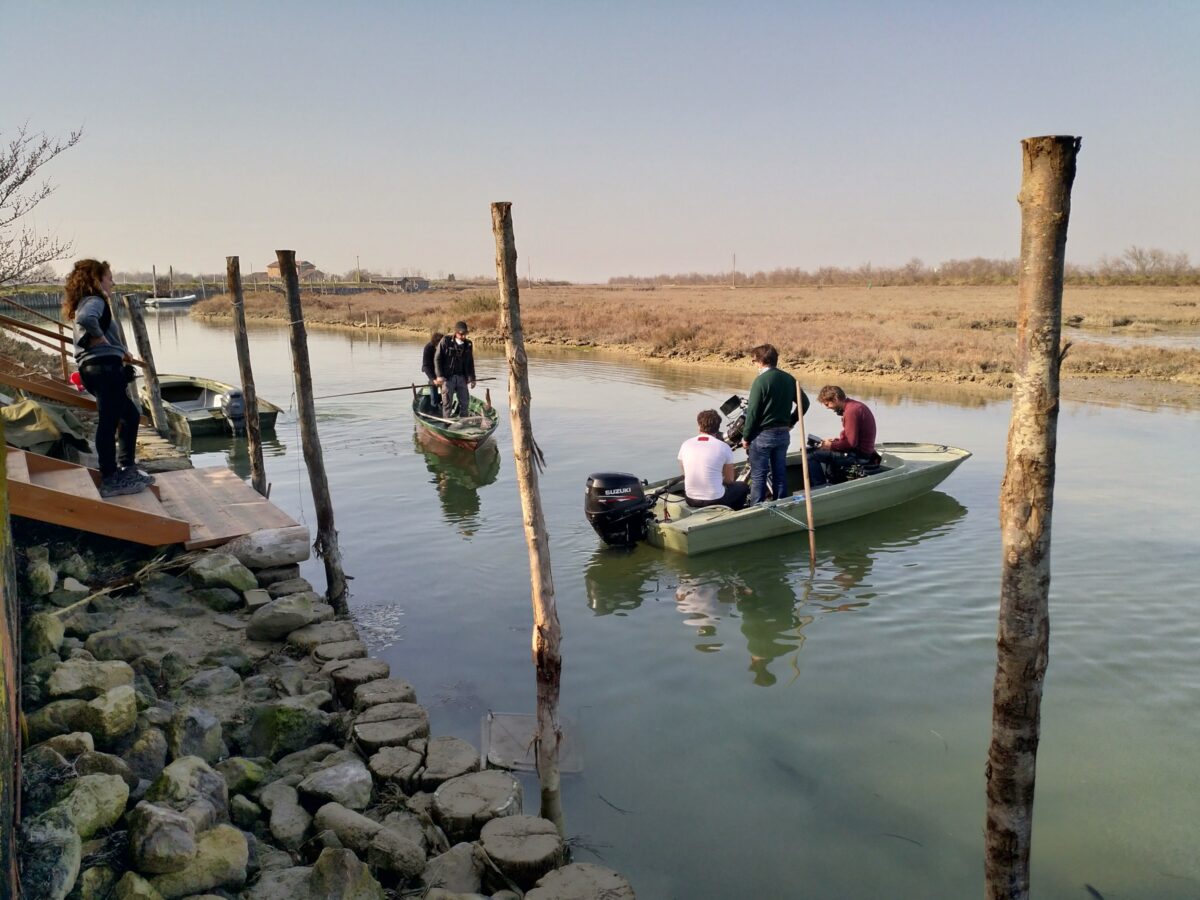
With the end of my engagement in Venice Kayak, I had to remove it from the marina on the Certosa island. It is not easy finding a mooring in Venice for an almost twelve metre long boat, but I made an agreement with the good people on the Lazzaretto Nuovo to keep it there.
Unfortunately the times are not what they were, and a traditional Venetian boat moored in the lagoon is now subject to more waves and current than ever before.
Within a few months I had to realise that if the boat stayed there, I would lose it for good. It would be reduced to pieces in the winter.
The gondola on dry land
I conferred with Gerolamo Fazzini, the primus motor of the Lazzaretto Nuovo, and we decided that it would be a good addition to the collection of old traditional boats in the museum on the island.
Last week we pulled it out of the water and moved it inside the 16th century Tezon Grande, where it now sits along the other museum boats.
Naturally it’s been sad to say goodbye to the gondola, but I’m a lot happier to see it in a museum than destroyed by the moto ondoso of the Venetian lagoon.
There are some scenes where the protagonist rows a Venetian boat, but Liev hadn’t managed to learn the technique sufficiently well.
With a bit of makeup, a haircut and letting the beard grow we do look alike a bit. He looks older then me. He isn’t.
So far so good. I was to go and do some rowing scenes instead of Liev, and I’m not somebody to let go of a chance to fool around in a boat in a movie, so I accepted.
The boring part
Then came the boring part.
Or rather, the boring parts, because overall working as a double on a movie set is immensely boring.
They kept calling me for all sorts of non-rowing things. I spent days going around knocking on doors searching for something nobody ever told me what was. Lucia, the double of the female lead in the movie, drove me up and down canals in a vintage motorboat for days on end.
They would summon me for the most inconvenient hours, sometimes at 6am, other times at 8pm. Costume and makeup, that’s a couple of hours, then to the set in a motorboat.
On the set I would sometimes spend ten to twelve hours doing nothing whatsoever, dressed up as a 1950s US Army colonel. Some days they would have me do something, most often as a stand-in, but other days I would do absolutely nothing.
The most interesting days were with the second crew doing B-shots. At least I was doing something rather than just hang around.
After a few weeks I realised that they only called me three days each week. They had everybody work 12-14 hour days, so after three days they’d have to pay overtime. That’s after 40 hours weekly here in Italy. The trick was of course to have us work a full week, but only pay us for three days.
Kind of clever of them, but not exactly endearing. In the end we did very long days for much less than minimum wage.
Finally, finally we arrived at the scene where I would be rowing, and they told me to be at base at 6am. I was on the set at 8am, and sat there until 5pm. When they eventually got to the rowing part, Liev wanted to do it. I had to wait even longer before he gave up.
The rowing scenes
Another month passed before we got to the final rowing scene.
This was up in the northern lagoon, and I had to get up at 4am so they could pick me up in a car at 6am, and the days were just as long.
The first day up there I did nothing. What they did didn’t actually involve any rowing, just the boat as a stationary prop.
The second day I met a young man on the boat who proudly told me that he was going to row in the movie.
The fools had forgotten why they’d called me in the first place, and had called in somebody else. We didn’t anything all day, as the camera crew didn’t show up. They hadn’t been paid.
I spend the day fooling around in the boat, followed by a fairly good lunch. The next day the other guy didn’t come, and I got do the rowing bit.
Then, when I thought the ordeal was finally over, they asked me to go to Trieste for another scene there in a car on a road overlooking the Golf of Trieste.
The Aftermath
The Italian production company behind Across the River, Into the Trees hadn’t paid anybody for two months, and there was a lot of grumbling on the set the last few days.
That’s why the camera crew didn’t show up one of the last days.
The company kept promising, and kept not keeping their promises. Their lawyers even sent formal letters with promises that weren’t kept.
In the end I had to threaten repeatedly to withdraw the permission to use my image in the movie to get them to pay. They only paid me in September.
I was on the set a bit in December 2020, then a good deal in January and February 2021, and a few days in March.
They didn’t pay friends of mine, who manage places where the second crew stayed and ate, until later still.
Needless to say, I’m not going to run around looking for movie sets. It’s probably the most boring job I’ve ever done, and my first job as a teenager was washing dishes.
The movie Across the River, Into the Trees
The movie is still in post-production. I have no idea when it’ll be out, or even where.
I don’t think my name will be in the credits, but I’m at a point where I frankly don’t care.
The shots where the colonel is seen from the back or in the distance will most likely be me rather than Liev, though I know he did some distant shots too.
Liev reading up on his lines – Hotel Danieli
Hotel Danieli – the boring part
The set at Santa Maria Nova
Dinner with a fascist thug
Fooling around in vintage boats
Midnight in January is cold
Lucia mooring the vintage motorboat
Inside a parish building for lunch
Very fancy makeup
The inside of a Venetian palace
The Venetian rowing boat – a sandolo
One of the palaces in Venice
The vintage motorboat and Lucia
Cleaning the boat after rain
The lagoon at Lio Piccolo
More fancy makeup
The colonel’s about do die – Liev is good
Preparing for the colonel’s death
Slightly dirty boat
We had no oar and oarlock so we made do with what was lying around
Lunch and drinks
Director and camera crew of second set
Nice makeup
The camera crew playing with the Venetian boat on the set
I worked as a double for Liev Scheiber on a movie set in Venice, where I should do some rowing shots. This is video of me rowing during a break on the set.
The assistant director on the second crew made this little rowing video on a day the camera crew didn’t show up, so we had time to fool around.
I thought it a good idea to send my bicycle by train from Copenhagen to the Brenner pass, and then do the rest of the trip to Ancona in the Marche in central Italy by bicycle.
Everything worked out, and soon I was on the main road towards Bressanone/Brixen which I reached an hour later.
That were sixty kilometres and a change in altitude of about 1000m. The road had hair pin turns, went through long tunnels and across tall bridges, but I moved at the same speed as the cars on the road.
I had never done anything like it. The sense of excitement and achievement was immense.
That was some thirty years ago. I was in my twenties. The thought that a twig on the road could have sent me hurling off a tall bridge or into a deep ravine never crossed my mind.
Last August my father-in-law was diagnosed with pancreatic cancer.
After several periods in two different hospitals, the doctors gave him two months to live and they sent him home.
We decided that we could care better for both of my in-laws if they stayed with us. Thankfully they accepted.
My father-in-law stayed with us for five months. A group of doctors and nurses came to our home several times each week, so we had support, but all the day to day care was on us.
It was a slow protracted decline. My mother-in-law who has always had severe mental health problems flanked by dementia, went downhill alongside her husband.
I don’t think either of them really understood or accepted what was happening.
In January his health was so poor that we struggled to provide sufficient care for him. Even if we didn’t want to, we had to ask for a place for him in a hospice in Venice.
We didn’t have to wait for long, and he was moved by ambulance to the hospice on a Saturday morning.
He was there. He interacted with the nurses. He even made jokes and thanked us for having provided such a nice room for him.
The nurses told us to sleep at home, and get some rest. We would need the energy later, they said, so we went home.
The next morning, when my wife returned, he was hardly there anymore. She called me, and put the phone to his ear for a salute, but we don’t know if he heard me.
That afternoon I prepared our bags to stay the night there, and we settled in expecting a long wait.
Around ten his breath became irregular, then sporadic, then it stopped.
It was peaceful, my wife held his hand and spoke to him between the tears.
I had never experienced anything like it. The sense of sadness and impotence was immense.
Death has been with us since, and looking back, also before.
Two weeks later my mother-in-law died in hospital, most likely of Covid19, as she had all the symptoms.
We’ll never know for sure, however, as there were no tests available at the time.
We spent the next three months in lockdown. The news were little more than about many were infected and how many had died each day.
Death is always with us, even if we choose not to notice.
Looking back after what we’ve been through this last year, and I see things that I chose not to see back then.
Four years ago I had a stroke. It wasn’t that serious, and in little more than a month I was back kayaking and rowing. It would have had to much different, though, for it to have been the end.
Two years ago a idiot headbutted me, and broke my nose. The fracture was uncomplicated and didn’t leave any permanent scars. However, I still remember the suppressed fury of the doctor at the A&E when he told me that had the blow been ever so slightly different I would have been dead on the spot.
Further back, memories of near accidents on a motorbike, kayaking in 3m waves because the wind suddenly turned, screeching brakes as I raced my bicycle across the road on my way to school as a child.
We choose not to see, because the consequences are too huge to comprehend, but even in the most boring of human lives, there will have been hundreds of similar situations.
On a late Tuesday evening Fabio shouldn’t even be in his trattoria, which is only ever open for lunch. Yet here he was, sitting with his face in his hands behind the counter, while the water was pouring copiously inside. The barrier he had put in the front door was of little help keeping the high tide out. The water overflowed, and the water pressure such that it entered inside through underground passages used for gas tubes, water mains, electricity and phone lines, and even through cracks in the ancient walls. Three electrical pumps poured water out of the trattoria, but more came in. There was well over a foot of water inside.
When the high tide receded hours later, Fabio and his wife Stefania spent hours pumping out the water before they went to sleep, exhausted.
They were far from the only ones. All the shopkeepers were there all night, trying to save what they could.
High tide in Venice – Fondamenta under water with boats slipping off the moorings
High tide in Venice – flooded courtyard
High tide in Venice – trying in vain to keep the trattoria dry
High tide in Venice – record high tide at night
Early next morning the Via Garibaldi, normally buzzing with shops, bars, locals getting about their businesses, and tourists, was deserted and lifeless.
The only place open was the newspaper stand, but nobody cared about the news. That morning they were the news, and that is almost never a good thing.
The tide had been forecast the previous day at 140-145cm (a normal high tide is at 80-90cm) but it just continued up and up, and hit 187cm at 11pm. It was the second highest tide ever measured, almost matching the record level of 194cm in 1966.
All the front windows on the Via Garibaldi was covered on the inside with moisture from the water that had soaked walls, furniture, carpets, goods.
Slowly people reappeared, doors of shops and storage rooms opened, and the full scale of the devastation was revealed.
Tables, chairs, shelves, fridges, freezers, dishwashers were pulled out in the street, and huge black garbage bags starting piling up with merchandise and foodstuffs ruined by the mixture of lagoon water and sewage that had submerged everything.
Most places had had two to three feet of foul water inside.
High tide in Venice – debris in the streets after the tide
High tide in Venice
High tide in Venice – shopkeepers trying to clean up
High tide in Venice – humidity all over
Laura, from the shop selling detergents and perfumes, was sitting outside sobbing, repeating “We’ve lost everything. We’re ruined, ruined.”
From inside the bakery you could here loud crying, but nobody came outside.
Fabio was more up-beat: “We’ll clean it up and get back to work. We’re not giving up.”
A single bakery opened later in the day, selling only thawed frozen buns. No ovens or machinery were working, and most like neither was the freezer.
The schools were all closed.
Soaked and smelly mattresses and ruined furniture appeared in front of the ground floor apartments in the side alleyways.
The cleanup work on Wednesday was impeded by the tide which again went above the normal level for a high tide, so there was 10-15cm of water in front of most shops while the shopkeepers tried to pull out everything to assess the damages.
High tide in Venice – wrecked vaporetto in Venice
High tide in Venice – taxi on land after record tide
High tide in Venice – wrecked taxi
High tide in Venice – gondolas on land after record high tide
Via Garibaldi is not among the lowest parts of Venice, but everybody put in their barriers and attached their pumps at the end of the day, just in case. In any case, it went OK but few people slept well.
On Thursday most shopkeepers were still cleaning and throwing things out, and the garbage collectors started digging into the mountains of black bags and ruined merchandise which were piled up here and there.
The first few bars opened up again, so there was somewhere to grab a bite to eat between the constant cleaning.
The atmosphere was still one of sorrow and desolation. The normally lively street was like a funeral, and had the appearance of a war zone, with debris and destroyed objects lying all over.
The Friday morning tide was initially forecast to 130cm, then 140-145cm again, but it was clear to everybody that it would go higher. Then, in the last hour, the forecast was changed to 160cm and everybody starting bracing for the worst to repeat for the second in one week.
In the end the tide stopped at 154cm (the 7th highest measured), but it stayed at that level for far longer than expected, due to strong SE winds. A meter and a half of tide is still enough for water to enter shops and ground floor apartments, but in most cases not to overflow the barriers.
In any case, most of the work done to clean up was undone.
High tide in Venice – floating garbage
High tide in Venice – ruined furniture piled up
High tide in Venice – ruined fridge waiting for the garbage collectors
High tide in Venice – Via Garibaldi flooded
Saturday was nice, even with a bit of sun, and the water didn’t get up to problematic levels. A few shops were open for a while, and we managed to do a bit of shopping for basic foodstuffs and get rid of some of the household garbage, for the first time since Tuesday.
It almost gave a kind of semblance of normality, even if the talk on the street was only about the high water and the damages it had caused.
We helped some friends getting rid of waterlogged mattresses, a broken fridge and a printer that was leaking ink all over. The piles of garbage and broken things kept growing, as the garbage collectors couldn’t keep up.
Sunday hasn’t been very nice. Horrible weather, lots of rain, strong winds and the tide was back. Again a forecast for 145cm, which was then augmented to 160cm a few hours earlier, and in the end we had a period of 150cm from before noon to after 2pm. All the shops and bars flooded again, for the third time in a week, and all the cleaning had to start all over.
High tide in Venice – bar owner trying to fight the tide
High tide in Venice – floating plants tied down
High tide in Venice – Via Garibaldi under water for the third time in a week
High tide in Venice – water entering throug the ancient walls
By now we’re all tired, and I can’t even imagine how bad it has been for the directly involved, those working and living on the ground floor.
We’re the lucky ones. We’re out of water’s reach, we’ve had food and drinking water, electricity and gas for heating and cooking. Large parts of Venice have been with intermittent electricity, or entirely without, and many people living on the ground floors have lost most of their furniture and appliances.
To a large extent this week has brought out a lot of good things too. The schools and universities have been closed since Tuesday, and students and other volunteers, also from out of town, have gotten organised to help the worst hit residents. In their hundreds, they’ve set up meeting points around the city as soon as the tide has receded, to go and help clean up, and others have donated wellies, gloves and other things needed. Many have donated mattresses, fridges, furniture, linen and much more, to those left without.
The tide forecast for the next few days gives hope that the worst is over. The tide will still come up to around 110cm each day, but that is far more manageable, and in our part of town it won’t cause many problems. Hopefully, we’ll get back to some kind of normality in a few days time.
High tide in Venice – post-flood garbage piled up along the canal
This morning a huge cruise ship, the MSC Opera, lost control in the middle of Venice city, hit the quay and a moored ship.
Four persons are hurt, but non seriously.
This must be the end of these monsters in the city of Venice. Ships that size do not belong in the lagoon.
Below are a handful of videos which show the dynamics of the accident from several different sides. After the videos I’ve tried to collect what information is available on the accident, the dynamics of it and its causes and effects.
Video taken from the Giudecca island
Video by Marco Fantuzzo
Video taken from ashore
Video taken from the ship
Video taken from passing ferry
The aftermath
Where did it happen?
It happened around 8:30am very close to the San Basilio vaporetto stop, which the MSC Opera very nearly hit.
The map below shows the route of the MSC Opera within the lagoon and through the city, until the point of the accident.
The route of the MSC Opera and the location of the accident
It appears obvious that if the accident could happen there, it could have happened earlier on the route as well, like just in from of St. Mark’s square and the Palazzo Ducale.
This accident is no small matter. Venice was very lucky today.
What happened?
While the final story will only be determined later during the inquest which must be made, some statements have been made.
Apparently the MSC Opera had an engine malfunction, which caused it to go full speed ahead in a very narrow space for a ship that size. Not being able to slow down, they also lost control of the direction, and the ship veered to the right, hitting first the quayside and then the moored River Countess (a river cruise ship quite a bit smaller than the MSC Opera).
The cruise ships have one or two tugs attached, one front and one back, to help the ship turn the sharp corners on the route through the city. The ship advances under its own propulsion, and the tugs pulls it sideways front and back to turn.
The tugs did what they could to stop or divert the MSC Opera, but they were no match, and at some point at or after impact one of the tug lines snapped.
Apparently the MSC Opera moved at more than six knots at the time of impact, having accelerated from about 5 knots earlier in the Canale Giudecca.
After having scraped along the quayside for a bit, it hit the River Countess in a way as to push the smaller ship away from the quay, breaking the moorings.
The MSC Opera them came to a halt where there was a corner in the quay. The River Countess ended up on the outside of the MSC Opera.
At impact a few persons fell or jumped into the water from the River Countess, and the impact shook the River Countess badly, causing many to fall. Two or five persons were taken to hospital (accounts vary) but nobody was seriously hurt.
There were some 130 persons on board the River Countess, and up to 1700 passengers and 450 crew on the MSC Opera.
Both ships stayed afloat. The MSC Opera has damages to the bow and from side. The River Countess has most of the bow destroyed. The quayside probably sustained the most damage.
The River Countess with the bow destroyed
While this is all bad enough, had it all happened just a few hundred meters earlier, it would have been far worse. The MSC Opera would have hit a fondamenta (a sidewalk facing the water) and it would probably had destroyed the vaporetto stop at San Basilio, where people would be waiting for the boat.
Afterwards
Cruise ships arrive one after another in Venice, with about 30 minutes intervals. When the accident happened, others cruise ships were already entering the lagoon, and they had to stay put in the middle of the city for hours, while the two damaged ships were towed away.
Removing the two ships has taken a good deal of the day.
The Regata della Sensa and the Festa della Sensa, ancient annual Venetian celebrations, were scheduled to start half an hour after the accident, and most of the participants were already in the Bacino San Marco, when the entire event was called off. Nobody was told so, however, and the participants of the events only found out on social media.
Many performed the celebration anyway, without the participation of the local authorities.
Cruise ships in Venice
The presence of cruise ships in Venice has been contested for years. Such large ships cannot manoeuvre in the tight spaces in the lagoon, as need of tugs to turn the corners show.
However, the harbour is a state harbour run from Rome, and the major of the city is an industrialist with a sensitive ear for the needs and wishes of local industry, so nobody has paid any heed to the many grassroots movements who have warned about this for decades.
Thankfully there were no casualties in this accident, bit it must lead to a stop of the monster ships entering the lagoon.
The current, and potential new route for cruise ships in Venice.
The initial response of the major of Venice, Luigi Brugnaro, was that ships will have to enter the city by another route, which requires the dredging of millions of m3 of heavily polluted mud and sediments to open up the Canale Vittorio Emanuele II for the cruise ships.
There are other suggestions which could keep the ship completely outside the lagoon, at sea where they belong, but lots of vested interests are opposed.
I’ve had the great honour of being invited to the official celebration of Liberation Day in Venice by ANPI, the national association of Italian resistance fighters, to photograph their participation in the event.
Last Tuesday I placed the most difficult signature of my life on the most unwanted piece of paper ever.
I signed away the life of our Penny.
Penny came to us thirteen months ago. She was in a horrible condition.
Months of neglect has reduced her to shadow of herself.
Down to half her former weight and seriously dehydrated, her eyes sunken in to be almost invisible behind dark shades on her skin, some kind of infection around her eyes, mouth, nose and ears leaving a hard black crust. Even if she looked at us, it was like she wasn’t there.
A walking ghost in search of somebody who wasn’t there any more.
We took her in so she could die in a warm home, on a soft pillow, and not in a cage in the cold amongst strangers.
The vet gave her a month, maybe two.
Penny was stronger than that, though. She came back.
Penny, a scotch collie, wandering the alleyways of Venice after the death of her owner.
Penny at Milan Bar
Penny in Riva Sette Martiri
Once we figured out what she liked, she started eating. She drank lots of water. She put on weight.
We took her for short walks every day. Just a few hundred meters. It was all she could handle.
There was grass and dirt. She didn’t know what it was initially, having lived entirely on the paved alleyways of Venice, but she soon found out that it was nice and interesting for an old dog, and she willingly walked there twice every day.
There was a bar like the one where she stayed so often with her previous owner, and after a strenuous walk to the grass and back, she would rest between the tables, asking for treats with her characteristic double “vouf-vouf”.
After a while everybody knew her, just like where she lived before.
The hardest part was the stairs up to our second floor apartment, and she would often resist leaving the bar to confront the many steps up to her pillow.
When it was too hard, we would give her a helping hand, or even carry her which she enjoyed immensely.
She put on to much weight, so we had reduced her portion, of which she definitely didn’t approve.
Her eyes came back alive and almost ceased watering, the black shadow healed, and the black hardened stuff on her nose, in her ears, around the eyes and her mouth disappeared.
We brushed and gradually her fur became fitting for a beautiful collie, rather than the dense carpet it was when she came to us.
However, you can’t turn back time, or even halt it.
As the months passed, she became slower and more tired. She needed more help on the stairs. We stopped trying to take her for longer walks. She needed longer breaks at the bar.
In the hot summer she suffered the heat. She could hardly breathe. We bought an air conditioning unit, and she slept just in front of it all summer.
She continued to lie down in front of it, even when it became less hot and we turned it off.
We thought it was old age, arthritis and general weakness.
During the last few months there was a marked deterioration of her health. She was very short of breath, and would stop every few steps to breathe. She was very tired.
Last Saturday we spend the entire day on the Certosa island, where my company has its office. We took her along, even if the walk was a bit longer than she would normally do. She was tired, but has a good place to rest and still wanted scraps of food.
Penny, our scotch collie, having a rest in the Via Garibaldi.
On the return trip her luck ran out.
Stepping off the vaporetto to the platform, a wave moved the boat, and her hind leg got caught between boat and platform.
We got her free, and on the platform, but she couldn’t stand. Her leg gave way, and she was bleeding profusely.
I carried her to a safe spot, and we started phoning all the vets we could find a number for. Our own vet didn’t answer initially, and we were very scared. Penny was bleeding copiously, but didn’t complain and remained conscious and responsive.
I carried her in my arms, best I could, the 6-700m to our vet.
She had lost lots of blood, but was still responsive and didn’t complain.
The X rays showed a fracture of her heel bone, and the blood was from skin wounds, deep but not life threatening.
I carried her home, and we started searching for a veterinary orthopedic. It was a Sunday, and the worst emergency was over, so we were asked to call again Monday.
The best clinic is in Thiene at the foot of the Dolomites, 90 minutes drive away. Living in Venice we don’t have a car, and need to take a vaporetto towards the mainland, so it became a three hour journey.
We set off at 6am, and arrived the in a friend’s car at 9am. Penny was in a plastics crate from a bicycle trailer, and handle the journey well. She slept most of the time.
Once at the clinic she was visited by a vet, an orthopaedic, a neurologist and an anaesthetist. They took a blood sample.
We then waited for several hours. Penny was very tired, but she slept or at least rested as long as we were close besides her. We couldn’t leave as she would get very worried, twisting and turning to find the one missing.
At the vet on Saturday evening
The last day at the clinic – so very tire
When the anaesthetist came back with the results of the blood test, it showed that Penny was very anaemic, and it wasn’t just because of the blood loss on Saturday evening.
The only way to figure out if they could do the operation on her fractured heel safely, was to do a full body CAT scan.
To do the CAT scan they would have to do a full anaesthetic, and they couldn’t guarantee that she would survive that.
It wasn’t easy but I signed the papers and we sent her off for the scan.
They told us we had half an hour to get a quick lunch.
They called us back exactly half an hour later, and the news were devastating.
An entire lung was one giant tumour, and the other lung was half full of fluids. No wonder she was so tired and short of breath.
There was another tumour on the liver, so the cancer had probably metastasised.
There was no hope. We tried to plead for any kind of way out, but all alternatives would only cause Penny more suffering.
The fracture on the foot would take months to heal, but the lung tumour would kill her in a matter of weeks. When she died, it would be of slow suffocation, potentially taking hours of pain and agony.
We cried our eyes out, but tears won’t heal her, so there was no alternative. Every other option was unbearably worse for Penny.
We went to see her one last time.
She was still under full anaesthetic, strapped into the CAT scanner, with a huge green tube in her mouth for breathing.
I don’t know if it was a good idea to go and see her, because I now have that image of poor Penny, strapped into that machine, empty eyes and that big, green tube in her mouth, but we couldn’t just walk away.
After a while outside crying, we went in to pay the bill and sign the final papers.
Putting my signature on the euthanasia permit is the hardest thing I’ve ever had to do.
Her departure had left us devastated.
She is now reunited with her first owner, Claudio, with whom she spent her first thirteen years. He died six months before we adopted her.
I hope there are grass and bars and plenty of treats where she is now.
Penny in the Via Garibaldi for her evening walk with a bit of mist. Being old she likes to rest at the local bar, even though it was closing.
She has been a part of our life for over a year, and she had given us so much.
In the night she would come into our bedroom several times to make sure we were still there, and sometimes she would fall asleep just outside the open door. We always left a fleece cover there for her to sleep on.
In the early morning when Martina got up to go to work, she would be all sleepy, but wag her tail and wanting to be cuddled before falling asleep again.
Later in the morning when she wanted to go for a walk, she would do her “vouf vouf” continuously following me around as I got up. She would even check up on me in the bathroom to make sure I didn’t somehow escape without taking her along.
Our walks were usually about an hour each, but as soon as she had done her necessities she would head straight for the closest open bar, where she would lie down between the tables and beg for treats: “vouf vouf”.
At home she had her pillow in our living room where she would spend most of her time, but as our home also became her home, she started wandering around and rest wherever she felt like.
We tried to take her out for longer walks, but she got too tired. Her favourite place was no doubt the local bar, similar to the place she went every day for thirteen years with Claudio.
She lived fourteen years, ten months and twenty nine days. She spent just a tiny bit at the end with us, but she made us smile, laugh, and be happy.
Fascism is by definition authoritarian. Fascism is by definition violent. Fascism by definition oppresses dissent.
Roberto Siebessi is a self-declared fascist. He doesn’t hide his beliefs.
Fascist salute on Facebook
He is also a gondolier in Venice, who thought it is a good idea to decorate his gondola in this way.
He is also a pathetic cry-baby.
When the photo above made the rounds on social media, the local press, and then the national press, picked it up. The backlash was immediate, and justly so.
This pathetic example of a human being supports a type of regime that would beat up, torture, imprison, exile and kill opponents, and yet he can’t handle the public reaction to his “joke”.
His response? “I’m sorry”, “it was a stupid joke”, and “I’ve even been threatened”.
Well, fascism is no joke for the ones on the receiving end.
His “joke” had little to no real consequence for him, if not a few days suspension by his colleagues.
If he had made a similar “joke” in opposition to a fascist regime, the consequences would have been swift and violent.
Yet he can enjoy the freedom of belief and freedom of expression that he himself would happily deny others.
I find it hard not to follow the Brexit news from the UK, even if I’m not directly involved.
Much of the Brexit debate has been about freedom of movement.
When I can live in Venice now, being a Danish citizen, it is because of the EU rules on freedom of movement.
Freedom of movement
Both Denmark and Italy are members of the European Union, and hence I can live and work in Italy as if it was in Denmark.
Or almost.
I couldn’t just move here and that’s it. I had to ask, and I had to fulfil some requirements, but once I fulfilled those requirement living here is my right, not a concession from the Italian state.
First of all I had to prove that I had the means to support myself. No job, no freedom of movement. I did that by opening my own company, Venice Kayak. The alternatives would be to get a job on a regular contract, or prove every sic months that I had enough money in the bank to support myself.
Second, I had to sign up to and pay into INPS, the Italian national healthcare, pensions and social services provider. I could have made private health insurance, but it would have cost more and I would have had less coverage.
You cannot just move in without working and without contributing.
Having fulfilled all the requirements, I was issued an Italian carta d’identità which all residents in Italy must have. The only difference between my carta d’identità and that of Italian citizens is that mine is not valid for travelling abroad. For that I have to use my Danish passport.
I am still a Danish citizen, not Italian. I’m an immigrant.
The whole process took a couple of weeks.
Now, almost nine years later, I’m still here, I’m still working, paying my taxes and my contributions to INPS. My company has a times given work to 4-5-6 other persons, all Italians.
All in all, I believe I have been a fair deal for Italy. I have definitely been a net contributor to Italian society.
Why bother about Brexit
Brexit makes no direct difference for me.
Whether the UK leaves or remains will not change my right to live here in Italy as long as I work and contribute (and don’t break the law).
However, both Italy and Denmark have their fair share of euro-sceptics.
EurobarometerEU-Freedom-of-movement-2017
Nobody really saw Brexit coming, even just a year before the referendum, and it’s hard to believe that if it can happen there it can’t happen here.
I seriously hope it won’t.
If it should happen, my life here will be as difficult as it is now for the over three million EU citizens living in the UK and for the over one million Brits living in the EU.