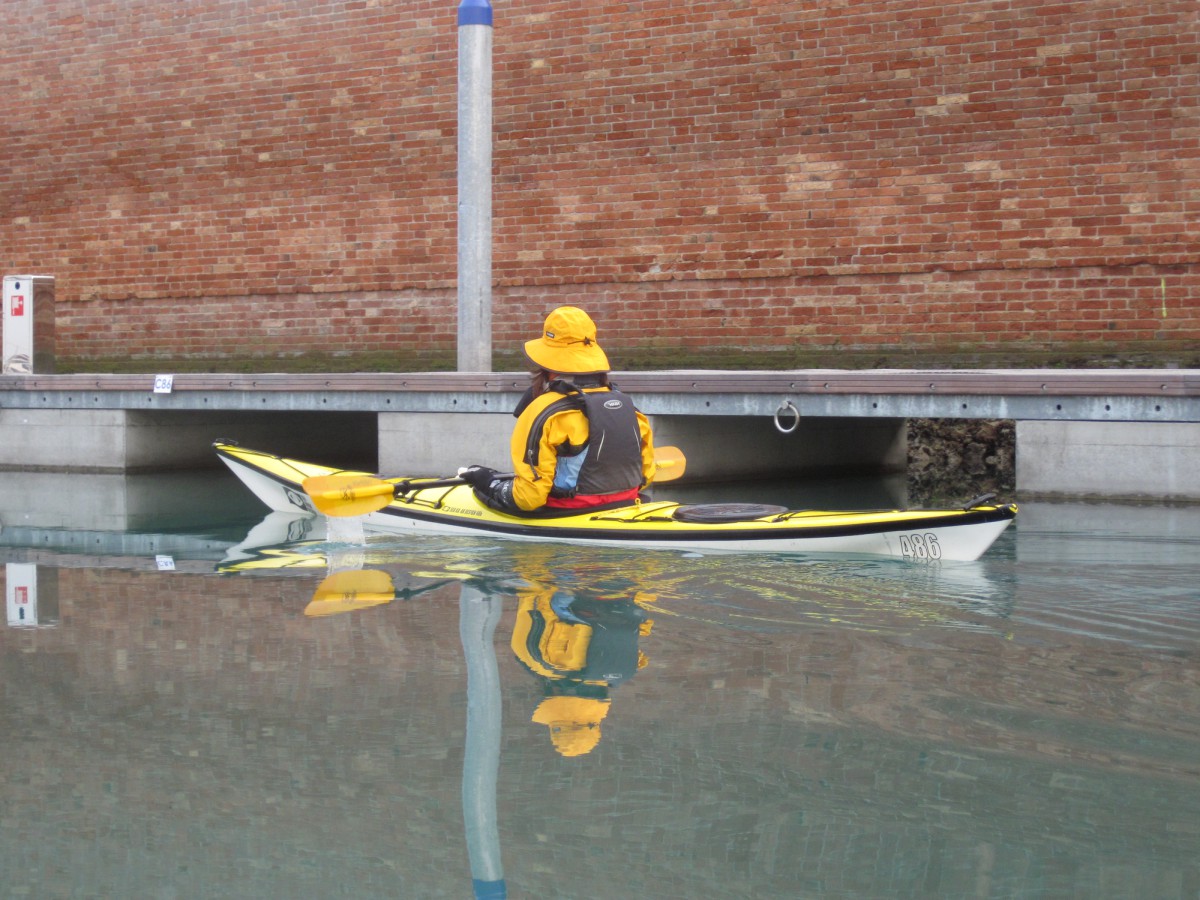
Ever since the fatal accident in August 2013 there has been a lot of debates about what to do to make boat traffic safer in Venice.
There has been little change in the year and a half since the accident. All changes have been blocked or sabotaged by the various vested interests in the city: the taxi cooperatives, the transporters, the gondolieri and the city administration itself, through the public transport company ACTV.
In short, nobody has wanted to give any concessions to make the city’s waterways safer for everybody.
Traffic today is more chaotic than ever.
Change is on the way, it seems. Articles in local papers refer to new regulations, which has not, however, been published on the city web site.
This might be a thing of the past
The new rules would (it seems) prohibit the passage of kayaks, canoes, SUPs, water cycles, dragon boats, yole and even some types of traditional Venetian boats (‘sandolini’), in the Grand Canal and about a dozen of other unspecified city canals.
Already published changes include limitations of the movement of all kinds of rowing boats on the Grand Canal, including the traditional Venetian boats from the local rowing clubs.
Venice is selling its soul for short term profit.
Now, how come such draconian changes come just now?
The thing is that Venice has no elected city administration. The former mayor fell on a corruption charge, and the entire city council sent in their resignation. Without a city council, the city is governed by a state appointed official until the next local elections in May this year.
The city is therefore run by people who have no knowledge of local affairs and traditions, and it seems they just try to manage by finding compromises acceptable to the most powerful lobbies.
When changing the rules, the city administrators have heard the taxi cooperatives, the transporters and the gondolieri, but they have failed to communicate with the local rowing clubs or any other with interests in how the city traffic operates.
Venice is ruled by the lobbies now.
We all know how it’ll end when decisions are taken exclusively based on short term economic interests. This does not bode well for Venice.
In the 1960s a deep canal was dug across the Venetian lagoon to give access to bigger ships to the commercial harbour at Marghera, and since then Venice has been flooded by ever more frequent and ever higher tides.
To counter this threat to Venice’s existence a system of mobile flood gates was devised at the three openings between the lagoon and the sea. They’re still being built. The costs are now over 6bn Euros, nobody knows if they will ever work, and the whole affair has become a cesspool of corruption and mismanagement of public funds.
Now, to make sure the next generation of still larger cruise ships will be able to enter the lagoon, a new branch of the canal from the 1960s will be made to take the 70m wide and 360m long future ships into Venice. The project is being sold as a necessity to avoid having the ships pass in front of St.Mark’s, without promising that they won’t, and as an environmental project to repair the massive damage caused by the first canal.
These are all lies. There is absolutely no doubt that this new canals will wreak havoc with the fragile ecosystem of the lagoon, already seriously compromised by the first canal, yet the government in Rome and their lackeys in Venice wants to force this new canal on a city that doesn’t want it.
The Canale dei Petroli
About a century ago, when the harbour in Venice city was no longer adequate for the traffic of the time, a new industrial harbour was built on the mainland at Marghera and a canal (called the Vittorio Emanuele) was dug to allow the still bigger ships to pass through Venice on to the new harbour behind the city.
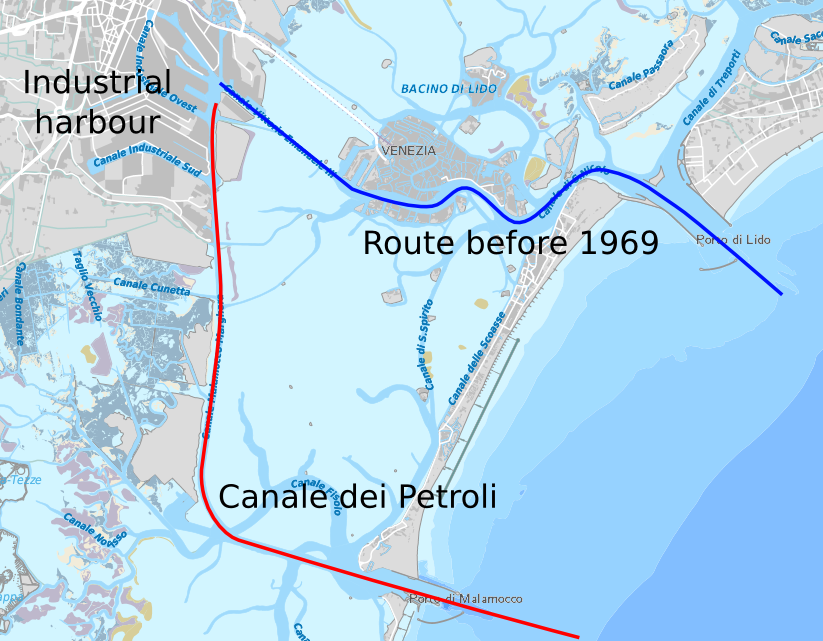
In the 1950s traffic and ship sizes had reached a level where having them pass straight through the centre of Venice city was no longer viable, and a new canal was dug, the Canale dei Petroli, leading from a more southern opening to the sea at Malamocco/Alberoni about 15km south of Venice, straight across the lagoon and up north along the mainland to the industrial harbour at Marghera.
Two huge areas destined for further industrial expansion were created at the bend of the new canal, by filling up large tracts of lagoon. They’re called the casse di colmate, but much of this was never finished and the areas lie waste even now.
Shipping routes through the Venetian lagoon
This new canal has all but destroyed the central lagoon where it starts, and it has made huge changes to the tidal characteristics of the southern lagoon.
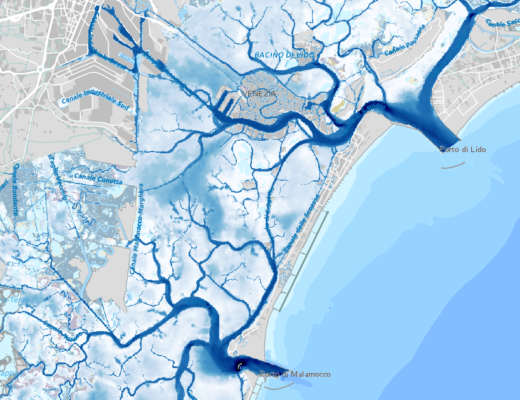
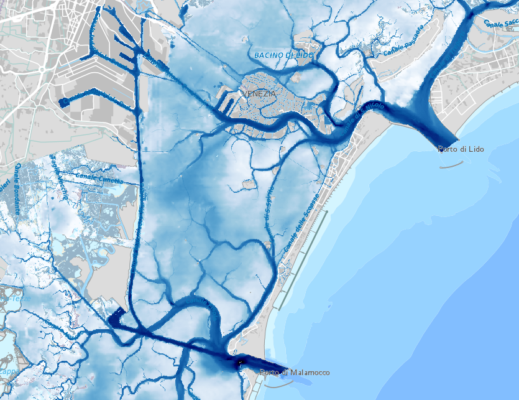
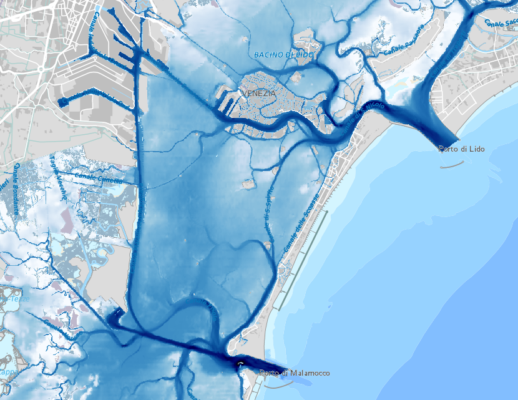
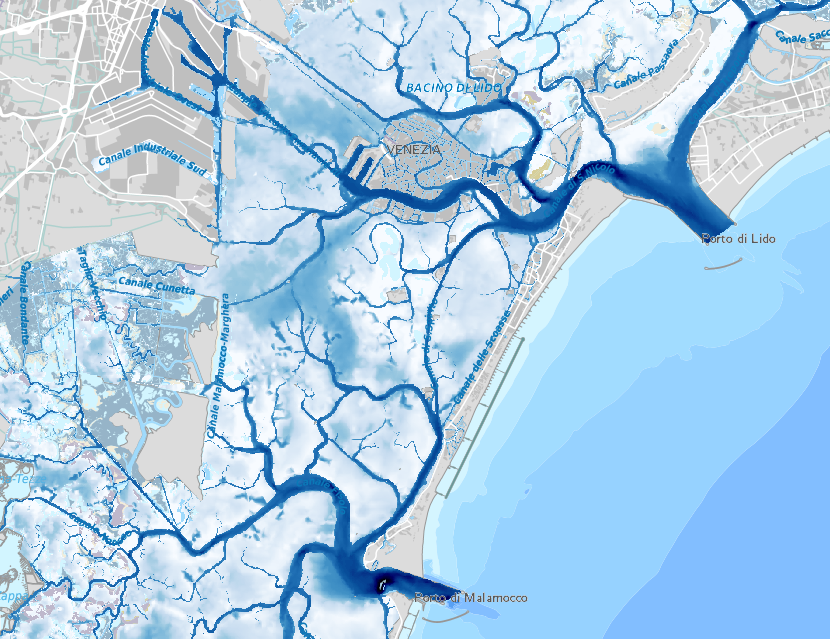
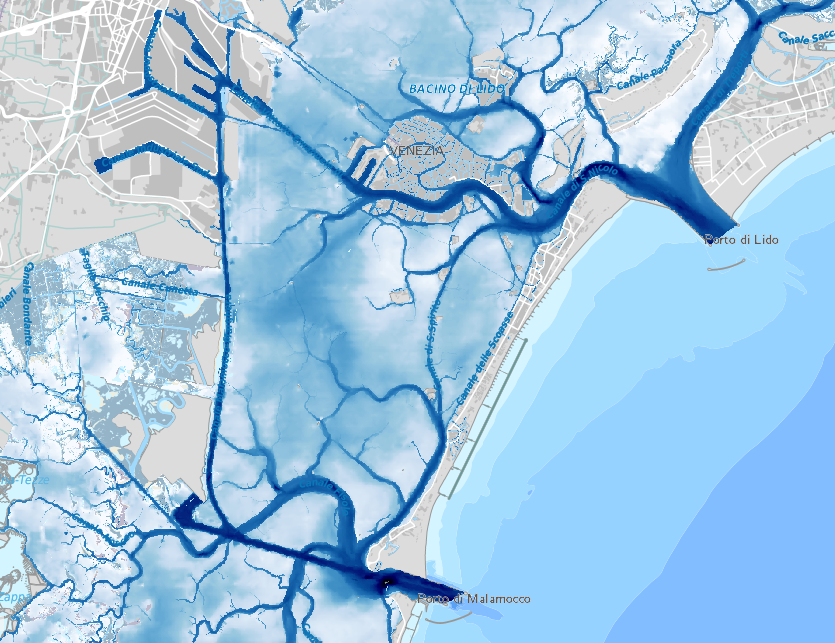
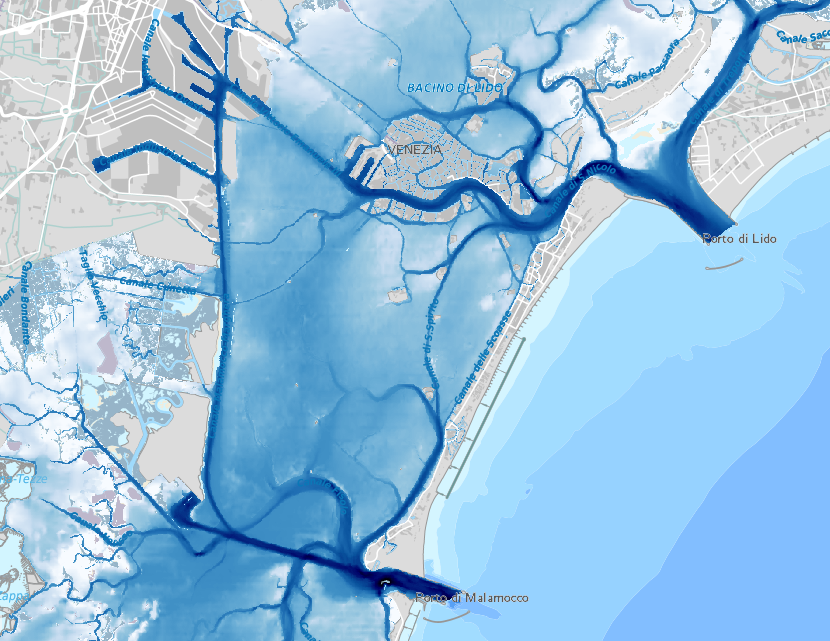
Winding and bending shallow canals have been replaced by a 12m deep 100m wide canal which channels a massive amount of tidal water through the lagoon at full speed. The erosion has been enormous. The following three maps show the average water depth in the lagoon in the 1930s, in 1970 and in 2002 (darker blue is deeper).
Central lagoon – avg depth 1930
Central lagoon – avg depth 1970
Central lagoon – avg depth 2002
Tens of millions of cubic metres of sediment has been lost to the sea over the last four decades.
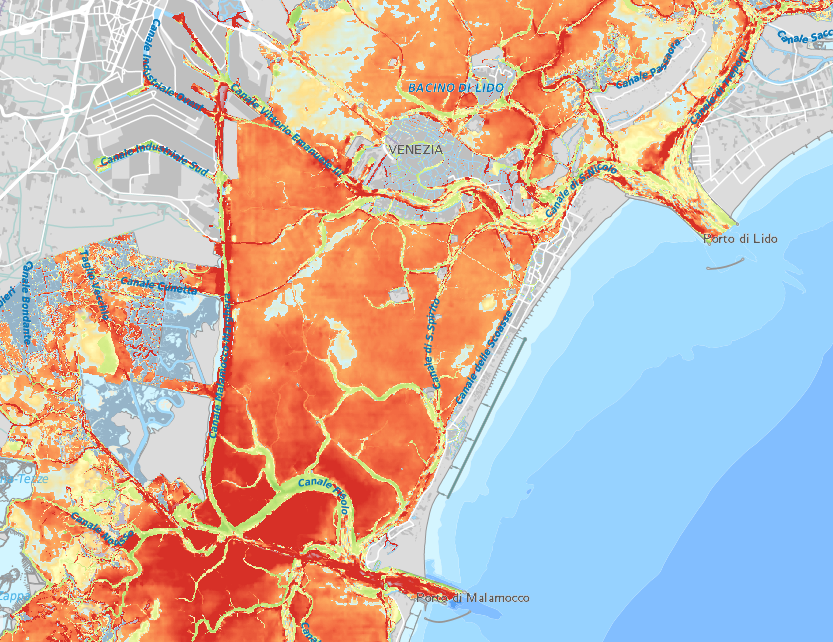
The map below summarises the changes in depth in the central lagoon over the period 1970 just after the digging of the Canale dei Petroli, and in 2002. Darker orange/red is deeper, green is shallower.
Central lagoon – dislevel 1970-2002
The entire area has become deeper, the most affected parts up to 2m deeper, except for the ancient natural canals which have silted up as less water now follows that path.
In short the bottom of the central lagoon has been levelled out by the tidal current through the new canal.
The tidal watershed
Besides having turned the central lagoon into a branch of the sea, now complete with flying fish and dolphins, the tidal flow through the canal have moved the tidal watershed in the lagoon.
A rising tide enters the lagoon through each of the three opening to the sea and in between there are two areas where the opposing tidal currents meet. At these tidal watersheds there is no current at any time, being the meeting point of two opposing currents.
Historically Venice has depended on the tide for cleaning the city canals. One could say that nature flushed their toilets twice a day, and the Venetians knew this and were always very careful to monitor the watershed whenever they made changes in the lagoon.
There was no such foresight when the Canale dei Petroli was dug.
The tidal watershed in the central lagoon, where the tides from the San Nicolò passage and the Malamocco passage meet, has therefore moved, pushed north by the now larger volume of water entering at Malamocco having a wider and more direct passage.
It used to be roughly in the middle, but with the Canale dei Petroli the watershed was pushed up behind Venice, just outside the city.
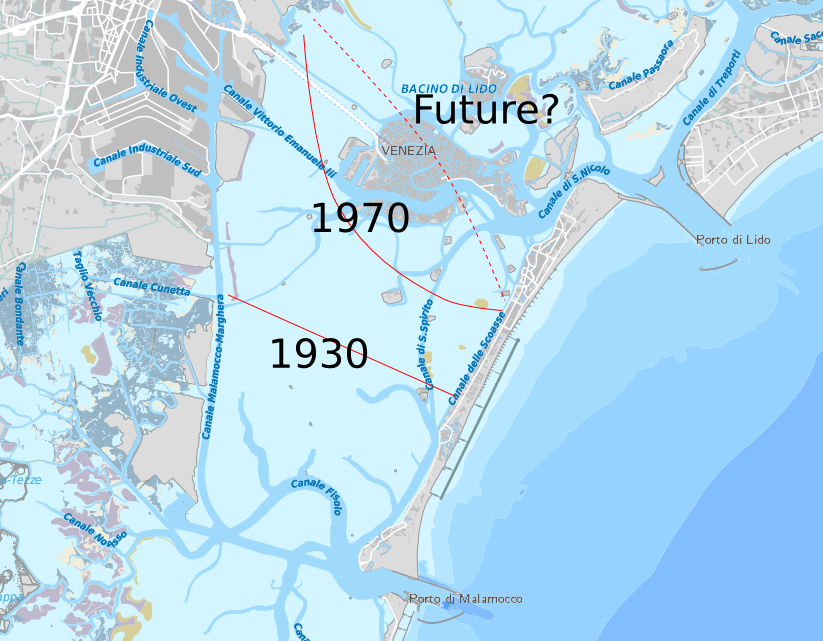
The map below show where the tidal watersheds have been approximately, before the Canale dei Petroli, after the canal and if the new cruise ship canal is dug.
Tidal watersheds
In short, the flushing effect of the tide has been very reduced since the digging of the Canale dei Petroli, and with the new canal planned it will be a thing of the past.
With the new Canale Contorta the water in most of Venice will be stagnant.
The frequency of high tides
Following the digging of the Canale dei Petroli Venice has suffered from ever more frequent high tides, as a consequence of the changes in the hydraulics of the lagoon.
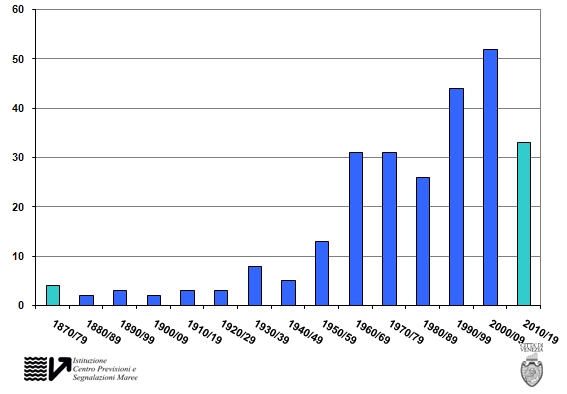
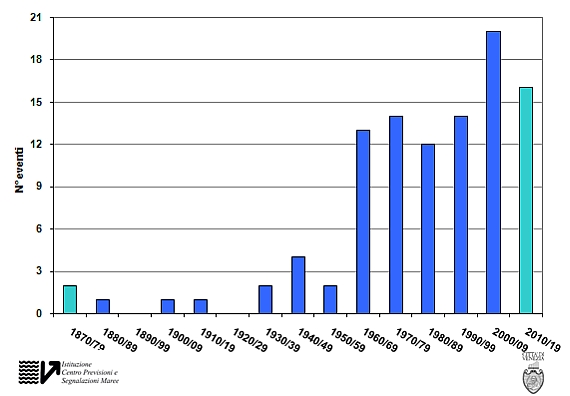
The city administration has a tidal forecast office which also keeps detailed statistics of the tides, and their graphs are revealing.
This is the frequency of tides over 110cm (which floods 12% of the city) aggregated over each decade since measurements were made.
The conclusion is evident: mess with the lagoon and you mess with Venice.
The MOSE project
However, rather than trying to roll back the changes made, another technological fix was chosen.
The MOSE project is for a set of huge floodgates to be built at each of the three openings between the sea and the lagoon, at San Nicolò in the north closest to Venice, at Malamocco in the middle where the Canale dei Petroli starts, and in the south at Chioggia.
The gates will lie at the bottom filled with water when not in use, and when a tide of 110cm or more is predicted, they will be pumped full of compressed air and swing up on hinges to impede the water from rising.
A tidal level of 110cm is already problematic for the city, but if the flood gates are activated at a lower level, they will be closed so often as to compromise the entire lagoon as a tidal marsh. The ecosystem of the lagoon breathes with the tide, and it will morph into something else if the tide is removed.
The original project was expected to cost little over 1bn Euros, but costs have inflated repeatedly and the bill now stands at over 6bn Euros.
The flood gates are still not operational. That is expected to happen in 2017.
The whole project has become a cesspool of corruption and mismanagement of the public funds involved. Rumours speak of about a quarter of the entire cost non being accounted for, and arrests have been made in the leadership of the consortium of companies building the flood gates, and in the public offices supposed to supervise the construction, both at the level of the state and the various agencies involved, the region of Veneto and in the city of Venice.
Most of Venice has been opposed to the building of the flood gates, in part because of the still unknown environmental impact of the project, and in part because it has diverted all the funds Venice used to received from the state for protecting and maintaining the city.
As the situation is now, the flood gates are not operational, nobody knows if they’ll work and it is not clear what the final environmental impact of the gates will be. What is sure is that a lot of well connected people have become a lot wealthier with all the money they have managed to extract from the project.
Until now, all that has been done to stem the high tides flooding Venice has had no positive effect whatsoever.
Cruise ships in Venice
Cruises and ferries were the only harbour activities which remained in Venice after most commercial shipping moved to Marghera.
Lately the ferries have moved to the mainland too, leaving only the cruise ships. They have, however, taken a huge upswing.
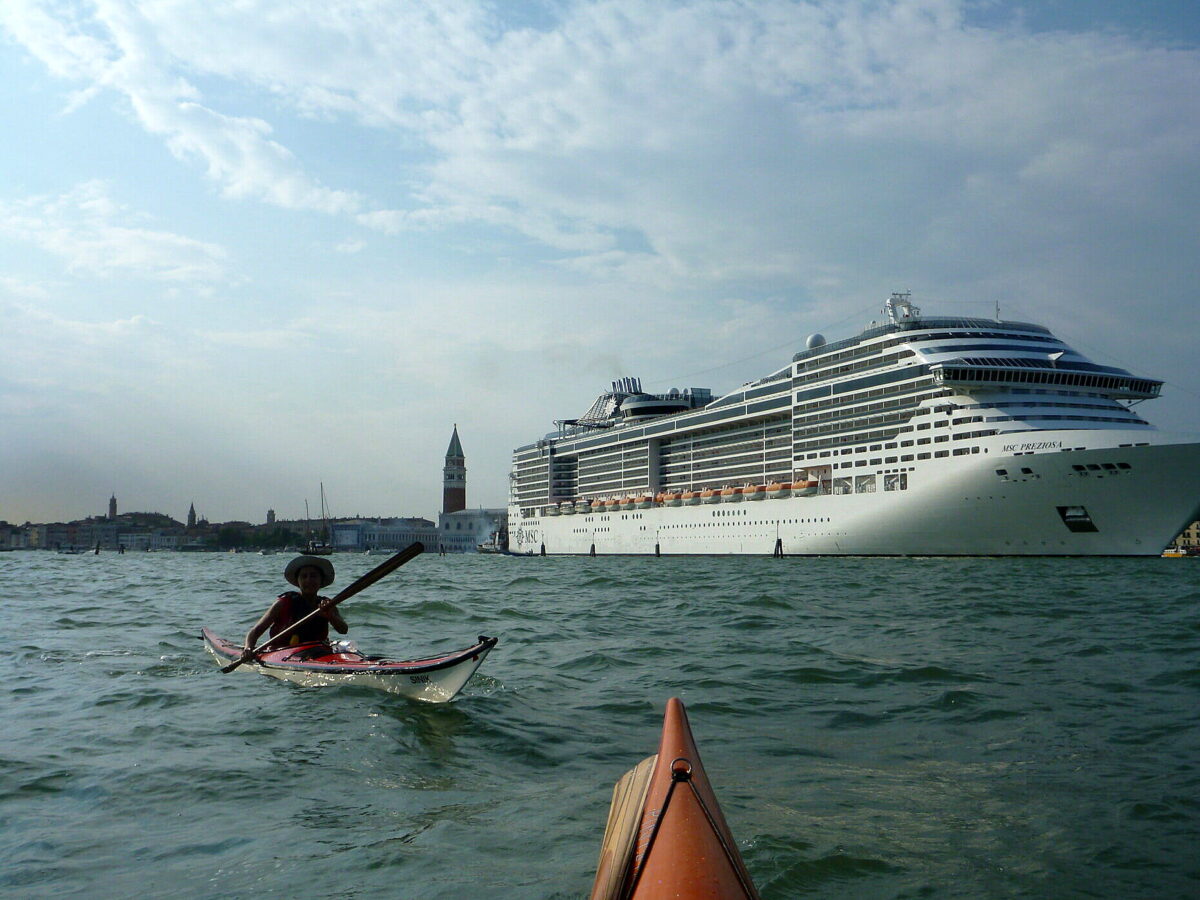
An ever rising number of cruise ships enter the cruise harbour of Venice every year, up to 600-700 visits a year, with as much as 12 ships in the harbour at any one time.
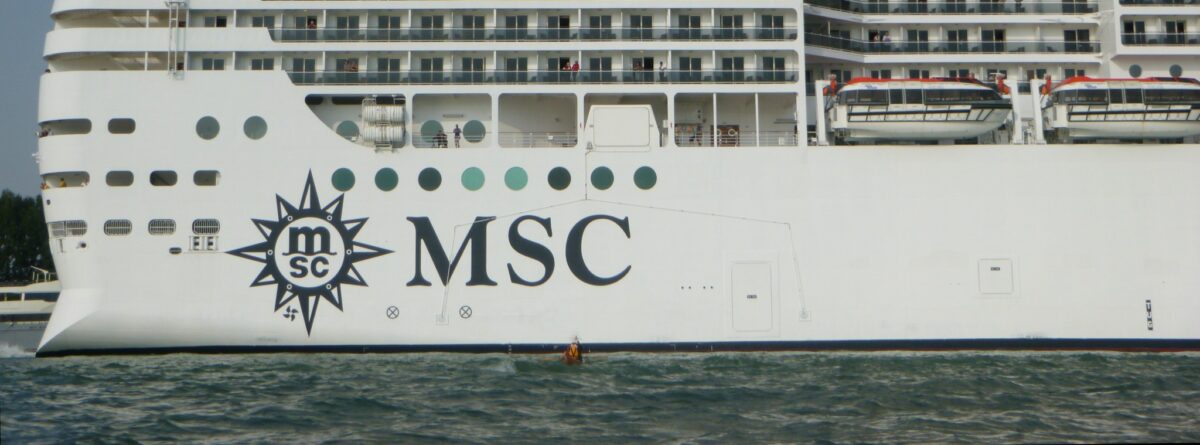
The ships have also become ever larger. The current generation of cruise ships are over 300m long, 50m wide, 50m tall with a draught of 10-12m, and with a displacement of 140,000 tonnes. They carry up to 3500 passengers and a crew of 1500-2000.
These ships are flowing cities.
The Titanic in comparison was 40,000 tonnes and not even half the width of a modern cruise ship.
The size of the Titanic compared to a modern cruise ship
The next generation will be even more gigantic, measuring up to 360m in length and 70m in width, with a displacement of 200,000 tonnes. They will not be taller or have a larger draught, as that would prevent them from entering many of the harbours they’re working from. The only way to make the ships bigger is to make them longer and wider.
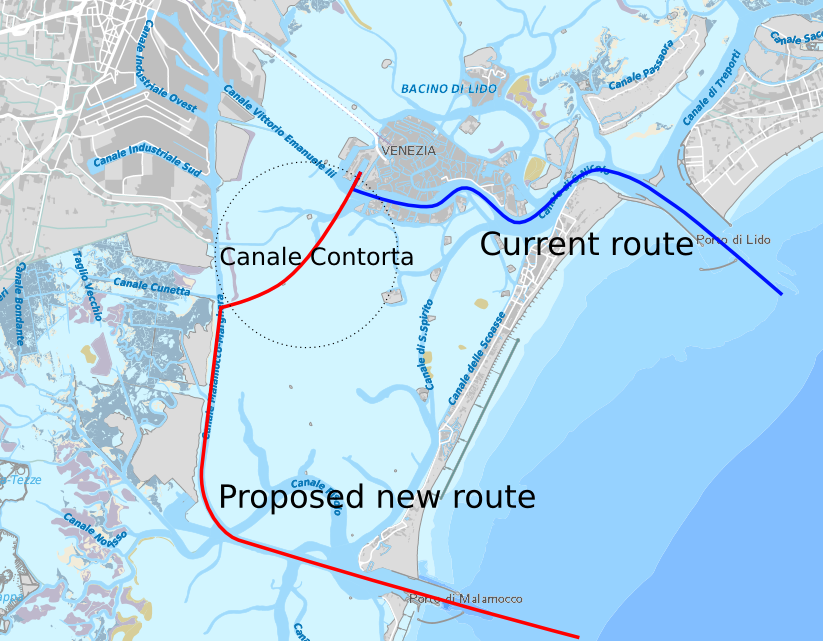
The current route followed by the cruise ships to the cruise terminal in Venice is marked in blue on the map below.
Cruise routes
This huge cruise ships pass straight through the centre of the city, and to say the least they’re an eyesore.
Various measurements of the air quality indicate that each of these ships pollute like 15,000 cars. With up to 12 of these passing on a good summer’s day, its like living on the side of a very busy motorway.
The route from the sea to the cruise terminal is very narrow as only a part of the basin in front of St.Mark’s have the required depth for the cruise ships to pass. The tight passage and the many sharp turns are beyond the manoeuvrability of the ships, and they’re always accompanied by two tugs, one in front and one behind, to help them turn the corners. They’re not able to navigate the passage on their own.
It is very unlikely that the next generation of cruise ships, being 20% longer and wider, will be able to negotiate this passage.
The Canale Contorta or Caotorta
Hence the need for the powers that be to find another passage to the existing cruise terminal, which have received substantial investments in recent years.
The residents have helped a bit. There is a marked hostility in the city of Venice towards the cruise ships passing through the city centre. They are very very ugly, the pollution scares people and they bring very little if any economic benefit to the populace in general.
Even the association of hotel owners in Venice have stated that they’d rather be without the cruise tourists who generally spend very little in Venice as they both sleep and eat on board.
The harbour authority has for a long time had the project for another access way to the cruise terminal in their drawers. With the mounting pressure to remove the cruise ships from the centre of the city following the Costa Concordia disaster in Tuscany, the plan for the Canale Contorta was taken out again.
The plan is to make a branch on the Canale dei Petroli that will lead straight to Venice.
Cruise routes
The Canale Contorta already exists and always have. It is about 15m wide and has a depth varying between less then 1m and about 2m. It can only be used by small boats and as all natural canals in the lagoon it is winding, not straight.
What the harbour authority proposes as a “recalibration” of the canal, will take it to 100m in width, over 10m in depth and straighten it out.
They’re taking a pretty country lane and making it into a motorway surrounded by mounds, calling it a “recalibration”.
The 6 million cubic metres of polluted mud they’ll have to dig away will be used to create what they call “marsh islands” around the canal. This is most likely to contain the waves caused by the displacement of the ships, and probably just as important, to dispose of the mud as close to digging site as possible to keep costs down. This is marketed as an environmental investment to return the central lagoon to what it was before the Canale dei Petroli was dug.
Other projects have been tabled, such as a new cruise terminal in Marghera as large parts of the old industrial harbour is unused and the canal already exists; or an off shore cruise terminal outside the MOSE flood gates at San Nicolò, but all alternatives have been swept away as inadequate, and only the Canale Contorta project has been examined.
This decision was taken by the government in Rome in mid August.
The project has to undergo a VIA, valutazione dell’impatto ambientale, or environmental impact assessment. This process should have taken two month including public debates, but the harbour authority has managed to fast track the procedure, claiming the project is of strategic national interest, so the VIA will be just 30 days and without any kind of public debate.
The residents of Venice has taken up the fight. They have collected almost 30,000 signatures online and around the city; and groups are contesting the project and the way it is forced through the system through legal means.
The impact of the canal will be to exacerbate the damages the Canal dei Petroli has already done to the lagoon, and mostly likely undo whatever positive effect the MOSE project might have on the lagoon in the future.
State versus city
How come such decisions are taken when the locals are clearly against them?
It is all a matter of state versus local administration.
The harbour of Venice is not the harbour of Venice city. It is a state harbour. The managers and directors are appointed in Rome, and they appoint people who share the government’s view of what should happen in the harbour.
Venice city and the local population has no say whatsoever in what the harbour authority does or doesn’t do.
What money the cruise industry brings to ‘Venice’ doesn’t benefit Venice city. All the money goes to Rome, to the government, the owner of the harbour.
When the Canale dei Petroli was build there probably wasn’t much of a public debate, but the MOSE project was fiercely contested locally. Yet the project was steam rolled over the city and local objections, channelling all funding from safeguarding the city to pouring cement in the lagoon.
As the mismanagement and corruption of the MOSE project has been revealed in the last few years, it has been clear that the opposition back then was right all the way, yet they were derided in the press, dragged to court and almost bankrupted, had their academic careers damaged.
Now the same procedure is repeating all over. Government agencies are forcing the project through against local opposition, and with all likelihood the canal will be dug, and with all likelihood the environmental damage will be massive and irreversible.
As an extra little finesse this time the powers that be have managed to force the mayor of Venice to resign after accusation of corruption related to the MOSE project, so the city of Venice has no democratically elected local government any more. The city is currently managed by a government appointed commissioner, who doesn’t speak up against the government in Rome, his employer.
That is Venice’s future if the Italian government gets it their way. In the process a lot of people will get richer and more powerful, and the mess they leave behind will be left to the future residents of Venice, who never wanted any of the projects from Rome.
The high tides will be ever higher and ever more frequent.
Stop the dredging of the Contorta canal, before it is too late.
The realisation of the new Contorta canal will bring the Canal dei petroli into the heart of the city of Venice, reducing its natural defences and subjecting it to the combined pressure of masses of water from both the Lido and the Malamocco openings, with consequences which could be irreversible. We’re against the dredging of new Cortorto canal because we consider it damaging to the city of Venice and to its lagoon. We therefore ask that the project be retracted immediately and that we return to work on all the suggested projects available.
Last but not least, we express the conviction that it should be the city of Venice that decide on a question which regards it so directly, and that its not treated as an almost undesired spectator
There’s another type of Venetian rowing using two oars. It is probably less well know than the one oar type used in the gondolas of Venice. Voga alla valesana involves using two oars simultaneously, crossed. It can be quite tricky.
Having made a living out of kayaking in Venice, whenever accidents happen on the water it always leaves an impression. This time so much more as the accident left an innocent tourist dead.
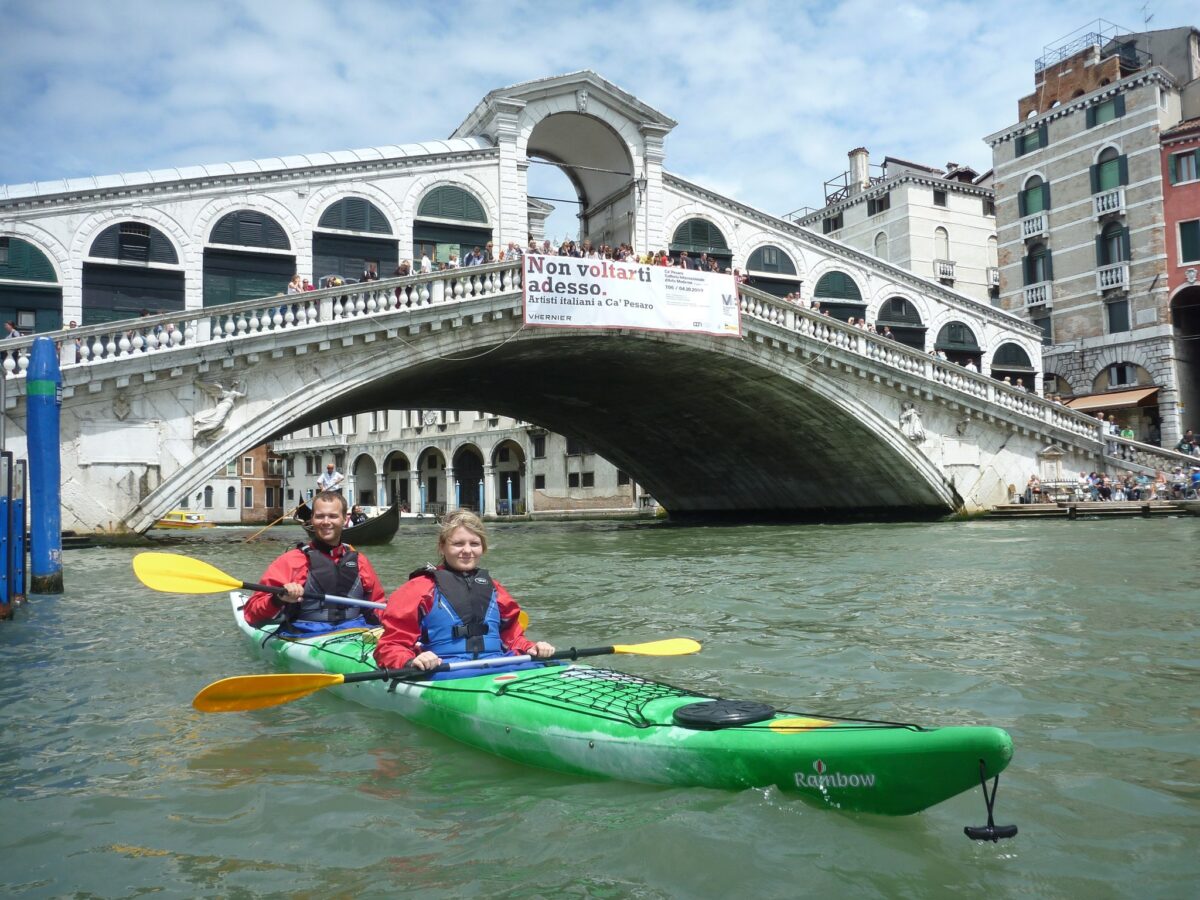
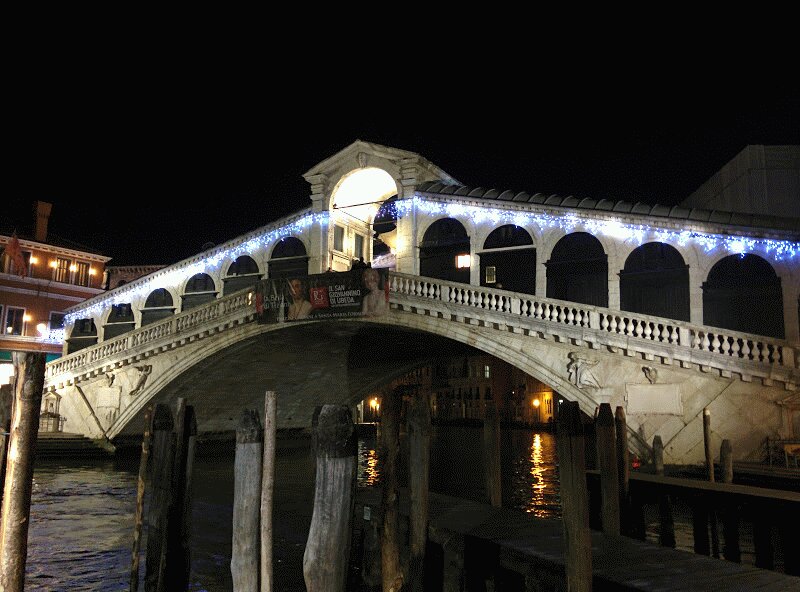
The accident happened on August 17th just before noon, at the Rialto bridge, in a spot we very often use to take photos of the participants of our kayaking tour in the city.
One of our tours had passed the exact spot half an hour earlier.
The accident
The precise dynamics of the event is not totally clear, but it most likely went like this. A vaporetto (water bus) came upstream towards the bridge in the direction of the station, on the left side of the canal as if should (of you’re facing downstream). Something, allegedly a gondola, caused it to divert towards the middle of the canal just before it reached the Rialto bridge.
Another vaporetto which had just passed the bridge moving downstream, was consequently forced to move further to the right, even if it had to stop at a platform on the left, where the other vaporetto was. It therefore ended up too far down the canal and had to back up to get back in position to moor at its designated platform. There might have been other boats involved here too.
Backing up the vaporetto hit a gondola that was waiting at a blue platform just at the foot of the bridge on the right. Apparently the gondolier had stopped there waiting for traffic to ease up a bit before continuing downstream.
The vaporetto squeezed the gondola against the platform, the passengers fell over and the gondolier was either pushed off the gondola (he’s higher up than the others) or he jumped ship.
The passengers were a German family, parents and three children. The youngest, a girl of three years, were badly hurt in the face, and her father, in some desperate attempt to help his blood covered daughter, got squeezed between the gondola and the vaporetto.
The vaporetto moved forward once it’s path had cleared, apparently without the conductor noticing anything unusual.
The area is usually crowded, lots of people standing on the Rialto bridge and along the shores of the Grand Canal saw everything, and some rushed to help and others called 112.
Ambulances, fire brigade and police were there in minutes, but for Joachim Reinhardt Vogel, 50 years, university professor from Thüringen, there was no help possible. He died in the gondola, a few metres from the Rialto bridge.
The aftermath
This should never have happened. Talking a gondola ride should be perfectly safe for children and adults alike.
From what I hear it has been at least twenty years since the last fatal accident involving a gondola. There have been a handful of gondola capsizes in the last few years but nobody has been hurt.
Naturally the blame game started immediately. Its always somebody else’s fault.
First three conductors of vaporettos were formally informed that they we’re under investigating.
Initially the gondolier was seen as a victim, after all he was hit by a backing vaporetto, and had seemingly done the right thing, trying to wait for the heavy traffic to sort itself out.
He disappeared from view and the Ente Gondola, the organisation representing the gondoliers, spoke on his behalf. He is 25 years old, has a gondola licence for a couple of years, which he acquired from his father, and he was described as an expert oarsman. Basically a hard working young man, who was so deeply chocked that he wouldn’t and couldn’t appear in public.
However, soon witnesses said that he had jumped off the gondola even before the impact, abandoning his passengers to their fate, and worse, he tested positive for hashish and cocaine, taken the same morning or at most, the evening before.
So, the gondolier also ended up under investigation. Likewise did another gondolier, who by doing a reckless manoeuvre might have caused the first vaporetto to get in the way of the second which then backed into the gondola.
Even if no taxis were involved directly in the accident, there were several in the area, and as everybody who moves around Venice in a boat will know, they’re the worst offenders with regard to reckless manoeuvres, speeding and making waves. Consequently, a lot of fingers were pointed in that direction.
The association of taxi conductors wisely kept their mouths shut.
A favourite pastime of most Venetians is to blame the municipal administration for everything, and in this case they’ve been blamed for not enforcing the already existing speed limits of 5 km/h, and for favouring public transport when regulating traffic, since the vaporettos are run by a municipal company.
Just to add a bit of flavour to the whole affair, it appeared that the blue platform that the gondola got squeezed against, belonging to the Magistrato alle Acque, a state institution managing water resources, didn’t have the necessary legal permit to be there.
That caused the debate to extend to the multitude of docks and platforms and various moorings along the Canal Grande, which cause it to narrow by a much as 25m in places.
What to do
Something will have to be done.
The city council have come up with a plan that will somehow take something away from everybody, so nobody have any excuses.
Nobody really wants to give up anything.
The 26 point plan includes among other things a separation of traffic, so garbage collection and goods deliveries to shop and hotels will have to be made between 4am and mid-morning, while the gondolas will be disallowed circulating in that same period.
Taxis will not be allowed to run empty on the middle part of the Canal Grande, around the Rialto Bridge, and they will not be allowed to run caravans with large groups of tourists in the same area.
The two vaporetto lines running the Canal Grande (one fast and one slow) will be united into one line with a frequency of every 4-5 minutes, compared with every 6 minutes now for the slower line 1 and every 10 minutes for the faster line 2. This should reduce congestion and dangerous manoeuvres around the platforms, and remove the situations where one vaporetto overtakes another.
Vaporetto don’t have bow thrusters or rear cameras, but its only recommended that it’ll be examined if something can be done.
Platforms used by gondolas, taxis and vaporettos will be physically separated by moving sometimes one of them, sometimes another. The danger spots are here a canal close to the Rialto, much used by gondolas, but entering the Canal Grande just between two vaporetto platforms, often leading to dangerous situations; and a similar situation neat the Hotel Danieli close to San Marco, again with gondolas moving about inbetween vaporetto stops.
The concessions for private docks and moorings in the Canal Grande will all be reviewed and retracted if there is no benefit to the public good from the docks and moorings.
Private motor boats will be disallowed between 6am and noon.
Obligatory test for use of drugs and alcohol by all people working with passenger transportation by boat. This is already done for the vaporetto personnel, since they’re employees, but not for taxi drivers and gondoliers, as they’re self-employed. The Italian laws presently doesn’t allow for such enforced tests of self-employed persons.
There will be two fixed points of presence by the municipal police at Rialto and at the Punto della Dogana.
Surveillance
One of the main elements of proof for the investigation into the causes of the accident is video footage from a system called Argo.
The entire Canal Grande has been under complete real-time video surveillance since 2009. For a while there was even a web site where you could follow traffic on the Canal Grande, with little red and green arrows for the boats, depending on whether they were speeding or not.
This system has been out of order in periods, and due to privacy reasons it is been mostly unused for regulation of traffic. The city tried to use it against some taxis caught speeding some time ago, but its use as proof was refused by the court.
Still, the images and videos exist, and they’ve been used to analyse the situation on the Canal Grande running up to the accident, which is what got the second gondolier in trouble.
From the surveillance it appears that some 4000 vessels pass under the Rialto bridge every day. As traffic is not evenly spread out over the 24 hours, it means that there can be a dozen or more boats just around the bend of the canal under the Rialto, which is also the narrowest part of the Canal Grande.
Recently the city has held a meeting with the ombudsman for privacy protection, to make sure that the Argo system can be used to regulate traffic and enforce rules in the future.
What will likely be done
The city administration tries to negotiate with the different groups, but leaving out some, like the private boat users who have no collective representation. This, of course, just fuels the pointing fingers.
The Ente Gondola representing the gondoliers, insist that they’re the weak ones in traffic, and also one of them the victim of the accident, so they don’t see any need to make compromises. Their claim is that the existing rules, most notably the speed limit of 5 km/h, just need to be stricter enforced.
The taxi drivers mostly keep their mouths shut, which is probably wise as they’re the number one problem of water traffic in the city, even if they weren’t directly involved in the accident.
The public transport company and the vaporetto personnel claim that they’re the only agents actually delivering a real public service, and that any cut in services will cause a deterioration of the quality of life for the real Venetians, and also for the tourists.
The goods haulers claim that prices will go up by at least 30% if they’re forced to do deliveries in the very early morning.
The garbage collection company also announced that garbage collection by night would cost at least 30% more, and the city administration changed the plan before going public.
The private boat users have been up in arms, but as they lack a collective representations, its mostly just roaring on Facebook.
Its going to be a hot autumn for boating people in Venice, but most likely very little will ever change.
David H. Johnston of the Paddling Instructor blog have published an interview with me in the series “I Want Your Outdoor Job” series on the blog. I’m deeply honoured.
via I Want Your Outdoor Job: René Seindal, Owner of Venice Kayak | paddlinginstructor.com.
In the five years I’ve lived in Venice, I haven’t had any one home for long. It’s been a lot of moving around, and basically camping out in the various places, hauling along a bare minimum of stuff to reduce the burden of the next move. Every time I thought I had found some kind of stability, something happened to mess up my plans.
I have lived for periods in a tent on a camp site, with a friend on the mainland, in a shared room in an apartment in Venice, in a small apartment on the Lido where the rain came in through the outer walls, and in a shared apartment where my flatmate suddenly left for whatever reasons, and left me with a double rent for the remainder of the contract duration.
A home is a basic thing in life, and living for prolonged periods without the stability and certainty of knowing where you’ll sleep the next night, or next week, or next month, can be very burdensome.
I have now, however, found a place I believe will be a home for the next years to come. At the very least I’ve signed a contract for a place I like, in a fantastic location, for a rent I can pay.
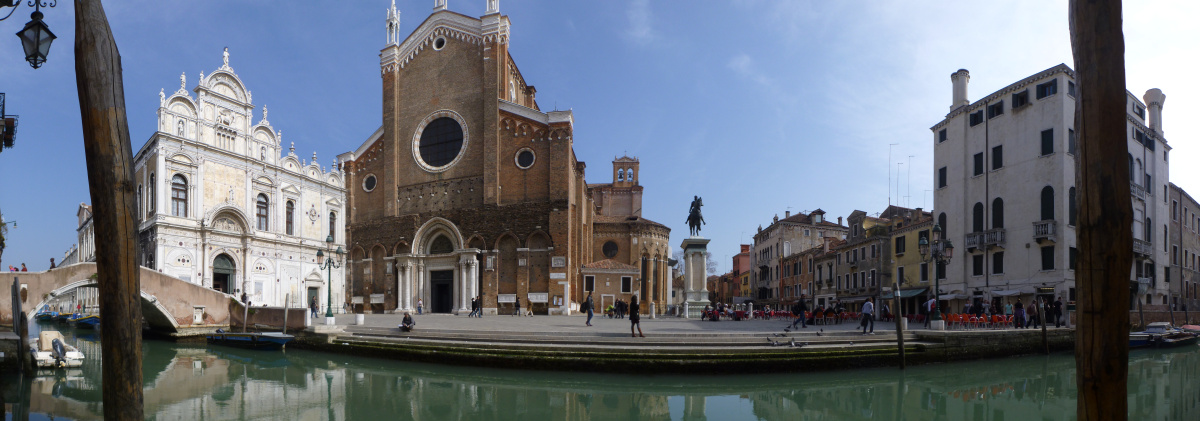
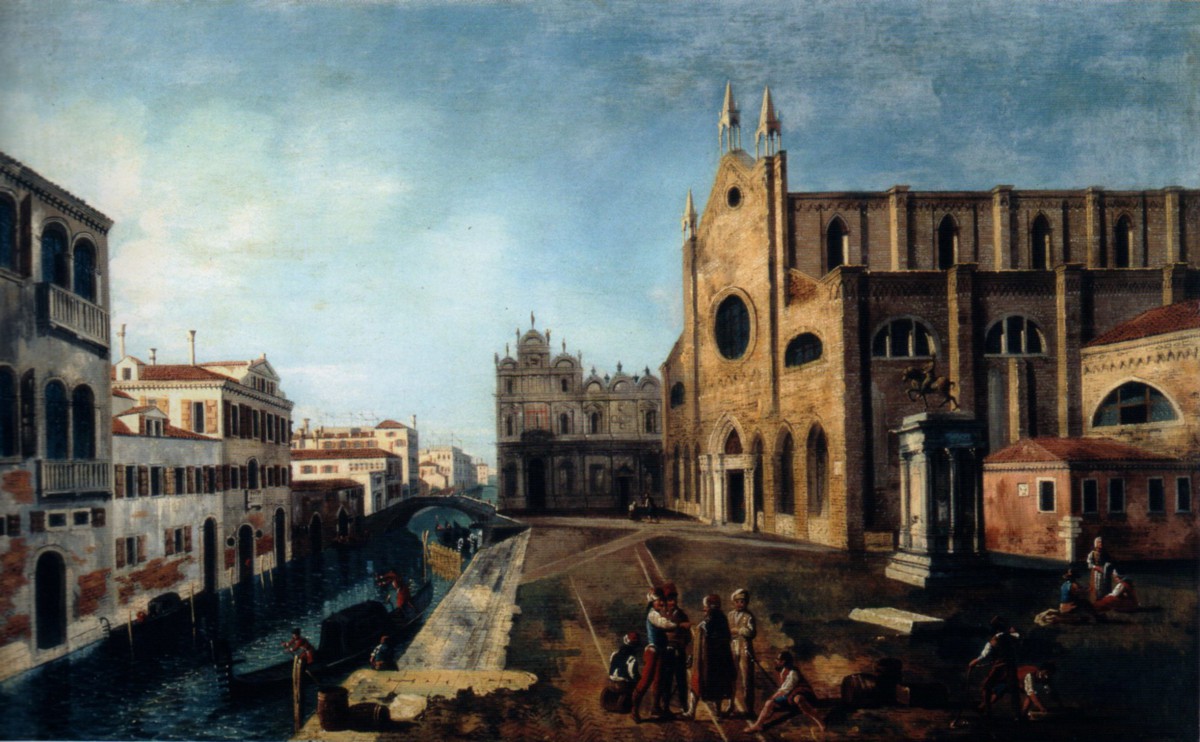
Panorama of the Campo S.S. Giovanni e Paolo
The location is in the centre of Venice, on the Campo S.S. Giovanni e Paolo (shown in panorama above), which is one of the major squares in Venice, and one of the most beautiful too, in my opinion.
The apartment is small, but on the third and top floor, accessed from a courtyard on the main campo, with windows on an internal courtyard. That means light, air and little noise, all properties that are very hard to find in Venice, at least at an affordable price.
The previous place I lived was on the first floor, windows on a calle about 1 metre wide, where drunk tourists often roamed up and down, howling as they fought to find their way around the labyrinth of the calle, rughe and salizade of central Venice.
None of that here, though. The only noises in my new home are the nearby church bells a few hours a day, and my landlady across the courtyard singing along with the radio or trying to get her kids to do their homework.
The building itself is old, even by Venetian standards. It originates in the 14th century, and was originally the embassy and hostel for tradesmen from Brescia, hence the name Bressana of both the front courtyard and the adjacent calle.
(this painting is from the mid 18th century – little has changed)
Most important, I have a contract for at least two years, and extendible to four years.
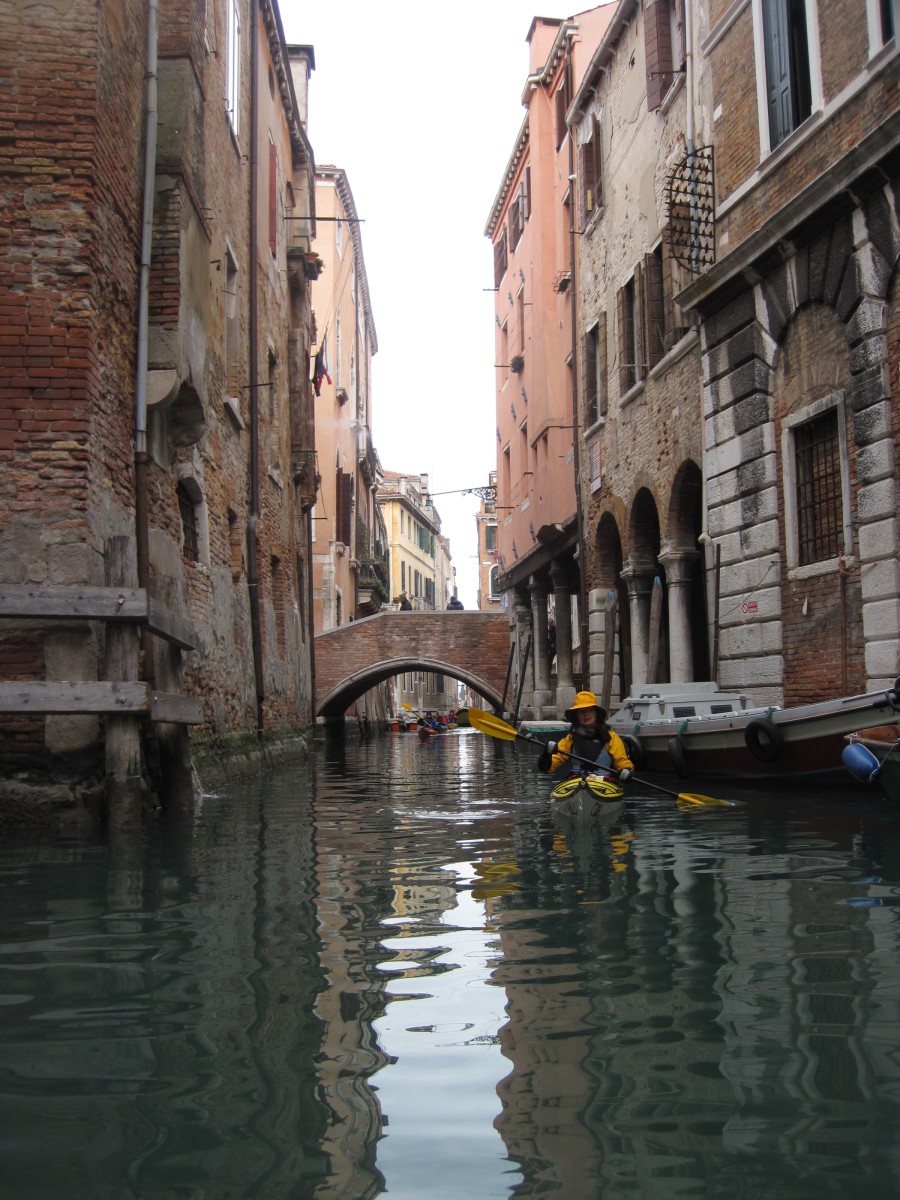
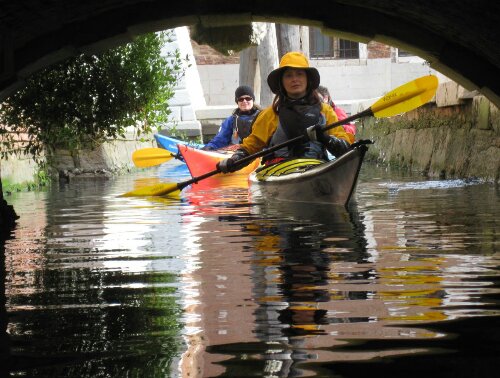
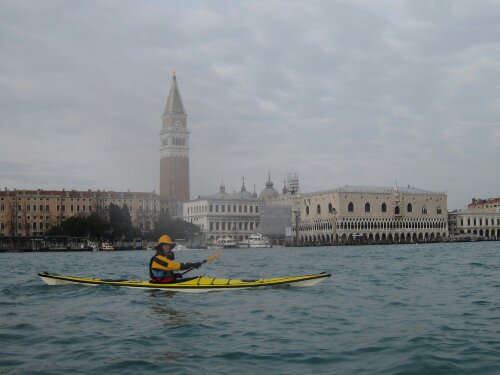
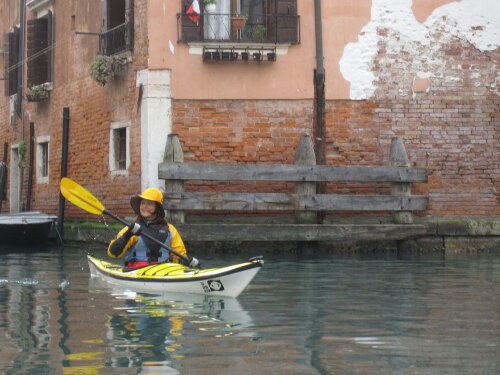
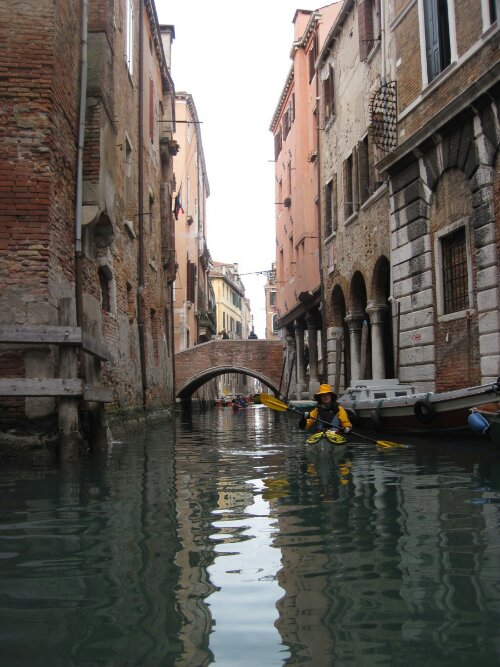
Between this and that it was late January before we got the kayaks out on the canals of Venice. It was before the cold set in, so there was no snow or ice on the canals. We had much of the city to ourselves, as most other boat people in Venice are having a slow period in January.
I’m not quite sure what to think about this, but I’m fairly confident a lot of Venetian rowers wouldn’t like the way these gondolas are punted rather than rowed.