Tag: Voga alla Veneta

  • High Water Gondola Rowing

    High Water Gondola Rowing

    Rowing a gondola at high tide requires some special skills. The higher water makes for lower bridges, and a gondola is not a low profile boat that’ll just go under anyway. The gondoliere have to do all sorts of weird manoeuvres to get the boat under the lowest of the bridges.

    Crouching

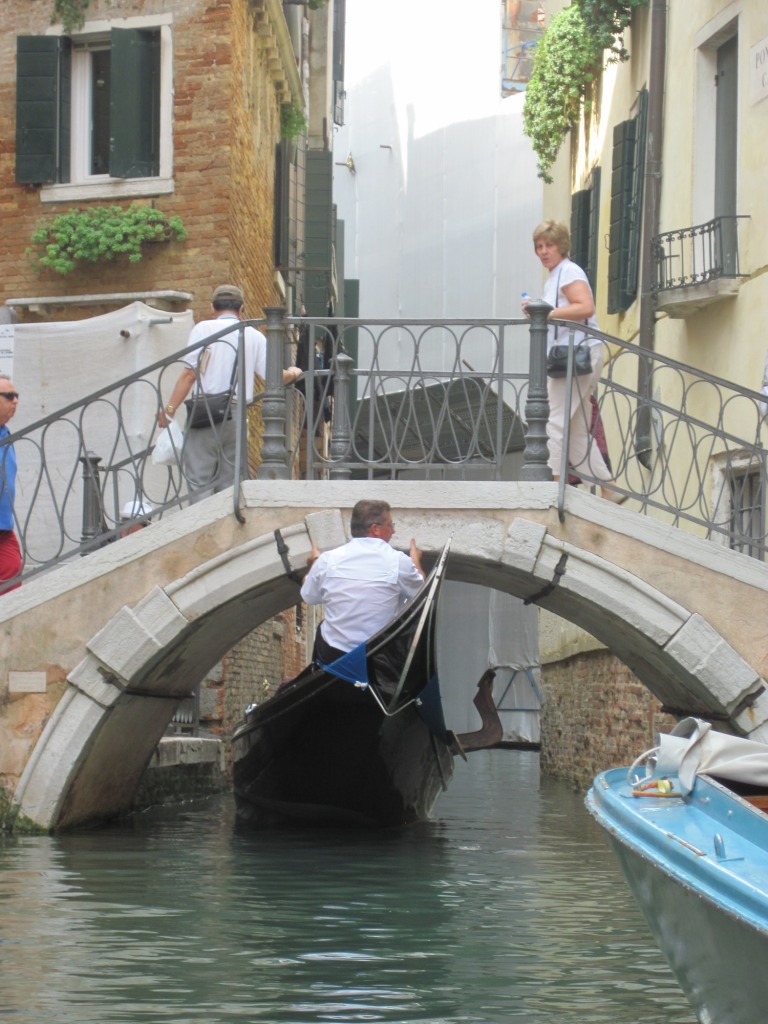
    The simplest way of lowering the height of the gondola is for the gondoliere to crouch on the back deck, while he keeps the oar straight backwards, propelling the boat with a sculling movement. The forcola, or oarlock, has a bend exactly to allow the operation where the oar is almost parallel to the boat. High Water Gondola Rowing - Lying down 1 - 1329 High Water Gondola Rowing - Lying down 1 - 1330 High Water Gondola Rowing - Lying down 1 - 1331 Another example of the crouching gondoliere, same place near Santa Maria Formosa: High Water Gondola Rowing - Crouching - 1 High Water Gondola Rowing - Crouching - 2 High Water Gondola Rowing - Crouching - 3 High Water Gondola Rowing - Crouching - 4

    Edging

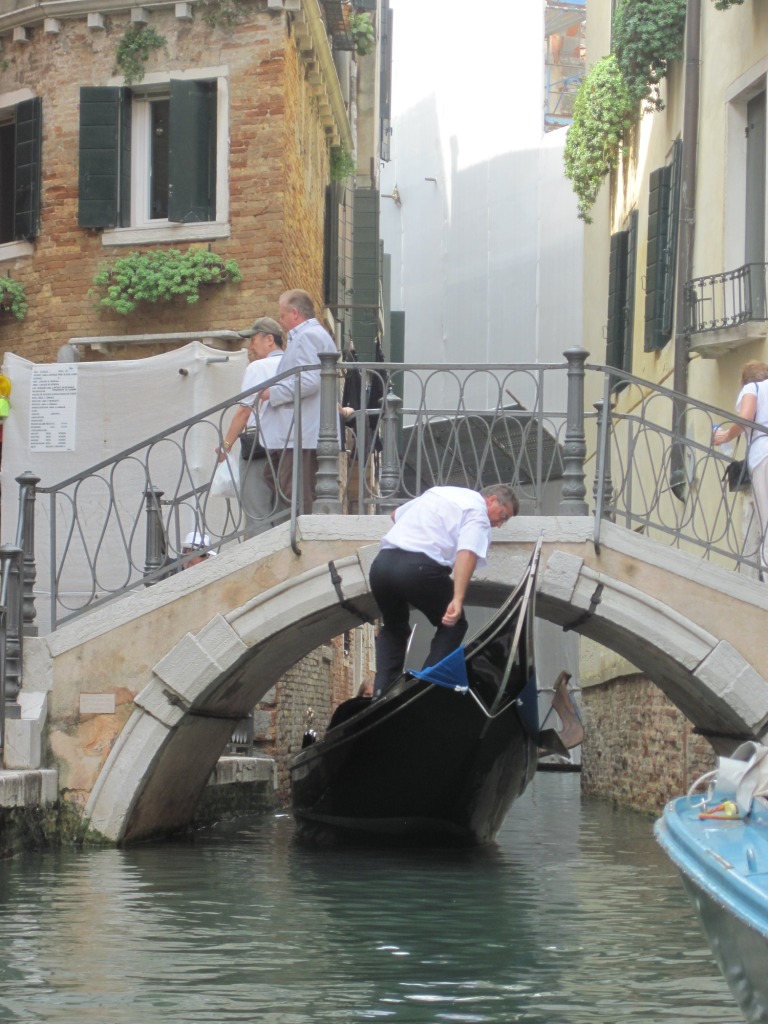
    If the bridge is very low, the gondoliere might have to edge to boat to lower the stern ferro, which is the highest point of a gondola. He will do so by stepping over to the right side of the boat, in front of the forcola. From that position he will scull the boat forwards. On many gondolas the stern ferro is on hinges, so it can be flipped down. If the bridge is too low for even the bow ferro the pass, he will have to edge the boat even more, by telling the passengers to all sit on the right side of the boat. From Rio del Mondo Nuovo, near Santa Maria Formosa: High Water Gondola Rowing - Edging - 1 High Water Gondola Rowing - Edging - 2 High Water Gondola Rowing - Edging - 3

    Lying down

    At times the gondoliere will have to pass a bridge where there’s just only enough space to squeeze through, and to make sure that he will not get stuck, with ferri scraping the underside of the bridge, he will lie down on the back deck of the gondola, and push it along with his hands until the stern ferro is well through the passage. From Rio San Provolo, S.Marco: High Water Gondola Rowing - Lying down 1 - 1334 High Water Gondola Rowing - Lying down 1 - 1335 High Water Gondola Rowing - Lying down 1 - 1336 High Water Gondola Rowing - Lying down 1 - 1337 High Water Gondola Rowing - Lying down 1 - 1338 High Water Gondola Rowing - Lying down 1 - 1339 High Water Gondola Rowing - Lying down 1 - 1340 High Water Gondola Rowing - Lying down 1 - 1341 High Water Gondola Rowing - Lying down 1 - 1342 High Water Gondola Rowing - Lying down 1 - 1343 High Water Gondola Rowing - Lying down 1 - 1344 High Water Gondola Rowing - Lying down 1 - 1345 High Water Gondola Rowing - Lying down 1 - 1346 High Water Gondola Rowing - Lying down 1 - 1347 And another case from Rio della Maddalena, Cannaregio: High Water Gondola Rowing - Lying down 2 - 1382 High Water Gondola Rowing - Lying down 2 - 1383 High Water Gondola Rowing - Lying down 2 - 1384 High Water Gondola Rowing - Lying down 2 - 1385
  • Regata di Mestre

    Regata di Mestre

    There are many rowing regattas in and around Venice during the summer, with various kinds of boats participating. The Regata di Mestre is the first of the season, and it was held last Sunday, May 10th. My initial plans were to watch it from a kayak, but Mother’s Day intervened causing friends to stay home, so in the end I walked to Sacca San Girolamo in the Cannaregio area, from where I had a good view of the canal where the race had to pass. Regata di Mestre Mestre is a city on the mainland, but the race started from Murano north of Venice, touched the NW corner of the city in the Cannaregio area, before heading towards towards San Giuliano on the mainland, on the outskirts of Mestre. I was watching at the mid point, so I didn’t get to see the finish, and I still don’t know who won. Regata di Mestre Regata di Mestre Regata di Mestre
  • Canottieri Diadora

    Canottieri Diadora

    The Canottieri Diadora is the Venetian rowing club where I have been taking voga alla veneta lessons recently. It is a very old rowing club, with a very particular history. The club was founded in 1898 in Zara in Dalmatia, modern day Zadar in Croatia, by a small group of rowers of mostly Venetian descent. Zara had been under Venetian rule from 1409 until the fall of the Venetian Republic in 1797, and a good part of the population were descendents of settlers from the Veneto region in Italy. They called the club S. C. Diadora, which is the Venetian name for the city of Zara. Zara was, however, under Austro-Hungarian rule at the time, and the Venetian club was not welcome in the Austrian rowing federation, so the club had great difficulty participating in races. It took a long strenous battle, but in the end the club managed to become associated with the “Reale Rowing Club Italiano”, after which the S. C. Diadora could participate in national Italian races, and later in international events under the Italian flag. In 1907 the club won their first medals at the internation regattas of Trieste, which was followed by many others in national and international events, including national Italian championships and an bronze medal in Mens Eights at the 8th Olympic games in Paris in 1924. The Second World War put an end to all this. Many club members died in the war, and many others fled Zara for Italy, as the city was all but destroyed. It was the end of the S. C. Diadora. However, in 1961 a group of old members got together in Ancona in Italy, and participated in an event there under the blue/white colours of the S. C. Diadora. The following year a group of Venetian rowers, together with some of the old members of the club in Zara, now living in Venice, met on the Lido di Venezia and reformed the club as the Circolo Canottieri Diadora, with seat on the Lido di Venezia, and the Diadora has been there ever since. Other Venetian rowing clubs gave a hand in establishing a new fleet for the reformed Diadora. As basically a new club, competitive results didn’t come immediately. In the 1960s results were few, but things got better in 1970s and 1980s, with many regional and some national wins. The activities were extended to racing kayaks in the early 1970s, and more slowly, to voga alla veneta.

    The first Venetian style boat in the club was a veneta a quattro, which was given to the club by the rowing club of the railway workers. Not a competitive boat, it became nevertheless a means of training, and in 1973 the Diadora won the Historical Regatta in a veneta on load from the Querini rowing club in Venice. The Diadora team consistently won the Historical Regatta for several years in a row. One of the members of the team was Lino Farnea, who still coaches rowers at the Diadora at the age of 70. The mid-70s was a time of revival of voga alla veneta in both Venice and on the mainland. The Vogalonga, started in 1975, was a part of this revival. Many of the city’s rowing clubs gradually switched their focus from English style rowing to Venetian style rowing, and so did the Diadora. Consequently, at the Diadora it is now possible to row English style, kayak and row Venetian style, both competitively and recreationaly.

    The Diadora now has a fleet of several mascarete, a gondolone and a caorlina, and has access to the municipal fleet of racing boats for use in the municipal regattas which are held at various places in the lagoon each summer. Lino Farnea is coaching still at the Diadora, and also at the Scuola Navale F. Morosini at Sant’Elena, and he is often a referee at the municipal regattas.
  • Vogando a poppa

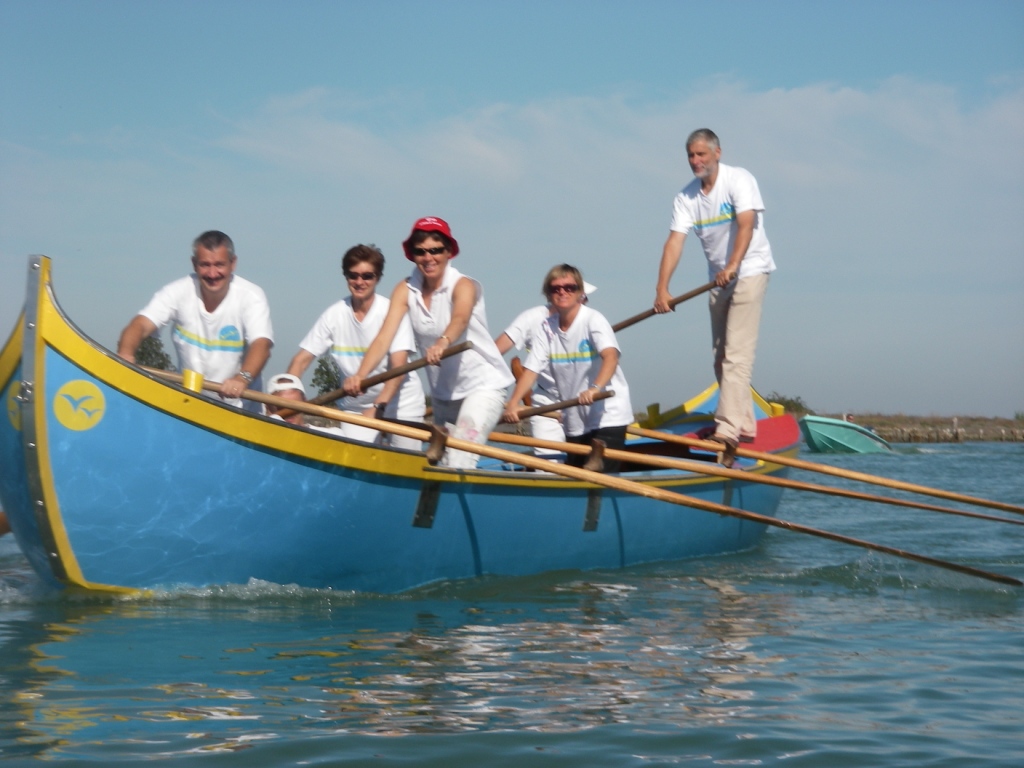
    Yesterday I had my first real lesson in Voga alla Veneta, the Venetian style of rowing standing up. I went out with Lino, one of the coaches at the Canottieri Diadora on the Lido di Venezia, in a mascareta like the other two times I have tried it. The first two times I’ve tried to row Venetian style, together with Enzo, I was always in the front position, a prua, and I automatically went there again, but Lino sent me to the stern, a poppa. The stern position is more difficult because the rower a poppa is in charge of steering, and therefore has to know various maneouvres to turn left and right, do sideways movement, turn on the spot and much more. Before we started, Lino changed and adjusted my forcola. Now, if anybody suffered from the belief that the forcola is just a piece of wood to hold the oar in place, they’re wrong. Adjusting a forcola is a fine art. The lower part of it doesn’t just fit into the holes on the side board of the boat. The holes are too large, and wedges had to be hammered in to keep the forcola in the desired position while rowing. By placing the wedges differently, the forcola can be made to lean outwards or inwards, forwards or backwards, and be placed at different heights. I can’t remember all the details, the explanation came rather fast in Venetian dialect, but outwards leaning gives better control but less speed, inwards leaning less control but more speed. Forward leaning was for racing. Being a beginner mine was outwards leaning, and rather high, as I’m taller than most of the locals. We started rowing in two, but fairly soon Lino just sat down watching me. He corrected a lot of little details of how I stood in the boat, how I shifted weight back and forth and how I held the oar. This was more or less what I had expected, as Enzo had asked Lino to teach me the correct position for rowing Venetian. However, without Lino rowing on the left side of the boat, with me rowing alone on the right side of the boat, we started going in circles. Its like doing only sweep strokes on one side in a kayak. There was a bit of wind, and like a kayak the mascareta wants to turn into the wind, ánd with the two things combined there was very little control of where the boat wanted to go. Lino then started to teach me a return stroke used by the gondolieri to keep the boat on course. I believe it is called a stagare, or stalìr, and it turns the boat to the right, but it is made as the blade returns after a forward stroke. At first I didn’t understand what the stroke was supposed to do, and consequently I performed miserably, but as understanding grew it got better, and after a while I could, with a lot of concentration and quite a few cases of dropping the oar from the forcola, mostly control the direction we were going. The stroke he taught me is rather hard to describe. On a normal forward stroke you put the blade in the water in a vertical angle, the lean on the oar, turn your wrists and the end of the stroke, and when moving your weight back on the back foot, the oar returns forwards with the blade parallel to the water, either out of the water or sliding through at the surface. A forward stroke with no correction will send the boat turning left in a small circle, and in fact it is not called a forwards stroke in Venetian, it is called a premere, pushing. The stroke to keep the boat going straight or even right, is made on the return movement, which is inactive in the simple forward stroke. Instead of turning the blade parallel with the surface on the return, it is turned a little bit more, so it bites into the water, while applying a downwards pressure on the oar handle with the left hand. It works a bit like a rudder but with the oar more horizontal than vertical. It has to be made very delicately to work. The angle of the blade, the pressure on the handle and the return movement of the blade has to be precisely coordinated and carefully measured, or the oar will drop from the forcola. The forcola gives a firm base for a forwards stroke, but when applying pressure on the return there is only a tiny little tap to keep the oar from dropping out, so the downwards pressure is all important and has to counter the downwards movement of the blade in the water precisely. It took me at least half an hour of deep concentration and many mistakes to get some kind of grasp on it, but at the end it was a great sensation getting the feeling of controlling the boat, even with this very alien style of rowing. Just as I started to feed I had it, my performance declined, the boat veered and I kept dropping the oar. In my eagerness and concentration I had forgot time, and I had been rowing for at least 45 minutes alone and I was very tired. After maybe an hour on the water, we rowed to boat back in unison, which was suddenly so incredibly easy compared to rowing the boat alone. When I jumped on the bridge back at the club, my legs shook under me. I was that tired. I’ll be hanging around Venice for at least another week, so there should be time to do a few more lessions of Voga alla Veneta. For now, I have an appointment on monday morning, still with Lino.
  • Vogando

    Vogando

    My little voga alla veneta adventure continues, at a slow but accelerating pace. I haven’t had a chance to try it again as work paddling around Venice with tourists have taken almost all my time, but today Enzo gave me a call and asked if I wanted to try again today. I threw down a quick lunch, way to quick to be decent here in Italy, jumped on my motorbike and sped down the Lido to the “Canottieri Diadora” where Enzo rows. I arrived at the club just as Enzo was coming back in with another newbie. He jumped out of the mascareta and I jumped in, and off we went. Even though I have only tried it once before, the basics I learned last time returned immediately: the position of the feet, the hold on the oar and the twisting movement of the wrist to release it from the water without dropping it from the forcola. We rowed south towards the little island of Poveglia, which I passed only a week ago with a group of Danish paddlers. Poveglia has a past as a lazzareto, which is a place where ship crews were put in quarantine if decease was suspected aboard, and the ruins of the hospital is still there, though in a rather poor state. Poveglia is cut in two by a small canal, and we stopped there to have a look. Most of the buildings are overgrown, and bits and pieces of hospital equipment are still lying around under the vegetation, though anything of value has been taken away ages ago. On the other side of Poveglia we met Angelo, also from Canottieri Diadora, obviously having a break, sitting down on his mascareta. After a short chat he agreed to join us on the return trip, but since he was rowing alla valesana, with two oars crossed, he was faster than us. My lack of rowing skills might also have been a factor 🙂 The whole process of rowing standing is working better now, shifting balance from one foot to the other, as the weight is used to push the oar through the water, coordinated with arms and wrists to control the entry, passage and release of the blade from the water. Naturally, I still drop the oar from the forcola regularly, but I did manage to do some decent stretches with a decent efficiency without looking completely silly all the time. Back the the club we took the boat out of the water, using an electric crane, and washed it well. Shortly after, one of the club’s instructors came in, and he gave me an appointment for tomorrow morning at 8.30 for a proper lesson in voga alla veneta. Now I only need to learn the dialect and buy a pair of flashy sunglasses, and I will be absolutely indistinguishable from the natives 🙂
  • Voga alla Veneta

    Voga alla Veneta

    Today I’ve had my baptism at Voga alla Veneta. I went with Enzo, who has a small garden near the Camping San Nicolò where I stay, to the Circolo Canottieri Diadoro to try to row a bit with him. I had about half an hour on the water with Enzo, before his next appointment showed up. The boat was a Mascareta, which is a fairly small boat made for two oarsmen. Here are a few pictures of Enzo getting the boat ready, fitting the forcole and finding the right oars. Voga alla Veneta is like kayaking a full body exercise. You have to stand in the right way in the boat, feet in the correct position, oar turned the right way relative to the water, and then push with your arms while moving your upper body forwards a bit and shifting your balance from the back foot to the front foot. At the same time, during the push, you have to turn your wrists in the right way at the right time, so you extricate the blade from the water, allowing you to the return body and blade to the starting position, without having the oar drop from the forcola. Dropping the oar from the forcola is a common problem for beginners, and I had my problems too, though not as bad as I had feared. The forcola only supports the oar fully in the push phase, and in the return phase you have to be very careful not to have it fall out. Both forcole can be seen on this photo, when Angela was getting into the boat after me. In a Mascareta the more skilled rower is always in the back, steering and controlling. The front rower only has to keep a constant, regular forward stroke, while the back rower does all the interesting stuff. This is also the explation of the difference between the two forcole. The right forcola has more points of support because it is used for much more, while the left forcola is only for forward strokes and breaking. Standing up in the boat was very awkward in the beginning, but as I started to concentrate on getting my forward stroke right and not dropping the oar, it became a secondary issue, and it wasn’t really difficult. The important thing is not to move your feet unnessarily. As long as both rowers keep their feet in the same position, there will be no sudden shifts of balance. Unfortunately, I have no photos of myself in the boat – or maybe I should say fortunately 🙂 – but here are a few pictures I took of Angela and Enzo as they set out for their afternoon vogata.
  • Voga alla Veneta

    Voga alla Veneta

    Tomorrow will be the basis of another anniversary. I have just made an appointment to have my first lesson of Voga alla Veneta, or rowing Venetian style, tomorrow.