
I’ve been bicycling all my life, and its one of the very few things I miss here in Venice. Berlin, on the other hand, is full of bicycles.
Category: Travels
-

Berlin 25 years later

Child playing on the Kurfürstendamm In July 1990 I bicycled from Copenhagen to Prague, and I passed Berlin on the way. This was done eight months after the fall of the wall, but some month before the reunification, so I spent a week mostly in the DDR.
I entered the city at the northern end of the wall, where workers had removed a small wall segment blocking a road, and I crossed the border while some workers were clearing out 30 years’ growth of trees and shrubs, while others were laying new asphalt on the soon to be reopened road.
As I pedalled through the western part of the city, at some point I noticed that it had changed somehow, and I stopped to figure out where I were.
I was on Unter den Linden, well inside eastern Berlin.
Somewhere I had crossed the border again, but I have no idea where. In just eight months large parts of the hated wall was removed, to a point where I didn’t even notice crossing it.
This month I went back, to attend the ITB Berlin travel fair, but I decided to stay three more days to see a bit more.
While I walked many of the same places, I didn’t recognise one single place.
I have no photos from back then, but Berlin 25 years later could just as well be another city.
-

Copenhagen paddle
These photos are from a short paddle in early January in Copenhagen, with our friends Per and Lise. Many thanks to Kajakhotellet for lending us the boats.
Copenhagen paddle 
Copenhagen paddle 
Copenhagen paddle 
Copenhagen paddle 
Copenhagen paddle
Copenhagen paddle 
Copenhagen paddle 
Copenhagen paddle 
Copenhagen paddle 
Copenhagen paddle 
Copenhagen paddle 
Copenhagen paddle 
Copenhagen paddle 
Copenhagen paddle 
Copenhagen paddle -

New Year at Tivoli
We spend New Year’s evening in Tivoli in Copenhagen, with a handful of Italian friends.
-
Arrived in Cardedu
I arrived in Cardedu in the afternoon on Saturday, and I was hardly in the door at Francesco’s before he declared that we were going fishing in kayak that afternoon. It is like that at Francesco’s house. It is very hard not to end up paddling most of the time. We went to a local camping where his trailer were, picked it up and were off to Cardedu beach for a late afternoons paddling and fishing. Francesco does a lot of fishing from his kayaks, and he has had some spectacular catches, including a 27kg “pesce luna”, which is a tropical fish not normally found in Sardinian waters. We didn’t catch a thing. Francesco got a few “tracine” but they either got off the hook or were let off because they were undersize. Anyway, when we got home after sunset, Elisa, Francesco’s wife, had made homemade pesto with basil from the garden, so we had another dinner that couldn’t be beat nonetheless. Food is good here in Sardinia, and much of grows literally on people’s doorsteps. I should have written something on the blog then, but we ended up in front of Francesco’s computer looking at photos, websites and leaflets, and at eleven I just collapsed on my bed. Francesco is a person who prefers to stay active rather than taking half a day off, so Sunday morning we were off again to take a couple of Poles out paddling at nine. Just as we were about to leave, the camping where they stayed called to say that they were still too drunk from the evening before, and that they weren’t going. We had, however, recruited a few others for the excursion on the beach the day before, so we left anyway. On the beach, only one of the promised three persons had showed up, so the group ended up being of just one persons. After a bit of instructions, communicated in an unholy mix of Italian, German and English, we paddled down the coast for a while, and back again. It was a quite calm day, with a light scirocco and only some modest swells to deal with. Back on the beach we had a beer with our German paddler, and they and Francesco arranged for next years exchange of German beer for Sardinian red wine. In the afternoon we went sight-seeing in most of Ogliastra on motorbike. We drove to the Lido di Orri, to Santa Maria Navarrese, over the small mountains and down to Pedra Longa, then back and on to Baunei and up to the Golgo plain behind the Cala Goloritzé and the Cala Sisine I visited last year in kayak. We spent some time there, throwing pebbles into a 270m vertical hole, visiting a 16th century church, and hanging around the local bar. We then returned almost to Santa Maria Navarrese, before going to Triei where they had a city-wide celebration of the ancient traditions, with people dressed in traditional clothes, stands serving local specialities and many old houses open for visitors. The city also sported a large number of murals, some quite interesting. There we met some friends of Francesco, who took us up the hills to see an ancient nuraghe and a “tomba dei giganti”. The nuraghe had been really big, but it was in bad shape, mostly a ruin, and it wasn’t even indicated on the street signs like other local sights. Francesco’s friend told us the it had been quite different when he was a kid, almost complete, but it had been ruined on purpose by somebody over 20 years ago. It is so sad to hear than something which has been standing for thousands of years has then been ruined so recently, but of course, human stupidity and ignorance know few bounds if any. The “tomba dei giganti” is another type of neolithic monument, traditionally thought to be a tomb, but who knows what it was. This one consisted of a covered passage with the remains of an elongated mound, with a crescent shaped series of stones on one side. According to our guide it had the shape of a bull’s head when seen from above. It was getting late, and we had a pizza appointment at Cardedu Marina a 8, so we had to head back homewards. We arrived half an hour late, found nobody there but desided to eat anyway as we were rather hungry and heard on the phone that the others were coming anyway. Not as soon as we had ordered did they show up anyway. Today Francesco and I got up early and we’re off for a paddle to Goloritzé and back, which is about 30km along some of the most beautiful coastline in Sardinia, which is saying a lot as most of the coast here is breathtaking. It is hard to find a bit of time for blogging, as Francesco likes to keep his guests on a tight schedule. After all, you can always sleep when you get old(er) 🙂 It also helps that there is no mobile coverage in or near his house, keeping me offline unless I go and sit in the orchard or between the vines. -

Cardedu Kayak
Francesco Muntoni has run Cardedu Kayak for ages. He organises kayak excursions for both beginners and experienced paddlers along the middle part of Sardinia’s eastern coastline, from between Muravera and Cardedu to Cala Gonone, which includes the national park of the Golfo di Orosei.
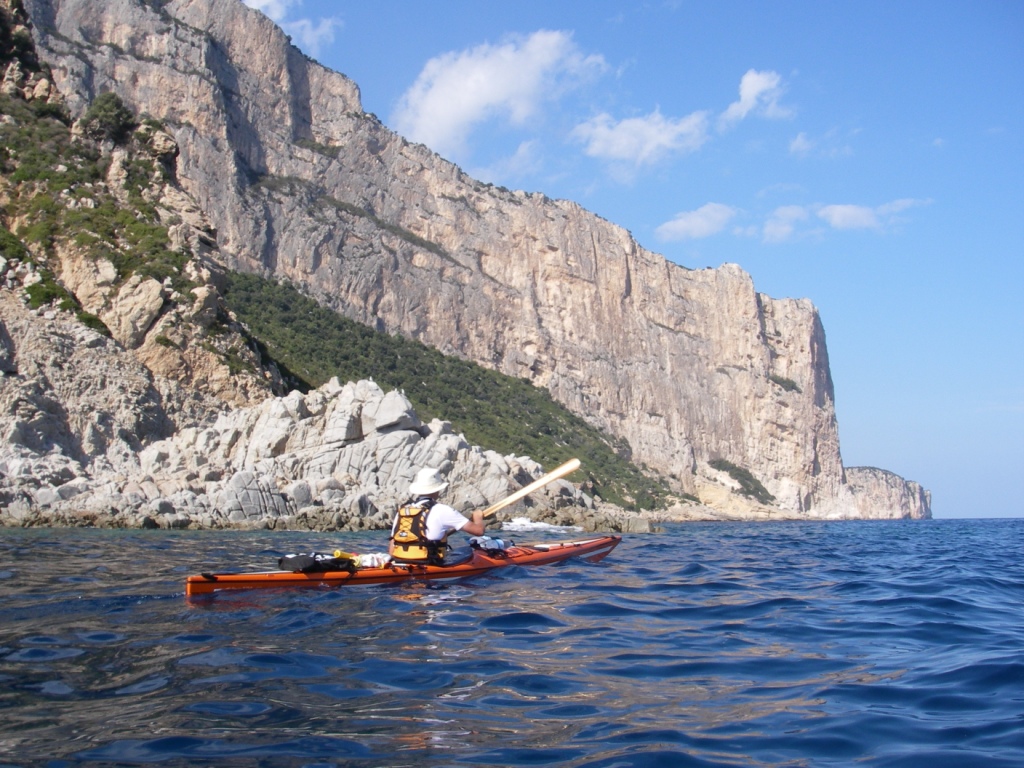
Visiting Francesco without ending in a kayak is an impossibility. On our first day we went for a short afternoon paddle from Marina di Gairo south along the coast, admiring the fantastic rock formations in the red rock of the Cardedu coastline. Many look like manmade sculptures. There’s the eagle, the old lady and many others.
 Francesco spends most of his time either on the water with tourists, or getting ready or cleaning up after an excursion. In his spare time he works for a local wine cantina. The Perda Rubia cantina is one of the very last cantinas that still produce Sardinian red wine of the local Cannonau grapes in the traditional way.
 We got a special guided tour of the cantina, which is a fascinating place with fermentation tanks and oak barrels so huge they have been built inside the cellar when the cantina was started in 1949. Francesco presented me quite unexpectedly with a very special and absolutely priceless gift: a bottle of Perda Rubia from 1964, the year I was born.
Sardinian cuisine is a journey in itself. That evening we had culorgiones, a kind of large ravioli with a filling of potatoes and pecorino.
-
Cagliari
Tuesday evening (March 25th) we left Palermo for Trapani. The ferry was scheduled to depart at nine in the evening, but we ended up at Giacomo’s chatting until after seven, and arrived at Trapani harbour at ten to nine, only to discover that the ferry departed from a new more distant pier, which we had problems finding as the signs weren’t quite in working order. We hauled our gear from the car onto the ferry, said a hasty goodbye to Giacomo and hurried on board, only to hear a message on the loudspeakers that departure had been postponed to ten o’clock. Initially the sea was quite rough, but it got calmer during the night, and we had a reasonably quiet passage to Cagliari where we arrived at about ten in the morning.
Francesco Muntoni of Cardedu Kayak wouldn’t be able to pick us up until in the late afternoon, so we carried our gear to the nearby bus station where it was possible to leave luggage for a while. We checked in our bags, and a greenland paddle, and set off exploring the city.
 Cagliari is an ancient city. It was founded by the Phoenicians some 800 years BC, and later pass into Roman hands, followed by Byzantine, Pisan, Aragonese, Spanish, Austrian, Piedmontese and finally Italian. We walked through the busling lower quarter Marina on our way up the hillside to the old fortified city, the Castello, which in comparison seen almost lifeless.
 Francesco Ravasio, one of the persons who brought sea kayaking to Sardinia over twenty years ago, met us at the station at half past three, and he took us for a short excursion to Nola before dropping us off at Diana Canoe, a local kayak producer run by Stefano Diana.
Diana Canoe makes a wide range of recreational kayaks in fiberglass, and they can make almost anything in fiberglass and kevlar. When we were there they were even working on some fiberglass roofs for ambulances.
 Francesco Muntoni of Cardedu Kayak came to Diana Canoe a bit later to pick us and a couple of kayaks up. Francesco uses kayaks from Diana Canoe for most his excursions in the Ogliastra area in Sardinia. The kayaks in question are in part designed by Francesco himself, especially for daytrips with less experienced paddlers along the rocky coast near Cardedu and in the area of the Golfo di Orosei.
We had a quiet drive to Cardedu in the dark, and arrived there at about ten in the evening, dead tired and ready for bed.
-

Easter in Palermo
The weather has gone haywire in most of Europe, and we’ve got our part of the fun here in Sicily too. No snowstorms though, its not that extreme, but we’ve had a lots of rain, winds between force 4 and 7 and seas so rough many ferries have been deviated or had to remain in port. The weather hasn’t given us any chances for a relaxed holiday paddle, but we’ve spend quite a bit of time with our Sicilian kayak friends Giacomo della Gatta and Salvatore Bartoli.
Salvatore has the dubious honour of having a pizza named after him at a local pizzeria, Actually the Pizza Bartoli is a very good pizza, with cherry tomatoes, mozzarella di buffala, red onion, anchovies, and a touch of rucola. We all enjoyed it immensely, except Salvo who didn’t feel well.
The day after we had a spectacular meal at Giacomo’s, with mackerel and sausages on the barbecue, salad and an unbeatable chocolatecake for dessert. Poor Salvo still didn’t feel well so most of the laughs were on him as he snored away on the sofa, but the rest of us had a great time.
 We’re spending a good deal of our time with Valentina’s family. After all we don’t see them that often. Sunday was justly one of the few sunny days this Easter, and we went for a walk on the beach at Isola delle Femmine. The wind was strong, though, and we didn’t stay for long.
Today we gambled on decent weather in spite of a forecast of rain, rain and more rain, and we’ve been reasonably lucky. In the morning we left for Segesta, some 75km west of Palermo, where one of the worlds best preserved hellenistic temples stand, near the ruins of the ancient Elymian city of Segesta. We were fortunate enough to have some nice long spells of sunshine,and we took our time to explore the ruins.
From Segesta we went to visit some very dear friends in Castellammare del Golfo. I’ve known Mariangela and Paolo since before I started to learn Italian some 15+ years ago, and a visit to Sicily without dropping by in Castellammare del Golfo is just not right.
Mariangela and Paolo took us to Balata di Baida to taste a local delicacy, the cassatelle. They are little half moon shaped cakes, filled with ricotta cream, deep fried, and covered in fine sugar. Our short excursion for the sake of a cake became a two hour meandering through the landscape of western Sicily, between fields of durum wheat, beans, vineyards, olive groves and citrus orchards, with a multitude of houses in between, large and small, old and new, beautiful and ugly, abandoned or well kept.
Tuesday is meant to be our final day in Sicily for this time, and we have a bit of shopping to do before we move on. We do not know, however, if the ferry will depart tomorrow evening as scheduled. The wind will be at its strongest tonight, up to 35 knots, so the ferry might not be able to depart from Trapani in time, it might not even be able to arrive there, or even to leave Cagliari tonight. We’ll have to call the shipping line tomorrow for news.
There are more photos from Sicily on Flickr.
-

Italian Commercial Neologisms
Italian shops are often called something ending in “-eria”. A bookshop is a libreria, from libro which means book. A pizzeria makes and sell pizze (plural of pizza), a gelateria sells gelato, icecream, and so on. An osteria sells hospitality, literally a “hostery” like in “host” 🙂 Since the scheme is very simple, it is very easy to create new words this way, words that are immediately understandable, though missing in most dictionaries. Here are a few of the ones I have stumbled upon lately.
A yogurteria probably sells youghurt icecream, since it is also a gelateria. It is also a creperia from the French “crepe”, pancake. Seen in Alghero, Sardinia.
 A drinkeria sells drinks. It is a bar, after all. They also sell sandwiches, as it is also a panineria In Palermo, Sicily.
 The word pantofole means slippers, so a pantofoleria is probably a shop specialised in slippers. Palermo, Sicily.
 Cous-cous is not only eaten in North Africa, it is also considered native to Western Sicily. Hence one should not be surprised to find a cous cousseria in Palermo, Sicily.
-
Mobile phones in Italy
I have understood from a previous post that Wendy travels without a mobile phone, and hence have limited internet access. Here is how you get a mobile phone with internet access in Italy. There are three mobile phone operators in Italy: TIM (Telecom Italia Mobile), Wind and Vodafone. TIM has a red/blue logo, Wind is orange and Vodafone is red/white. They have affiliated shops all over, also in smaller towns. It should be easy to find a shop for one of them. In the shop (there will likely be at least one person who speaks English or French) ask for a cheap mobile phone (telefonino economico) with a prepaid contract (prepagato) and internet access (accesso internet). Un telefonino economico, prepagato con accesso internet. Internet access can be with GPRS, EDGE or UTMS. The phone must have support for Bluetooth, but I guess all have by now. They will ask for a document of identity, for example a passport. In some cases they will also ask for an address, where I have just given the address of a friend. They won’t send anything to the address anyway. I don’t know how much the phone itself will cost, since I had an unlocked GSM phone with me to Italy, but phones aren’t that expensive anymore. My guess is that it should be possible to find a usable phone for €100. The prepaid account costs €10 of which €5 are for talking. Activating a new SIM card can sometimes take a while, so be prepared to wait for a couple of hours at this point, until the phone gets a signal when turned on. When the phone is connected, return to the shop. Internet access requires a configuration on the phone to work. The people in the shop will do that if asked. It only takes a minute or two. Mi serve la configurazione per l’accesso al Internet, per favore. At this point the phone should be ready to go. Internet access with the mobile network can be expensive in Italy, but there is a plethora of ever changing discounts, offers, incentives and so on. It should be possible to get a “100MB for €20” deal or something similar. It depends on the operator. The Nokia Nseries N800 Internet Tablet For use with the Nokia Nseries N800 Internet Tablet a few steps are needed to get the tablet on the Internet through the phone. As I have managed to fry the charging circuits on my own Internet Tablet, I cannot check the correctness of the description below. It is written from memory, so please excuse me if there are inaccuracies. On the tablet, open the Connection Manager. It is in the “Applications” menu (third from the top on the left) select “Tools” and “Connection Manager”. In the menu of the Connection Manager (menu at the top of the display) select “Phones” and a new window should appear. Click the “New” button and let the tablet find the phone. Don’t forget to enable Bluetooth on the phone first, or it won’t be found. Once the phone is found, select it and follow the instructions to connect the two devices. It will involve entering a numeric code on one device and then the same code on the other device. Its a one time thing so I haven’t done it all that often. Once the phone and the tablet are connected (or paired as it is called), an internet connection can be set up through the phone. Still in the Connection Manager, select “Connections” from the menu (it might be on a sub-menu, I’m not sure) and click “New”. Follow the instructions. The tablet should ask a series of questions about the connection, the phone and the operator. The connection is a “Packet data” connection, and it should be associated with the phone. The tablet will then ask about country, operator and such. When that is done, the tablet should be able to access the internet using the mobile phone. That should (hopefully if my memory has served me well) suffice to get back in Beach Blogging mode. The Nokia Nseries N800 Internet Tablet isn’t a very common device yet, so it is unlikely the local mobile phone shop will be able to help with the setup, but it doesn’t hurt asking. -
TIM Prepaid Mobile Internet Warning
As mentioned previously, I have had some problems with my Telecom Italia Mobile prepaid mobile phone account. It ran out of money, I put in €50 and was told my account was still at €0. My assumption was that the payment had somehow failed. I spent hours on the Internet and on the phone to figure out what had happened. In the end I had to go to a TIM service point to get help. The fellow there weren’t very helpful. I just had to call 119 to get help, but I had spent hours there the day before. Then he did the call and got me an operator, or rather an operatrix. “Your account is empty” she told me. “I’ve just put in €50”. “Yes, but you still have to put in at least another €110 to use your phone”. According to TIM I have run up a deficit on my prepaid account by using the Internet. I find it rather weird that I can make a deficit on a prepaid account, and frankly, it seems to be TIMs problem if they have delivered services I haven’t requested. I don’t see how I can have obligations beyond the amount I have prepaid. The agreement on a prepaid account is exactly that I pay in advance, and TIM stops the services as soon as my account reaches €0. That way both parties are sure there will be no unpaid balance, no debts incurred and no money to collect afterwards. I’ve used TIM’s services on that assumption, that once the money was gone my connection would be shut down. That gave me a safety that expenses would run out of hand. TIM, on the other hand, has broken the agreement by not stopping their services as the money ran out, and I don’t believe they can hold me accountable for whatever they believe they have provided in excess of my payment. The account ran into deficit because I had used the Internet on a “€20 for 100Mb traffic” deal, but that deal ran out without any warning whatsoever, and TIM then switched me over to their default “€6 per Mb” tariff. That ate the credit on my account in a split second, but they didn’t terminate my access as they should have. They just let me go on, until my account was over €156 in the red. According to TIM my “€20 for 100Mb” (€0.2/Mb) deal has in fact become a “€176 for 126Mb” (€1.4/Mb) deal, which is quite a difference. Let this be a warning if you intend to use mobile Internet in Italy with TIM. You might not get the deal you bargain for, due to their slightly less than honest and transparent business methods. TIM has lost a customer for good here.


