Category: Living in Venice
About my experience of living in Venice
-

The Burano Colour Game
Burano is famous for its many coloured houses. One of the fun things to do there is to find houses that matches people’s clothes.The Burano Colour Game The Burano Colour Game The Burano Colour Game The Burano Colour Game The Burano Colour Game The Burano Colour Game -

Bits of Rusty History
The Certosa island was home to an armaments factory, the Pirotecnica della Certosa, for the first half of the 20th century. It was shut down definitively in 1958. I found this on the ground a few days ago.
-

Gondoliere practise
Waiting for the Carnival procession on the Canal Grande at the traghetto San Samuele we enjoyed the view of two gondolieri practising the manoeuvres they need to do the operate the traghetto. They needed to turn the boat repeatedly and fast, to navigate the current and waves the other traffic caused and to enter the cavana safely. They used a normal gondola da nolo, not the standard barcheta da traghetto used by the traghetto.Gondoliere practise Gondoliere practise Gondoliere practise Gondoliere practise Gondoliere practise Gondoliere practise -

La Festa dei Veneziani
The Venetian carnival has just started, and one of the first events is the Festa dei Veneziani, which more or less implies that the rest of the carnival is not for or of the Venetians, which is also entirely true. The first part of this feast is a procession of Venetian rowing boats through most of the Canal Grande, and we went to have a look. Of course, we should have gone there rowing, but it didn’t really work out at the practical level, so we went by foot to look and take some photos. Here are some of the photos from the actual procession.La Festa dei Veneziani La Festa dei Veneziani La Festa dei Veneziani La Festa dei Veneziani La Festa dei Veneziani La Festa dei Veneziani La Festa dei Veneziani La Festa dei Veneziani La Festa dei Veneziani La Festa dei Veneziani La Festa dei Veneziani La Festa dei Veneziani La Festa dei Veneziani La Festa dei Veneziani La Festa dei Veneziani La Festa dei Veneziani La Festa dei Veneziani La Festa dei Veneziani La Festa dei Veneziani La Festa dei Veneziani La Festa dei Veneziani La Festa dei Veneziani La Festa dei Veneziani La Festa dei Veneziani La Festa dei Veneziani La Festa dei Veneziani La Festa dei Veneziani La Festa dei Veneziani La Festa dei Veneziani La Festa dei Veneziani La Festa dei Veneziani -

Venetian rowing in the 18th century
Antonio Vivaldi, the composer from the 18th century who wrote The Four Seasons, also wrote operas to be performed in Venetian theatres. They were rather modern for their time, and one of Vivaldi’s critics published a pamphlet against him, called “Il teatro alla moda“, which has an interesting incision on the cover.
It shows a small Venetian boat with a man rowing alla valesana. The rower is not a poor man, but dressed according to the fashion of the time.
What I find particularly interesting here, is that it shows that for a respectable and prosperous man, rowing around the city of Venice was as natural as riding a horse anywhere else. -

Martina rowing Venetian style
which is fair enough, as she’s Venetian.
Video by René Seindal, music by Beethoven, Sonata no.8 performed by Daniel Veesey.
-

Voga alla Valesana
There’s another type of Venetian rowing using two oars. It is probably less well know than the one oar type used in the gondolas of Venice. Voga alla valesana involves using two oars simultaneously, crossed. It can be quite tricky.
Video by Martina Sola -

Rowing in the Arsenale
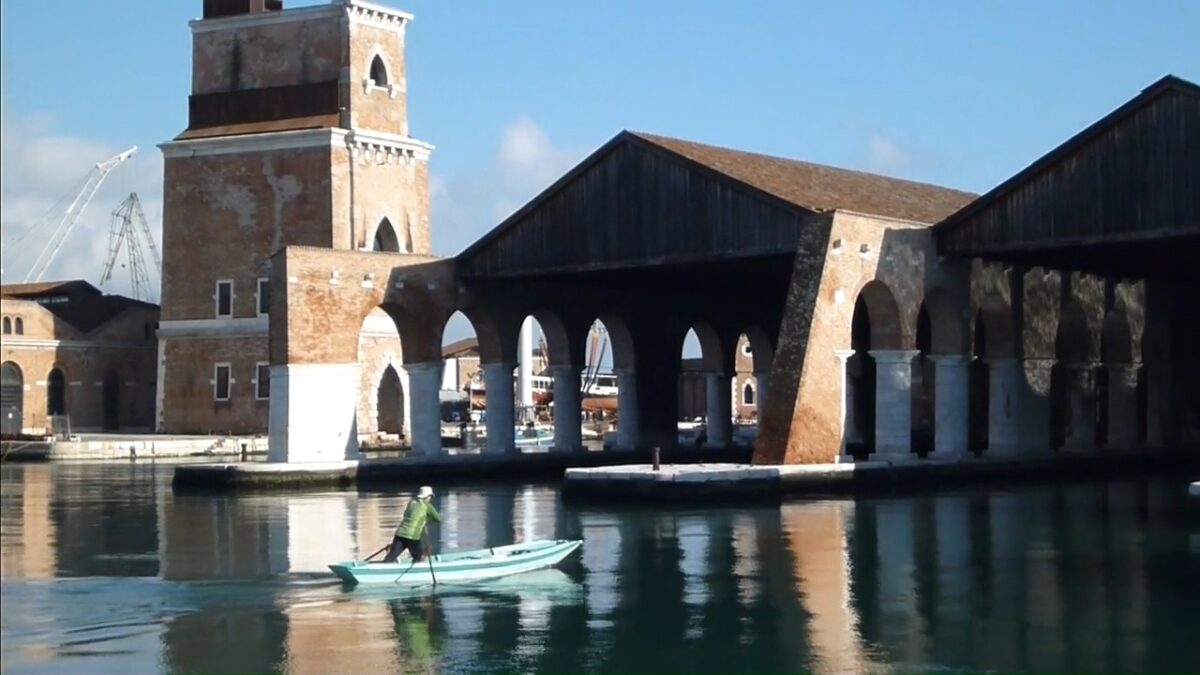
We went rowing inside the area of the ancient navy docks of the Venetian Republic and took some videos. Here’s one of me rowing Venetian style, voga alla veneta, in our small sandolo.
Video by Martina Sola -

A day a-rowing
Last year we bought a small Venetian rowing boat, a s-ciopon, which is one of the smallest traditional Venetian boats. Usually I just fool around in the lagoon near the Certosa island, but yesterday I took it to Venice. I rowed over to the bus terminal at Piazzale Roma to pick up Martina at 19.30 as she was coming back from work, and the with her back home. It was a beautiful tour through the dark deserted canals, and the photos below don’t do it justice, but its what I’ve got. The first photos are taken by myself, rowing with one hand and taking photos with the other. The photos taken after dark are taken by Martina when I’m rowing.Voga – Arrival at S.S. Giovanni e Paolo Voga – Bacino San Marco Voga – Under the Ponte Ca di Dio Voga – Campo Santa Ternita – stupid taxi Voga – Arrival at S.S. Giovanni e Paolo Voga – Rowing the in dark canals Voga – Rowing in the dark canals Voga – Rowing with Stella in the dark canals Voga – Rowing the dark canals Voga – The Canal Grande after dark -

Ancient graffiti
The current entrance to the hospital in Venice originally housed the Scuola Grande di San Marco, an important confraternity and one of the six Scuole Grandi of Venice. In the early 19th century it was turned into a military hospital by the then Austrian rulers of Venice, and later it became a civilian hospital.
The facade dates back to the late 15th century, and is one is one of the marvels of Venetian renaissance architecture.
If one examines the walls of this building after dark with a torch, all sorts of little wonders appears. The stone work is littered with graffiti, most of which are probably fairly old.
Here are some of those I found one evening.
This looks like a 18th or early 19th century ship with several masts. The naval past of Venice is evident.
Another wooden ship, probably a war ship as it has portholes for guns.
Yet another ship, but this graffiti might not have been finished. It looks a bit rudimentary compared to the others.
Here’s a fairly long writing, which I cannot really read, except that it says Venezia at the end.
Some mixed scribbles, including a few years: 1745 and 1872. Of course, a year is just a number, it could have been written any time. There’s also an @ in the middle.
This graffiti is made by a different technique than scratching the stone. It shows at least two gondolas, on with a felze which is a type of cabin that mostly fell out of use in the 19th century.
There’s also a year there: 1670 or maybe 1690.
Here too is a (partial) gondola, but at least the ferro is clear.
A five pointed star, whatever that might mean.