Category: Living in Venice

About my experience of living in Venice

  • Exceptional high tide in Venice

    Exceptional high tide in Venice

    The high tide in Venice today was even higher than forecast, reaching a level of 156cm above the historical average. This is the fourth highest level in the last 135 years. In 1966 the tide reached 194cm, 166cm in 1979 and 159cm in 1986. About two thirds of the city has been under water, with at least 60cm of water on St. Mark’s Square. It should be enough for a good paddle, if only I had been there. The tide was caused by a combination of several independent factors. The normal astronomical tide was only 56cm, but heavy rain in the area which drains into the lagoon and very strong SE winds in the Adriatic Sea caused the tide to build up to a much higher level than anticipated. A low pression zone on the upper Thyrrenean Sea caused heavy rain on central and northern Italy, which then moved towards the north east. On the Adriatic Sea a strong SE wind blew all night, at about 35-40 km/h, rising to 60-72 km/h in the early morning, and it continued all day. The effect of the wind is that the tide enters the lagoon slightly higher than the astronomical tide, but the water cannot return to the Adriatic Sea later, causing one high tide to build on top of the previous. Add to this the rain, and the water level just rises and rises. The first forecasts were for 140cm, which had to be adjusted several times during the day. The municipal tide forecast service has come under some criticism for this ‘error’ but the situation has been quite exceptional and none of the models used were able to forecast this tide correctly. At the entrace of the lagoon at San Nicolò the tide arrived at 160-170cm at its highest. At the time of the highest water level the weather in Venice was quite rough. The population of Venice was alerted throughout the day by voice mail services, SMS services to 10000 subscribers (I have at least 5 or 6 messages on my phone), electronic signs on the motorways, loudspeakers in Piazzale Roma, audible alarms and sirens. At first, based on the initial forecast, the employees of VESTA (the municipal garbage removal company) put out four kilometres of raised walking platforms used in the lower areas of the city during high tides, but they soon had to remove them again. The rising water level caused the platforms to float on the water, with the risk of people falling in the water. After the tide subsided the same people started cleaning up the city, as garbage had been left all over the place. The employees of ACTV, the municipal public transport company, had previously declared a strike, but declined in face of the gravity of the situation. A limited number of boats circulated to ensure communication between the various islands and to pick up people stranded on vaporetto stops and elsewhere. The photos are taken in Venice on December 1st, 2009, by Giuliana Pauletti and Riccardo Sambo. Links:
  • High tide in Venice

    High tide in Venice

    Tomorrow the tide in Venice will be exceptionally high, what they call the acqua alta. Normal high tides are about 80-90cm above the historical average, but a combination of rain and wind will push the tide higher tomorrow, up to around 120cm above the historical average, which means that about one third of the city will be inundated. The weather is going to be rotten, rain and occasional thunder, so it might not be a good day for a paddle in St. Mark’s square. Besides, I’m in Copenhagen anyway, so even if i could go paddling there I couldn’t 🙂
  • Canottieri Diadora

    Canottieri Diadora

    The Canottieri Diadora is the Venetian rowing club where I have been taking voga alla veneta lessons recently. It is a very old rowing club, with a very particular history. The club was founded in 1898 in Zara in Dalmatia, modern day Zadar in Croatia, by a small group of rowers of mostly Venetian descent. Zara had been under Venetian rule from 1409 until the fall of the Venetian Republic in 1797, and a good part of the population were descendents of settlers from the Veneto region in Italy. They called the club S. C. Diadora, which is the Venetian name for the city of Zara. Zara was, however, under Austro-Hungarian rule at the time, and the Venetian club was not welcome in the Austrian rowing federation, so the club had great difficulty participating in races. It took a long strenous battle, but in the end the club managed to become associated with the “Reale Rowing Club Italiano”, after which the S. C. Diadora could participate in national Italian races, and later in international events under the Italian flag. In 1907 the club won their first medals at the internation regattas of Trieste, which was followed by many others in national and international events, including national Italian championships and an bronze medal in Mens Eights at the 8th Olympic games in Paris in 1924. The Second World War put an end to all this. Many club members died in the war, and many others fled Zara for Italy, as the city was all but destroyed. It was the end of the S. C. Diadora. However, in 1961 a group of old members got together in Ancona in Italy, and participated in an event there under the blue/white colours of the S. C. Diadora. The following year a group of Venetian rowers, together with some of the old members of the club in Zara, now living in Venice, met on the Lido di Venezia and reformed the club as the Circolo Canottieri Diadora, with seat on the Lido di Venezia, and the Diadora has been there ever since. Other Venetian rowing clubs gave a hand in establishing a new fleet for the reformed Diadora. As basically a new club, competitive results didn’t come immediately. In the 1960s results were few, but things got better in 1970s and 1980s, with many regional and some national wins. The activities were extended to racing kayaks in the early 1970s, and more slowly, to voga alla veneta.

    The first Venetian style boat in the club was a veneta a quattro, which was given to the club by the rowing club of the railway workers. Not a competitive boat, it became nevertheless a means of training, and in 1973 the Diadora won the Historical Regatta in a veneta on load from the Querini rowing club in Venice. The Diadora team consistently won the Historical Regatta for several years in a row. One of the members of the team was Lino Farnea, who still coaches rowers at the Diadora at the age of 70. The mid-70s was a time of revival of voga alla veneta in both Venice and on the mainland. The Vogalonga, started in 1975, was a part of this revival. Many of the city’s rowing clubs gradually switched their focus from English style rowing to Venetian style rowing, and so did the Diadora. Consequently, at the Diadora it is now possible to row English style, kayak and row Venetian style, both competitively and recreationaly.

    The Diadora now has a fleet of several mascarete, a gondolone and a caorlina, and has access to the municipal fleet of racing boats for use in the municipal regattas which are held at various places in the lagoon each summer. Lino Farnea is coaching still at the Diadora, and also at the Scuola Navale F. Morosini at Sant’Elena, and he is often a referee at the municipal regattas.
  • Vogando a poppa

    Yesterday I had my first real lesson in Voga alla Veneta, the Venetian style of rowing standing up. I went out with Lino, one of the coaches at the Canottieri Diadora on the Lido di Venezia, in a mascareta like the other two times I have tried it. The first two times I’ve tried to row Venetian style, together with Enzo, I was always in the front position, a prua, and I automatically went there again, but Lino sent me to the stern, a poppa. The stern position is more difficult because the rower a poppa is in charge of steering, and therefore has to know various maneouvres to turn left and right, do sideways movement, turn on the spot and much more. Before we started, Lino changed and adjusted my forcola. Now, if anybody suffered from the belief that the forcola is just a piece of wood to hold the oar in place, they’re wrong. Adjusting a forcola is a fine art. The lower part of it doesn’t just fit into the holes on the side board of the boat. The holes are too large, and wedges had to be hammered in to keep the forcola in the desired position while rowing. By placing the wedges differently, the forcola can be made to lean outwards or inwards, forwards or backwards, and be placed at different heights. I can’t remember all the details, the explanation came rather fast in Venetian dialect, but outwards leaning gives better control but less speed, inwards leaning less control but more speed. Forward leaning was for racing. Being a beginner mine was outwards leaning, and rather high, as I’m taller than most of the locals. We started rowing in two, but fairly soon Lino just sat down watching me. He corrected a lot of little details of how I stood in the boat, how I shifted weight back and forth and how I held the oar. This was more or less what I had expected, as Enzo had asked Lino to teach me the correct position for rowing Venetian. However, without Lino rowing on the left side of the boat, with me rowing alone on the right side of the boat, we started going in circles. Its like doing only sweep strokes on one side in a kayak. There was a bit of wind, and like a kayak the mascareta wants to turn into the wind, ánd with the two things combined there was very little control of where the boat wanted to go. Lino then started to teach me a return stroke used by the gondolieri to keep the boat on course. I believe it is called a stagare, or stalìr, and it turns the boat to the right, but it is made as the blade returns after a forward stroke. At first I didn’t understand what the stroke was supposed to do, and consequently I performed miserably, but as understanding grew it got better, and after a while I could, with a lot of concentration and quite a few cases of dropping the oar from the forcola, mostly control the direction we were going. The stroke he taught me is rather hard to describe. On a normal forward stroke you put the blade in the water in a vertical angle, the lean on the oar, turn your wrists and the end of the stroke, and when moving your weight back on the back foot, the oar returns forwards with the blade parallel to the water, either out of the water or sliding through at the surface. A forward stroke with no correction will send the boat turning left in a small circle, and in fact it is not called a forwards stroke in Venetian, it is called a premere, pushing. The stroke to keep the boat going straight or even right, is made on the return movement, which is inactive in the simple forward stroke. Instead of turning the blade parallel with the surface on the return, it is turned a little bit more, so it bites into the water, while applying a downwards pressure on the oar handle with the left hand. It works a bit like a rudder but with the oar more horizontal than vertical. It has to be made very delicately to work. The angle of the blade, the pressure on the handle and the return movement of the blade has to be precisely coordinated and carefully measured, or the oar will drop from the forcola. The forcola gives a firm base for a forwards stroke, but when applying pressure on the return there is only a tiny little tap to keep the oar from dropping out, so the downwards pressure is all important and has to counter the downwards movement of the blade in the water precisely. It took me at least half an hour of deep concentration and many mistakes to get some kind of grasp on it, but at the end it was a great sensation getting the feeling of controlling the boat, even with this very alien style of rowing. Just as I started to feed I had it, my performance declined, the boat veered and I kept dropping the oar. In my eagerness and concentration I had forgot time, and I had been rowing for at least 45 minutes alone and I was very tired. After maybe an hour on the water, we rowed to boat back in unison, which was suddenly so incredibly easy compared to rowing the boat alone. When I jumped on the bridge back at the club, my legs shook under me. I was that tired. I’ll be hanging around Venice for at least another week, so there should be time to do a few more lessions of Voga alla Veneta. For now, I have an appointment on monday morning, still with Lino.
  • Vogando

    Vogando

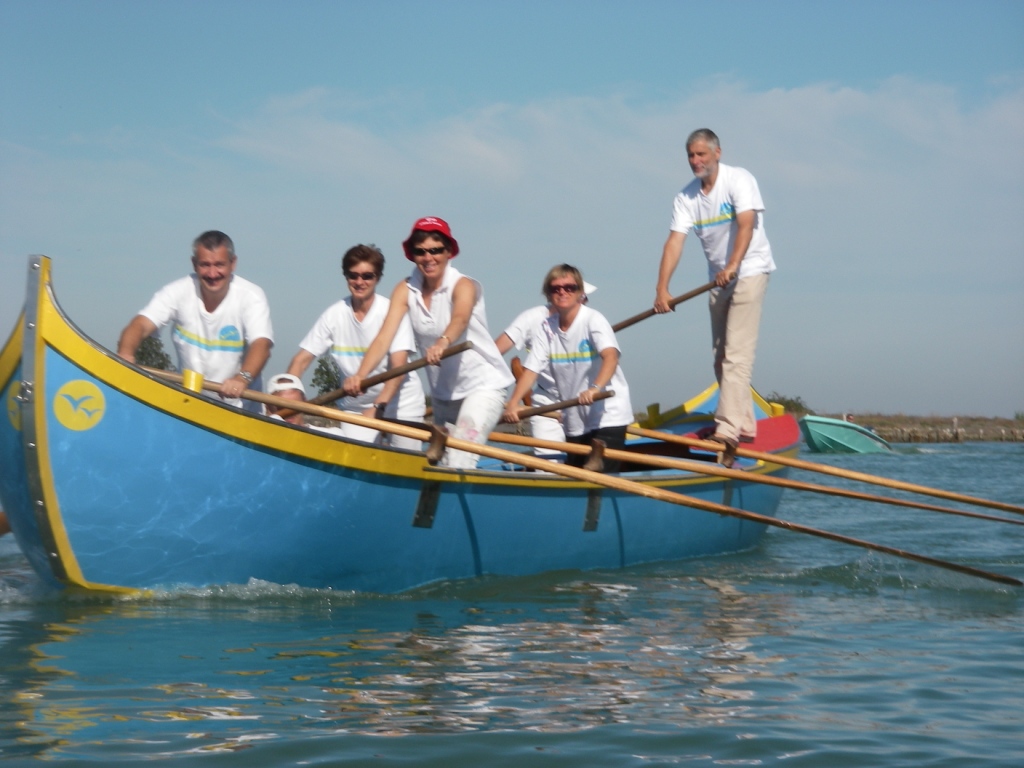
    My little voga alla veneta adventure continues, at a slow but accelerating pace. I haven’t had a chance to try it again as work paddling around Venice with tourists have taken almost all my time, but today Enzo gave me a call and asked if I wanted to try again today. I threw down a quick lunch, way to quick to be decent here in Italy, jumped on my motorbike and sped down the Lido to the “Canottieri Diadora” where Enzo rows. I arrived at the club just as Enzo was coming back in with another newbie. He jumped out of the mascareta and I jumped in, and off we went. Even though I have only tried it once before, the basics I learned last time returned immediately: the position of the feet, the hold on the oar and the twisting movement of the wrist to release it from the water without dropping it from the forcola. We rowed south towards the little island of Poveglia, which I passed only a week ago with a group of Danish paddlers. Poveglia has a past as a lazzareto, which is a place where ship crews were put in quarantine if decease was suspected aboard, and the ruins of the hospital is still there, though in a rather poor state. Poveglia is cut in two by a small canal, and we stopped there to have a look. Most of the buildings are overgrown, and bits and pieces of hospital equipment are still lying around under the vegetation, though anything of value has been taken away ages ago. On the other side of Poveglia we met Angelo, also from Canottieri Diadora, obviously having a break, sitting down on his mascareta. After a short chat he agreed to join us on the return trip, but since he was rowing alla valesana, with two oars crossed, he was faster than us. My lack of rowing skills might also have been a factor 🙂 The whole process of rowing standing is working better now, shifting balance from one foot to the other, as the weight is used to push the oar through the water, coordinated with arms and wrists to control the entry, passage and release of the blade from the water. Naturally, I still drop the oar from the forcola regularly, but I did manage to do some decent stretches with a decent efficiency without looking completely silly all the time. Back the the club we took the boat out of the water, using an electric crane, and washed it well. Shortly after, one of the club’s instructors came in, and he gave me an appointment for tomorrow morning at 8.30 for a proper lesson in voga alla veneta. Now I only need to learn the dialect and buy a pair of flashy sunglasses, and I will be absolutely indistinguishable from the natives 🙂
  • Voga alla Veneta

    Voga alla Veneta

    Today I’ve had my baptism at Voga alla Veneta. I went with Enzo, who has a small garden near the Camping San Nicolò where I stay, to the Circolo Canottieri Diadoro to try to row a bit with him. I had about half an hour on the water with Enzo, before his next appointment showed up. The boat was a Mascareta, which is a fairly small boat made for two oarsmen. Here are a few pictures of Enzo getting the boat ready, fitting the forcole and finding the right oars. Voga alla Veneta is like kayaking a full body exercise. You have to stand in the right way in the boat, feet in the correct position, oar turned the right way relative to the water, and then push with your arms while moving your upper body forwards a bit and shifting your balance from the back foot to the front foot. At the same time, during the push, you have to turn your wrists in the right way at the right time, so you extricate the blade from the water, allowing you to the return body and blade to the starting position, without having the oar drop from the forcola. Dropping the oar from the forcola is a common problem for beginners, and I had my problems too, though not as bad as I had feared. The forcola only supports the oar fully in the push phase, and in the return phase you have to be very careful not to have it fall out. Both forcole can be seen on this photo, when Angela was getting into the boat after me. In a Mascareta the more skilled rower is always in the back, steering and controlling. The front rower only has to keep a constant, regular forward stroke, while the back rower does all the interesting stuff. This is also the explation of the difference between the two forcole. The right forcola has more points of support because it is used for much more, while the left forcola is only for forward strokes and breaking. Standing up in the boat was very awkward in the beginning, but as I started to concentrate on getting my forward stroke right and not dropping the oar, it became a secondary issue, and it wasn’t really difficult. The important thing is not to move your feet unnessarily. As long as both rowers keep their feet in the same position, there will be no sudden shifts of balance. Unfortunately, I have no photos of myself in the boat – or maybe I should say fortunately 🙂 – but here are a few pictures I took of Angela and Enzo as they set out for their afternoon vogata.
  • Voga alla Veneta

    Voga alla Veneta

    Tomorrow will be the basis of another anniversary. I have just made an appointment to have my first lesson of Voga alla Veneta, or rowing Venetian style, tomorrow.
  • The Redentore Feast

    Tonight is the night of the Redentore feast here in Venice. We’ll take the bus to the city, where we’ll meet my friend Marco and some of his friends on a sail boat to watch the fireworks. We’ve never seen the Redentore feast before, so its probably going to be quite interesting. It is one of the really big annual celebrations here in Venice. There’s little chance of ever witnessing this feast from a kayak, as the boat traffic in the area is intense and highly regulated. Tradition dictates that you take part in the feast in a boat if at all possible. Tomorrow afternoon the Redentore regatta is held, but I’m not sure we’ll be here for that. We will probably be on our way to Elba then.
  • Life at the Lido

    So today I’ve spent most of the time sitting at Café Maleti on the Gran Viale of the Lido, updating blogs and doing email. Life is hard, but they do make good coffee and food, and absolutely great icecream.

    Voga al veneta in a Caorlina
    Voga al veneta in a Caorlina

    Then I have to stand the pathetic view across to the lagoon to Venice each and every day on my way to the ‘office’ at Bar Maleti. I don’t know how I can stand it, but I guess when you have no choice you learn to cope.

    We’ve got a few new sponsors for our journey. ODLO has sent us a package of underwear, Tec shirts and jackets. Wendy will bring it with her to Venice later. North Water has sent Wendy a large package of deck bags, tow lines and other good stuff, including a huge mesh duffel bag Wendy seems to be in love with :-). Last, Hilleberg, the Tentmaker, has given us a very good discount on a good size light weight tent for the journey.

    Now, for the rest of the day, I think I will go back to the camping, and go paddling for the afternoon. A good paddle up Sant’Erasmo to Burano and Torcello wouldn’t be bad for a sunny afternoon on the Lido. In the evening I might go to the local trattoria for a pizza.

  • Camping San Nicolò

    Camping San Nicolò

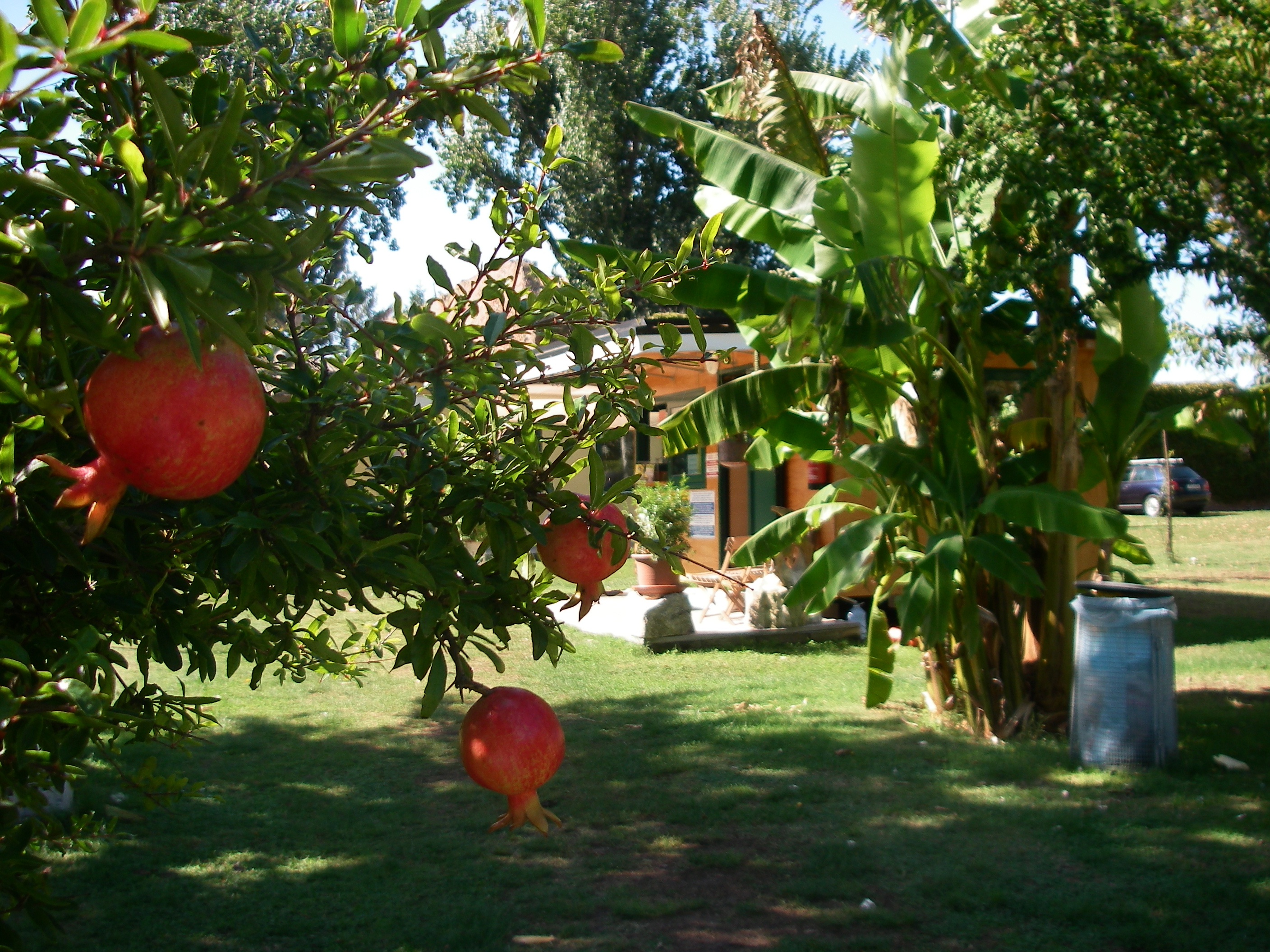
    I’m still stuck in Venice waiting for documents and credit cards so I can continue my journey. Naturally, it’s a downer being stuck somewhere when you expected to be somewhere else, but there are worse places to be stuck than on the Lido of Venice. Camping San Nicolò, bar and reception with banana palmI’m staying at the Camping San Nicolò at the northern end of the Lido. While it is formally only a one star camping, it is still one of the very best camping sites I have ever stayed in. The owner, Paolo, and his assistants Tatiana and Natasha are all smiles and helpfulness, and the site itself is more like a garden than a camping. There are pomegranates, bananas, grapes and a plethora of other plants I can’t recognise. Camping San Nicolò, pomegranate and bananaThe sanity facilities are basic, but always clean. There’s a fridge free to use, a large tent to sit in, a little bar for a coffe or a drink. They rent out bikes for a few euros so it’s easy to get around on the Lido. Often the little things make a large difference. It is such a luxury taking a shower without having to worry that the time will run out just has you have shampoo in your hair. When living in a tent, having a fridge in the camping is huge. It means you can buy milk and cheese. Having stayed there for over a week I haven’t got one bad thing to say about the place. It might have just one star in the public books but it has five stars in my book.

    Camping San Nicolò Camping San Nicolò Camping San Nicolò, my tent and tarp