The City of Venice did it again, and issued a ban on kayaking in Venice active from August 1st, 2018. Venice Kayak took the city to court, and won, so the ban is overturned for the time being.
The rules for paddling in Venice city will be moderated from April 20th.
The new rules were decided by the city executive on April 3rd, published officially on April 9th and they’ll be executive ten days after publication.
The kayak/canoe/dragon/sup ban in the Grand Canal and other canals will be reduced to the hours 8am-3pm on weekdays and 8am-1pm on Saturdays. On Sundays and holidays there are no limits.
There’s a series of minor canals designated as “blue” canals, reserved for non motorised boats, running north to south through the city centre, and it will be allowed to cross the Grand Canal in proximity with these “blue” canals, giving precedence to all other traffic, even in the hours where normal navigation on the Grand Canal is banned. In this way it is possible to move about the city also before 3pm on weekdays.
All the rest of the city is available for paddlers at all times.
The new rules seem to indicate that it will be obligatory to carry at all times (also by day) a white light, visible at 360°, to be lit between sunset and sunrise.
The ban has not been lifted completely, but changed from a blanket ban on certain canals to a system of time limits, which is not really different from what gondolas, taxis and goods haulers also have to abide by, so I don’t think we can really complain. We’re not treated worse than other categories of traffic in the city.
The City of Venice has issues a wide ban on kayaks, canoes, SUPs, dragon boats and more.
Yesterday I had a meeting with a representative of the municipal government, sufficiently high up in the hierarchy to be able to influence municipal policies. While the meeting itself was rather inconclusive, there was a recognition that there is a real problem to solve, and another meeting will be called later, with both politicians and technicians present, in an attempt to find a solution.
The proposal from the municipal administration is to ease the ban a bit, allowing free passage for everybody after 5pm on Monday to Friday, after 1pm on Saturdays and all day on Sunday.
We have no idea whether they’ll stick with this or if we can still make suggestions. We will no doubt make our suggestions.
For Venice Kayak the proposed modifications will be worth very little. We will have to move our longer tours to later hours, and the viable season for longer tours will be cut from 7-8 months a year to 3-4 months, if we are to avoid returning after dark.
Venice has issued a ban on kayaks, canoes, dragon boats and more, which is effective from Sunday, March 1st.
Currently it is illegal to go by kayak, canoe or dragon boat on the Grand Canal and several other canals in the city.
As a consequence, the city’s canal network has been cut to pieces, from a kayaker’s point of view, where it is not longer possible to go from one part to another.
Today I have had a meeting with the city official who have signed the new regulations, and it was not as bad as I had anticipated.
As things stand now, the ban is there and it is an offence to even paddle across the no-go canals.
However, the city administrators have finally understood that they have made a mistake by issuing a blanket ban like they have. Being unable to turn back, there will be a modification to the new rules, which will give kayaks, canoes and dragon boats more room so it will be possible to move around the city in a reasonably rational way.
In short, there will be some points on the no-go canals where passage will be allowed, most notably on the Grand Canal. There will be some limits on when you can pass, it’ll be mostly in the afternoon, and maybe even on who can pass, for example a requirement that there is a qualified coach in a group of kayaks.
It is my hope that they will also allow passage, at least in the afternoon, on parts of the lower Canal Grande, so we can still visit the ancient gondola shipyards in the Dorsoduro area, which will otherwise be unreachable.
While this will not be a perfect solution, it will be a marked improvement on the no-exceptions-allowed ban they have made for now.
Bureaucracy
The current rules banning kayaks etc from the Grand Canal and more, are not made by the city administration alone, and the city administration cannot therefore change them alone.
The changes from February 11th were published after a meeting of what they call a conferenza dei servizi, where all the different public bodies meet to coordinate.
A change to the new rules will have to pass the same way. This means that there will be a meeting on March 12th, where a commission will meet to prepare everything for the next meeting of the conferenza dei servizi, where a change can be formally decided.
Once we get there, we’ll know what they’ll come up with.
I do not know the date of the next meeting of the conferenza dei servizi, but I’ve been told that they’re normally held once a month.
Legal Challenge
The legal challenge to the kayaking ban in Venice will not stop before the city administration publishes what exactly they intend to do, and they cannot do that before the meeting of the conferenza dei servizi has met, and at than point they have also decided.
There will be no public hearing, beside the kind of privately requested meetings with city officials, like the one I had today.
The Arcobaleno association has no intend of backing down before they know what the new rules will be, so the process will go forward.
The collection of funds in support of the legal challenge continues.
The meeting
My appointment today was on behalf of my company Venice Kayak, so I did not represent anybody else there.
Besides explanations about what we’re doing — kayaking excursions in Venice lead by qualified guides, and not any kind of rental to whoever shows up — the discussion was mostly about what kind of modifications we would need to be able to continue our work.
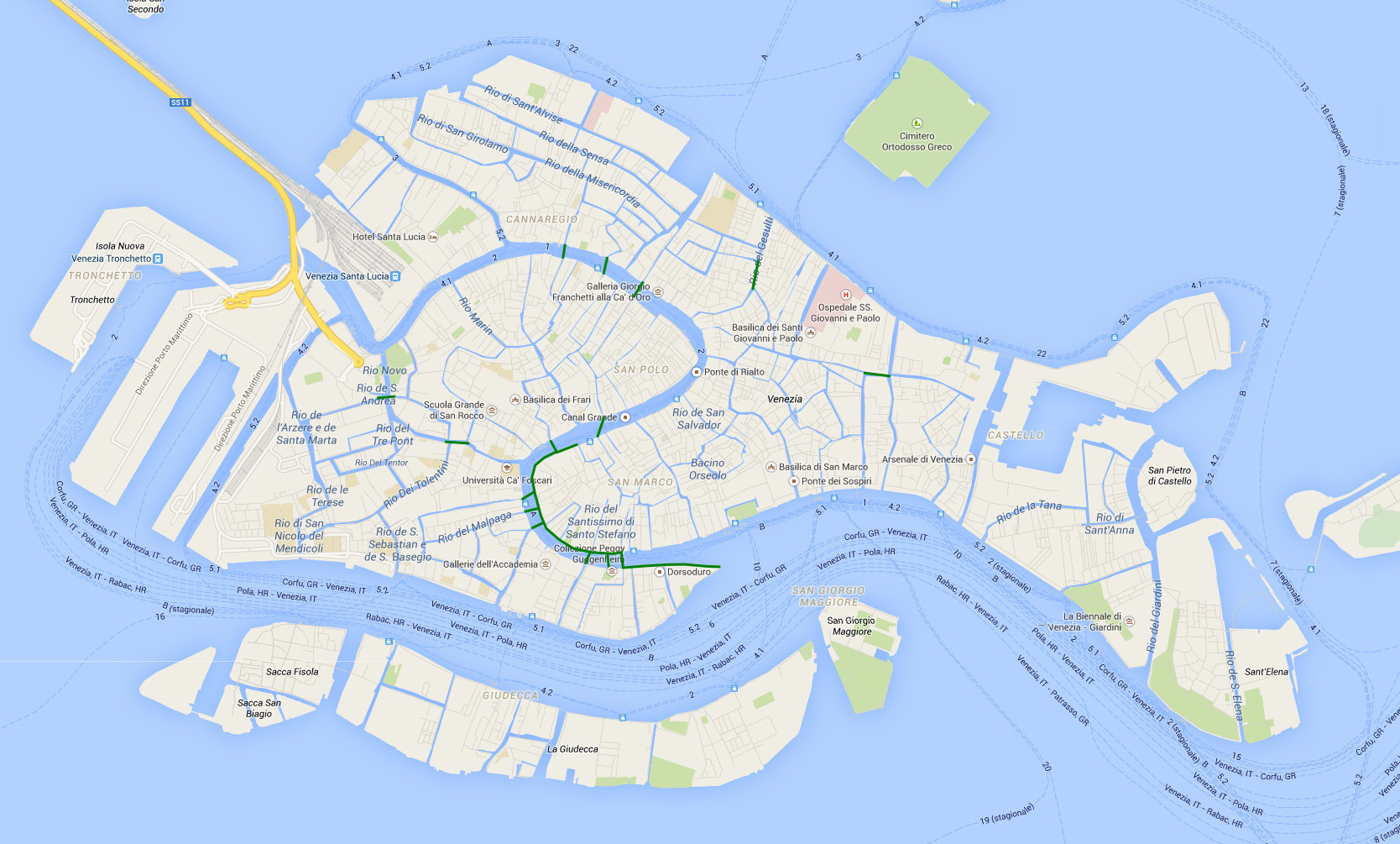
This maps shows the ‘dispensations’ we’ll need to be able to carry on in the way we have done now in seven years, without accidents or conflicts.
Summarised we need
a few passages on inner city canals to connect the otherwise detached segments of the city’s canal network,
some predetermined points where we can cross the Grand Canal, on each of the three parts of the canal, and
the possibility of transiting on a part of the lower Grand Canal to reach otherwise unreachable areas.
For now we’re crossing our fingers, hoping for the best.
If the city administration cannot come up with a working solution for us and the other paddlers in Venice, we will have no choice but the throw all our effort at the legal challenge the Arcobaleno association is preparing.
All of these groups, together with the Italian Federation for Canoe and Kayak (FICK) and other organisations, are trying in various ways to counter this blanket bans of most paddle crafts in Venice.
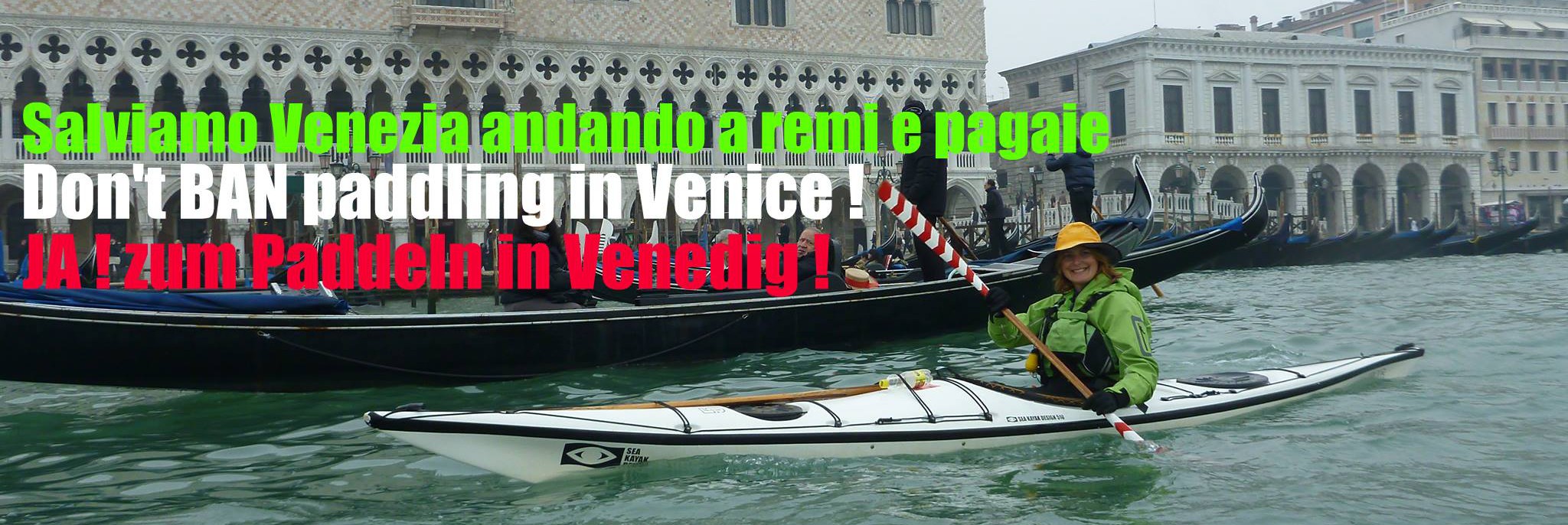
A lot of discussion is going on the Facebook group called Salviamo Venezia andando a remi e pagaie.
Most of the discussion is in Italian, but it is open for all interested parties. I try to put in something in English every once in a while, but I’m neither the creator nor an administrator of the group.
Arcobaleno is one of the oldest kayaking clubs in the wider Venice area, and they have been active for many years.
A PayPal account, ricorso@arcocanoa.org, has been set up to collect funds for the legal battle ahead. The needs aren’t huge, all in all, around €3000 will be needed, but it is more than the club and its supporters have.
Even contributions of €5, €10 or €20 will be a help in the fight to keep Venice open for paddlers.
The City of Venice has published a modification to the city traffic rules, which bans kayaks, canoes, dragon boats and others from navigating certain canals.
The relevant text is this:
Nei Rii principali interni di collegamento: Canal Grande, Cannaregio, Giardini, Greci – San Lorenzo, Santa Giustina – Sant’Antonin – Pietà, Noale, Novo, Ca’ Foscari, Santi Apostoli – Gesuiti, è vietata la navigazione dei natanti denominati jole, dragon boat, pattini, pedalò, canoe, kayak e tavole a vela e/o a remi.
It lists a series of city canals where “navigation is prohibited” for a series of paddled and rowed types of boats.
Navigation is prohibited
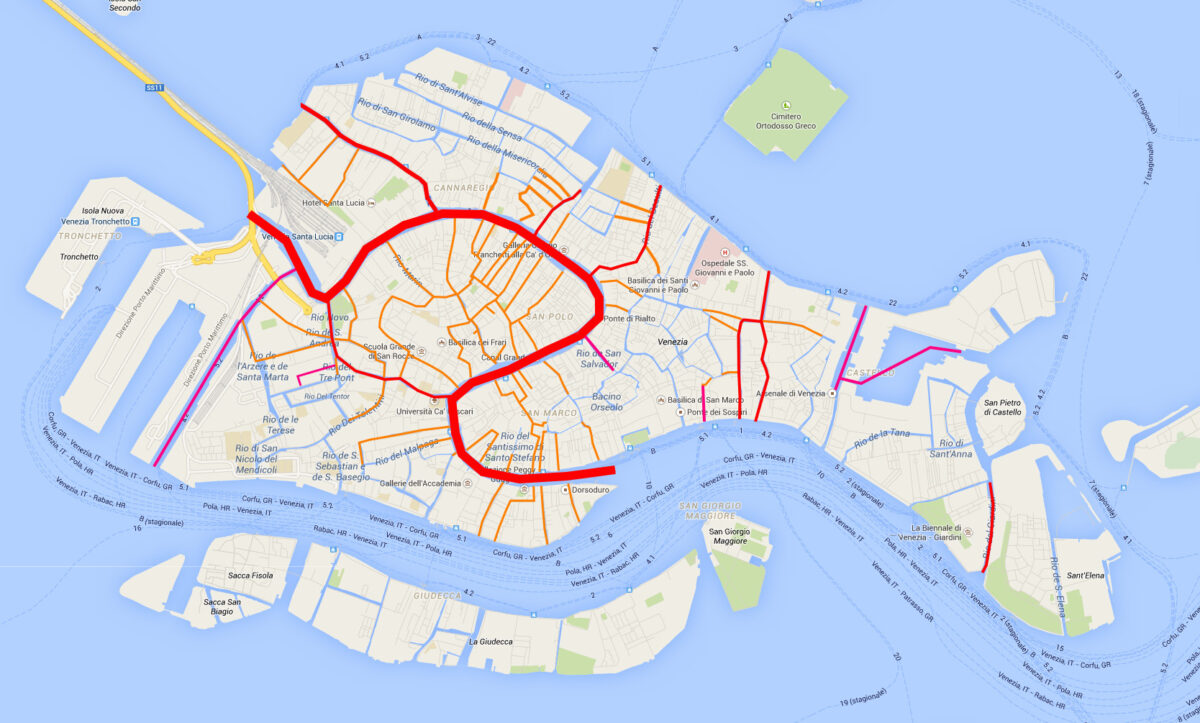
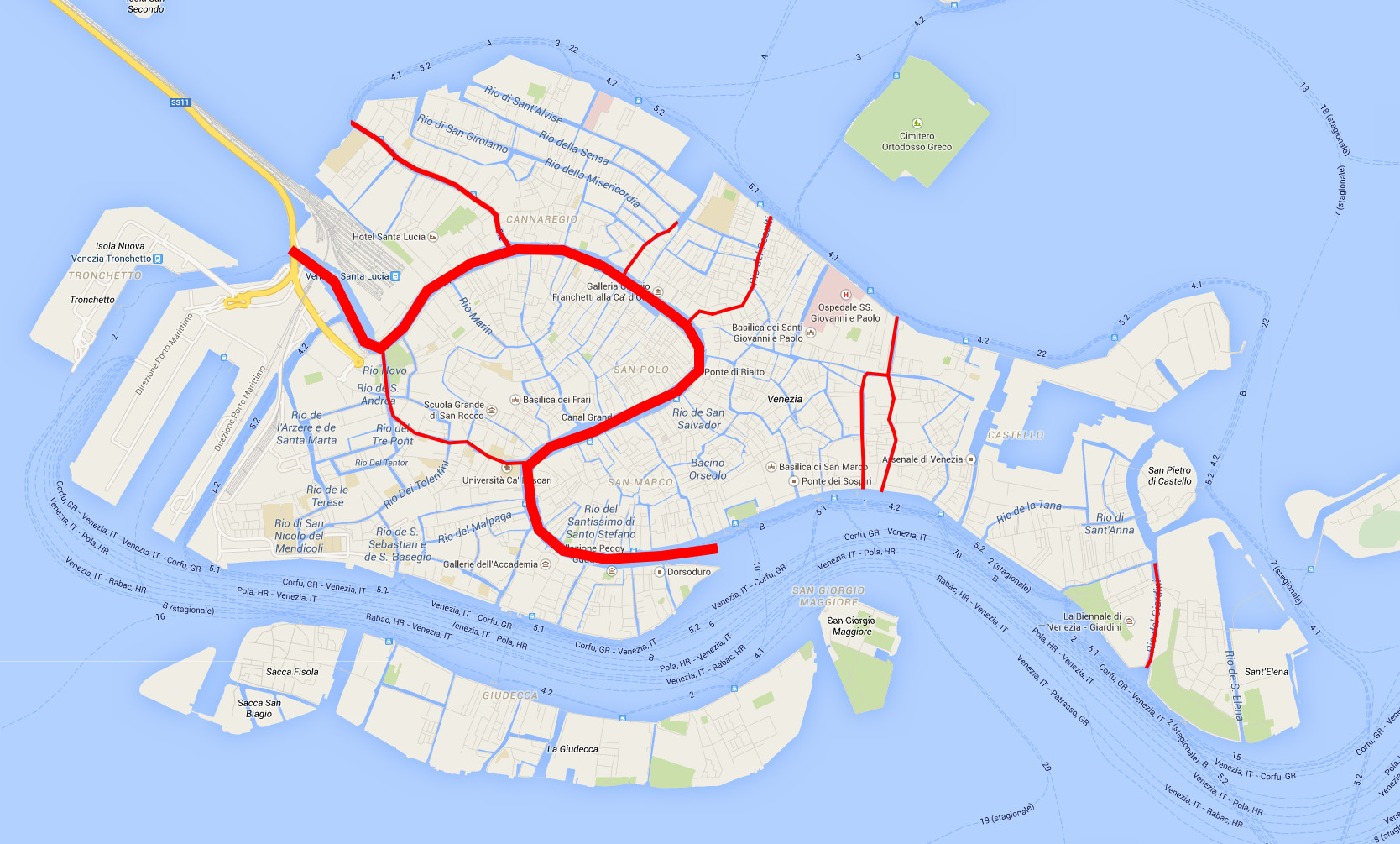
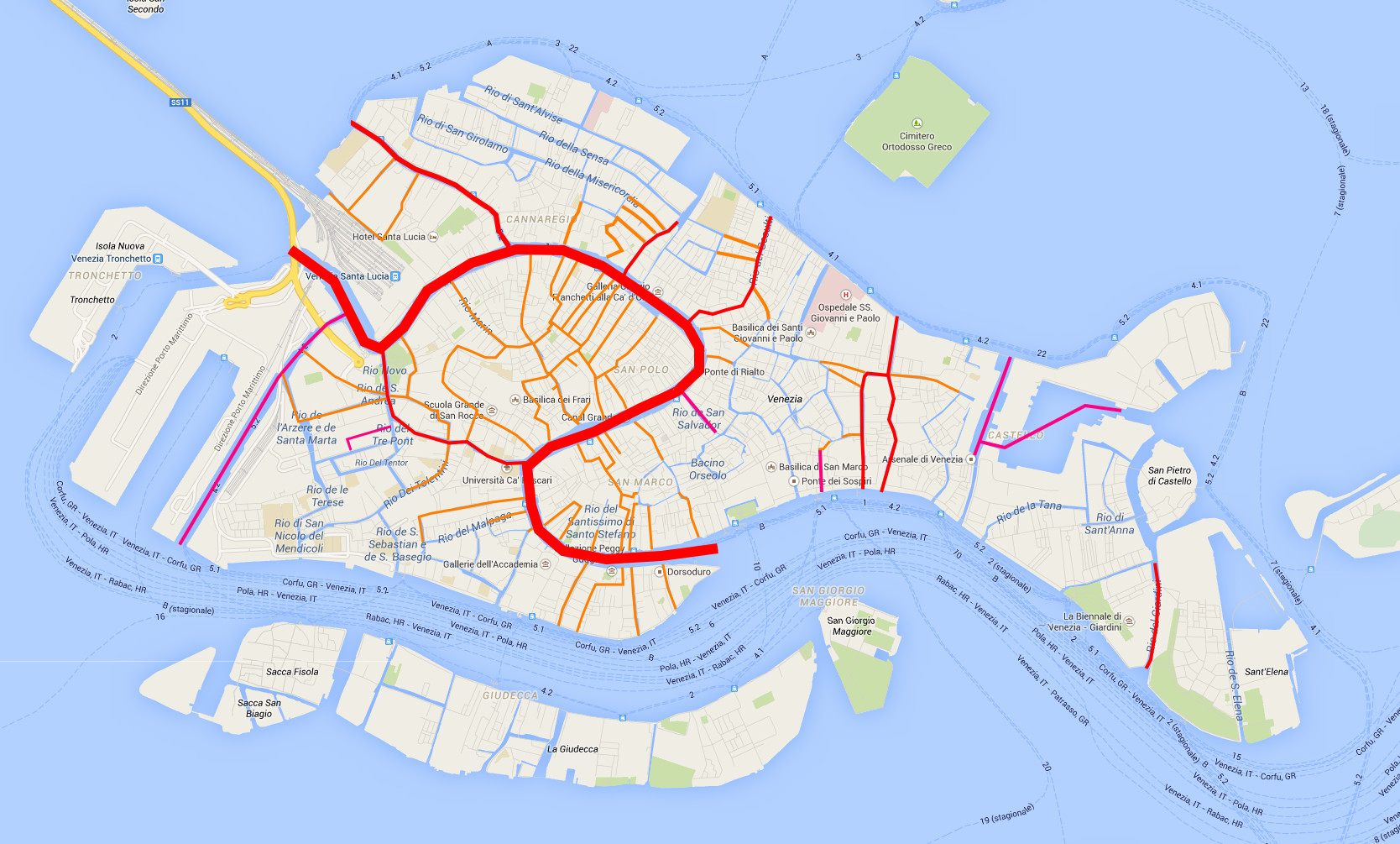
The canals in question are these, coloured red.
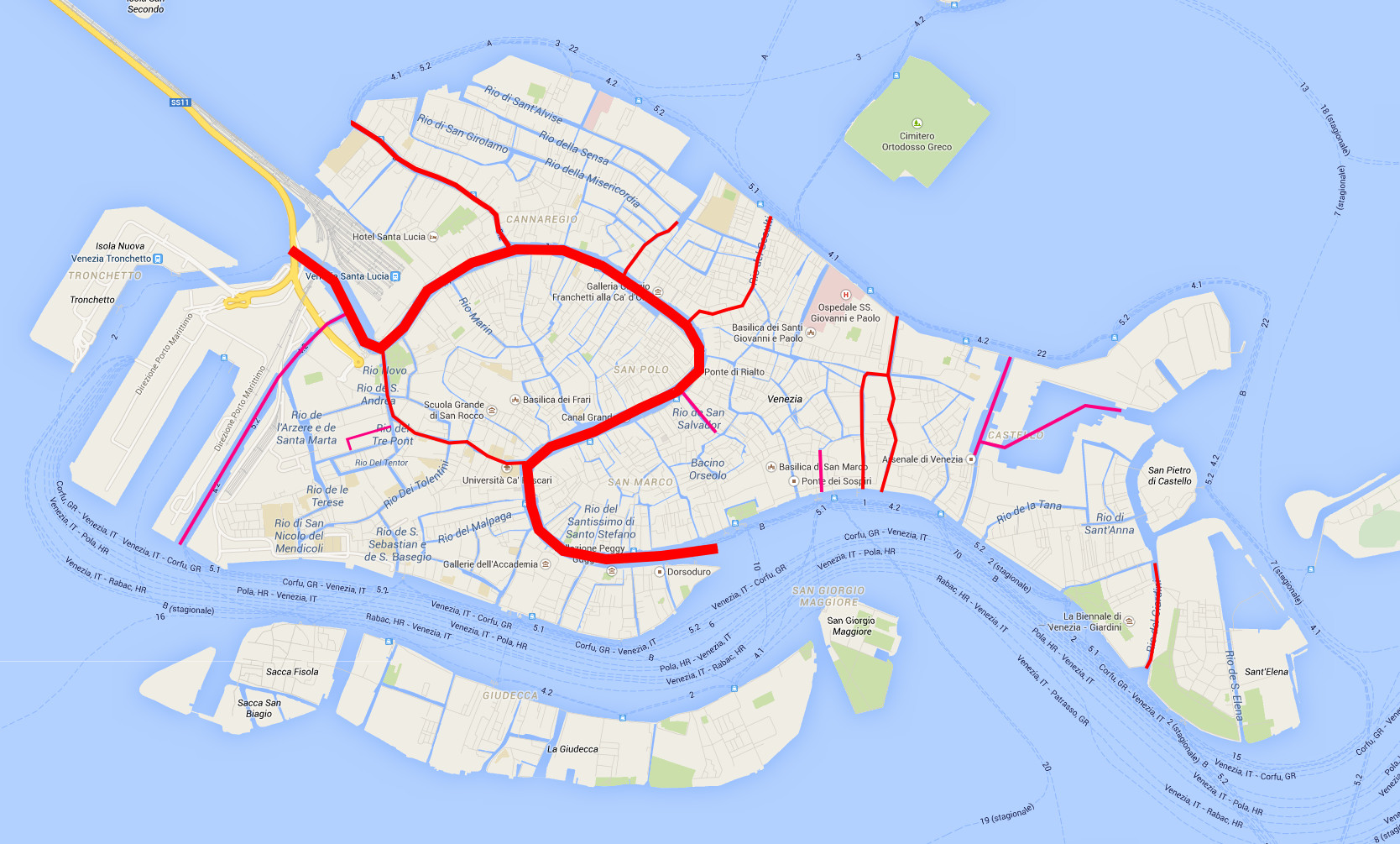
Now, besides the Grand Canal it doesn’t look excessive. There are a few other restrictions on traffic, not specifically targeted at kayaks and the like, for military areas, heavy traffic, or dedicated areas for the gondolas.
With these added (in violet) the map of the no-go canals become:
The canal network in Venice is Medieval in origin, and anything but regular. Some are very interconnected, others are detached from most others. A lot of very narrow canals lead down to some of the no-go canals, so if you went down there in a kayak, you wouldn’t be able to get out legally.
Therefore, the ban is for more than just the listed canals. The de facto banned canals are added to this map in orange.
Now, that’s a good deal more.
If you enter one of these nominally ‘legal’ canals, you won’t be able to get out again, unless you paddled backwards through a narrow, winding and possible busy canal.
The above map is made under the assumption that “navigation is prohibited” in the canals marked in red, which would mean that you can’t even paddle across.
If the city were to allow crossing of some of the no-go canals in some places, the map above would have to be changed, but with the current wording of the regulation, it will not be possible to go in kayak in any of the canals on the map above, which are marked in red, violet or orange.
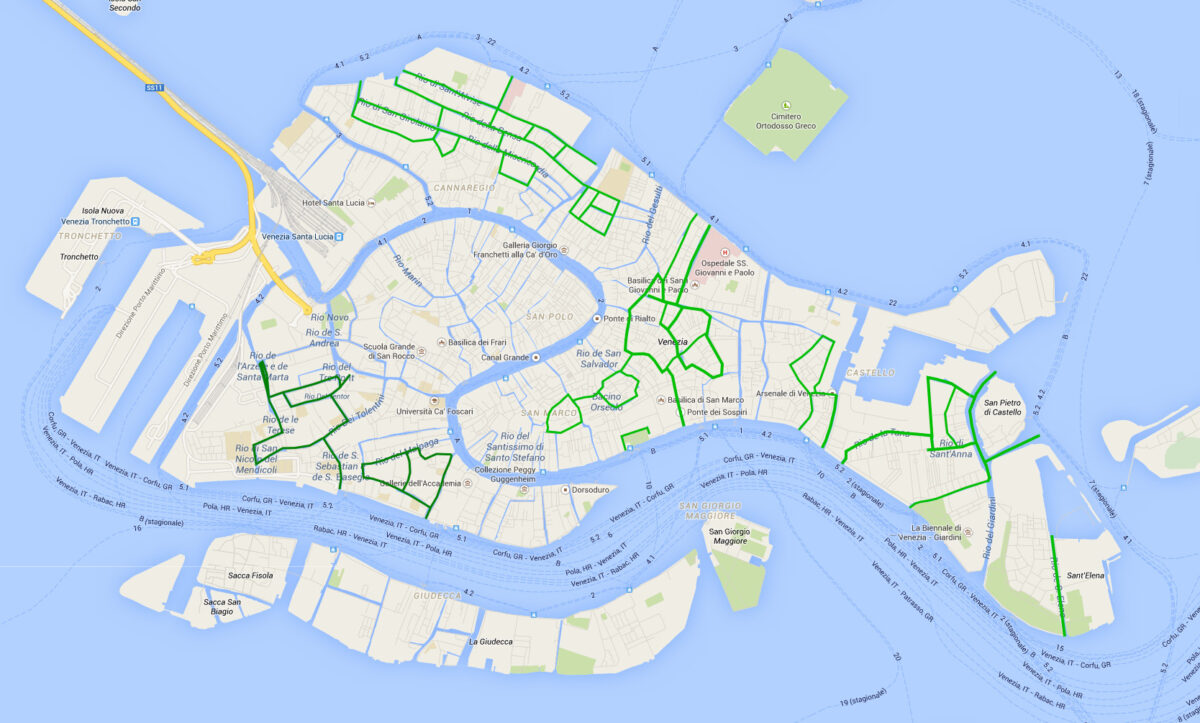
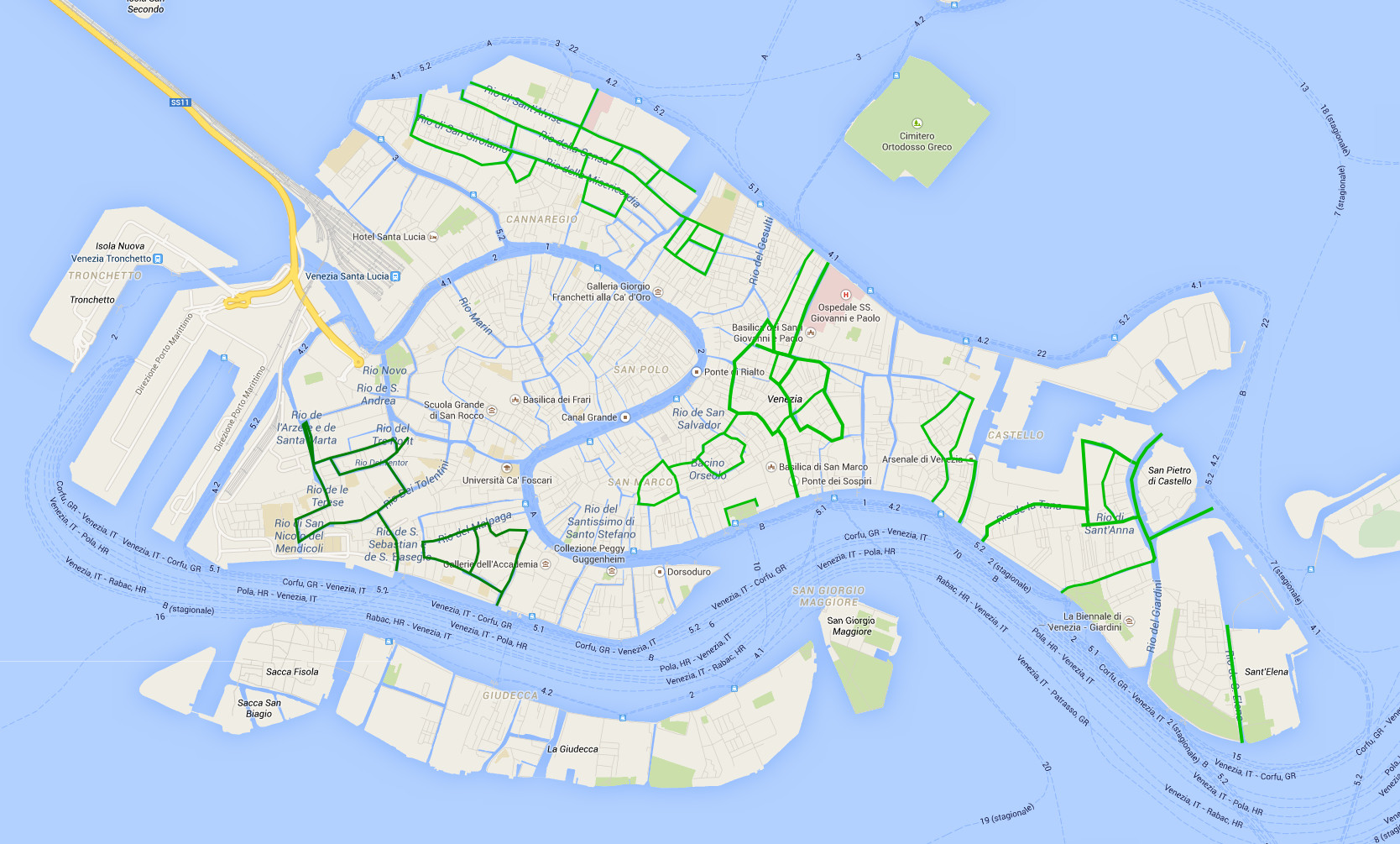
I realise that it is hard to see from that map where you can actually go, so I have made the reverse map which shows in green the canals where you can go in a kayak and still have a legal way out.
As is apparent, after the introduction of the new regulations you can only paddle in a few separate and non contiguous areas of the city.
As before, this map relies on a strict interpretation of the wording of the new regulations, where we’re not allowed to traverse any of the no-go canals.
There are six distinct zones, where you’ll need to get out of the city canals, potentially in some very busy waters, to get from one area to another.
Safety issues
The two areas in Dorsoduro (marked in a darker green) are only accessible through the Canale Giudecca, which is where the big cruise ships pass. It is a very busy canal, and not safe for even intermediary level kayakers.
To move from the eastern part (Castello basso) to the central part around San Marco, it will be necessary to cross the Bacino San Marco, which is likewise very busy. Besides a large number of water buses and taxis, this area is also full of large tourist tour boats, which moor there for boarding and disembarking. Paddling through there will too require a good deal of skill and nerves.
And let’s remember the new rules are introduced for safety reasons.
To keep us and everybody else safe, they send us out in the middle of the busiest parts of the city. And not just busy, but busy with far larger boats that are ever allowed inside the city, even on the Grand Canal.
Curious as to why they have decide this? Look here.