Category: General Silliness
-
Highway holidays
I’ve spent today exploring a few North Italian motorways. The A4 from Venice towards Milan is nice and spacious, but it was much too wet for my taste. It rained on and off for most of the time, and the lateral decorations are mostly urban and industrial in nature. All in all practical but not very inspiring or pleasing to the eye. The A21 was better in many ways. It was definitely warmer and dryer, with mostly sunshine and very little rain. On the negative side, it is rather narrow, only two lanes, and the lorry drivers seemed very chatty, insisting on driving side by side, thus slowing down both lanes. The lateral decorations were non-descript, mostly cultivated fields. All in all not an unpleasant experience but neither one than remains with you for long. The last motorway was the A7, which was completely different. It was nice, dry and warm. Still narrow, but the lorry drivers seemed more focused on their own affairs, and definitely less chatty. The best part was the side decorations. I must say, this is one motorway where they had thought about the surroundings, striving to create a complete experience and not just trying to be functional. The motorway curved in and out between small forested mountains, delightfully interspersed with little towns and traversed by small streams. It was a pleasure driving there, and in the end it didn’t matter much that the curves forced us to go slower. Italian traffical creativity at its best. More motorways like the A7 I’d say. So, if you have plans of spending your summer holidays on the Italian motorways, I can heartily recommend the A7. It was by far the best experience of they day. Now, I don’t know why anybody would want to spend their holidays on the motorways, but people seem to do it a lot, and who am I to judge. Share and enjoy. -
Skim Dipper
I just noticed that Skim Kayaks have a new model out, the Skim Dipper. They haven’t put up much information about it yet, except that it is 536cm long (17ft 7in) and 51.5cm wide (20.3in). There are some photos linked from the front page. It seems to be a middle thing between the Skim Dex and the Skim Distance, in the sense that it looks a lot like them on the photos and the dimensions are somewhere inbetween. I think it will be a welcome addition to the Skim family, suitable for those who want a more spacious boat than the Dex, but find the Distance too long to handle. Here in Italy the Distance has another problem, which has to do with its handling on cars, not on water. Italian transport regulations only allows cars to transport objects shorter than 130% the length of the car, which means that to put a Skim Distance of 588cm on a car, the car must be at least 453cm long. Most Italians have shorter cars than that, so a Skim Distance is simply not an option here for most people. They can’t take it anywhere. The Skim Dipper might well be (if only you could get a Skim kayak here in Italy, which you can’t). I’ll have to see if I can get to try one in Copenhagen next month or at the Stockenträffen in late August. Photo from Skim Kayak’s web site. -

Venice by bicycle
I have bought a bicycle here in Mestre, and the other day I went to Venice by bicycle, and from there to the Lido. While it can be done, I’m not so sure it is advisable.

Driving a bicycle here in Mestre is great. There are bike lanes all over and it is easy to move around, so the first part of the trip was easy and quite pleasant.
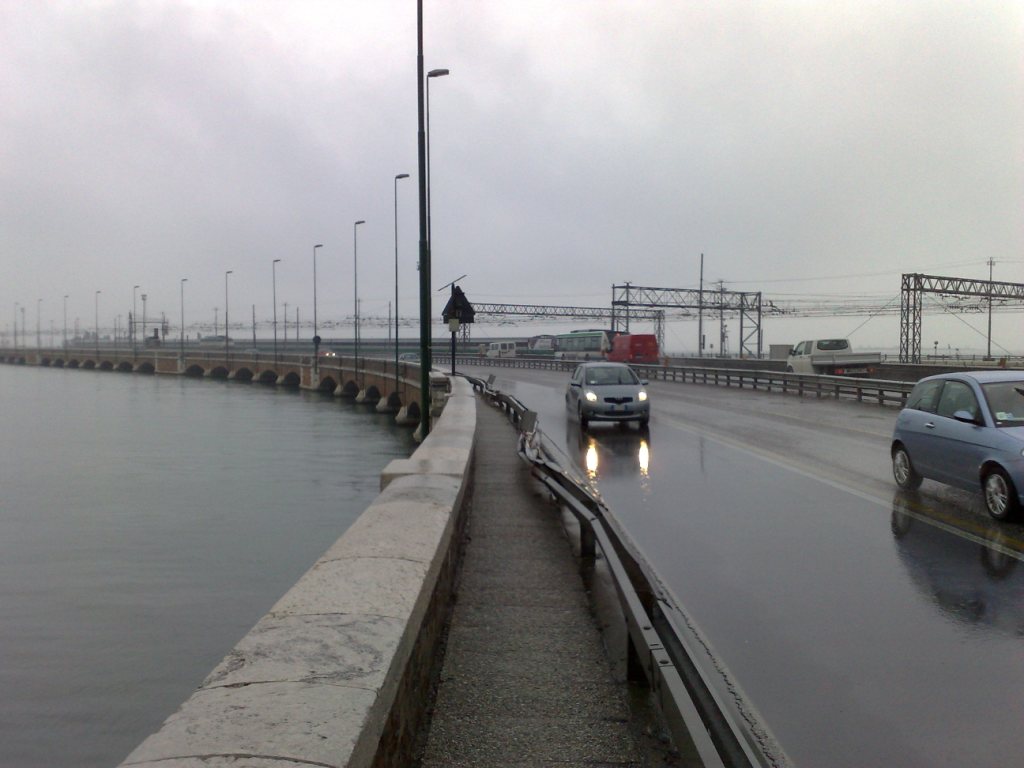
The problem is that Mestre is surrounded by some major roads with a lot of traffic. There is only one road leading to Venice, and that is the bridge between Mestre and Venice. It is officially a normal road with a limit of 50 km/h before the bridge and 90 km/h on the bridge, but in practise it is made and used like a motorway.

Once I arrived on the outskirts of Mestre, I had to follow the SS13 for a while driving alongside some quite heavy traffic, onto the ramps of the Via della Libertà which runs on the bridge. Its a bit scary having big lorries passing you that close.
The bridge itself has a pavement for pedestrians and bicycles, separated from the road by a guard rail. Initially it was some 1.5m wide and made for a pleasant ride, but a few hundred meters from Venice it narrowed to maybe 0.6m and as the guard rail had had some less amicable encounters with cars there were places where I could barely squeeze by.

Once on the first island of Venice, there’s a kind of booth in the middle of the pavement forcing you onto the road, and then the road leading right to the Maritime Station and the Tronchetto island. Continuing ahead, this time on the pavement for safety, I reached Piazzale Roma which is the only part of Venice where wheeled traffic is allowed. A visitor to Venice would have to leave the bicycle here, but I just had a chat with an ATM and went back towards the Tronchetto island and took the Ferry Boat to the Lido.
The Lido is a nice place to go by bicycle. There are cars but not that many, as the only connecting to the mainland is by two ferry lines, and many of the locals prefer to go by foot, bicycle or scooter for local business.

On my way back it got rather nasty. Things went well with the ferry and until the start of the bridge between Mestre and Venice. At the start of the bridge, I couldn’t find any path on the other side of the bridge, so I returned on the same side as I came. No problems on the bridge, Venice doesn’t seem to be a popular destination for bicyclists when its raining :-), but when I arrived at the end of the bridge, I found myself on the edge of a motorway ramp, going against the traffic. In the end I had to cross a three lane motorway by bicycle to get back on track, and I could return home through Mestre, but it wasn’t a good experience. Cars tend to move way too fast on motorways, at least if you are on a bicycle.

Bicycle holidays in the area around the Lagoon of Venice are great. The landscape is beautiful, there are many small roads with little traffic and there are loads of nice places to visit and enjoy, but should you want to visit Venice on such a holiday, don’t go there by bicycle. Leave the bicycle and your gear at the station in Mestre, and take the train or a bus to Venice proper. The approach to Venice by land is made for cars and trains only, with only cursory attention to other kind of travellers.
-
Kayak Fishing in Sardinia
My friend Francesco Muntoni from Cardedu Kayak in Sardinia has put up some photos of fish and other marine creatures he has caught while paddling in his local waters. Here are a few: Dentice, 5kg: Barracuda, 3kg:
 Squid 2.5kg:
 More photos of his catches in his photostream on Flickr.
-

Mestre
It’s time to get some of the nitty-gritty details of the Venice Kayak project done, so I’m now in Mestre where my business partner Marco Ballarin lives. It is our plan to get some of the basic formalities and agreements in order in the next week or two. Hopefully we can get going in May. The city of Mestre is a nice place, but quite overshadowed by the nearby Venice. The city’s roots are in the Middle Ages, when Treviso made a fortress here to counter the influence of Venice on the mainland. In the 14th century Venice expanded onto the mainland anyway, and took control of Mestre. Mestre became the main point of entry for all trade between the city in the lagoon and the mainland, and flourished. The city walls were completely destroyed in a battle in the 16th century, and only one tower of the original wall is still standing, the Torre dell’Orologio.
 In modern times Mestre has become the industrial and commercial centre for Venice and for much of the surrounding area too. A huge industrial harbour now exists south of the old city, at Porto Marghera, and loads of industry has followed too, causing Mestre to grow in all directions, so Mestre now has its own suburbs around the old city centre.
The old city centre is still where one goes for entertainment and an evening out. The area around Piazza Ferretto and Via Palazzo is full of bars, cafés, restaurants, cinemas and ice cream places, and the piazza’s and small roads are full of people in the evening.
 A major issue in Italian cities is vivibilità , the “livability” of the cities. Congestion is often so bad that people spend hours each day coping with problems of traffic, parking, garbage and other daily problems. Mestre must have a very high vivibilità index. Much of the city centre is almost entirely closed off to motorised traffic, leaving ample space for pedestrians and bicyclists. Traffic seems manageable, and I still haven’t seen a real traffic jam here. People can find parking spaces for their car without driving in circles for half an hour, and the city in general seems clean and well kept. Compared to many other Italian cities, both in the North and in the South, Mestre is a small paradise.
They even have something very rare here in Italy. They have bike lanes throughout most of the city. You can almost go anywhere on a well protected bike lane, and in some places they have converted streets into combined pedestrian and bicycle roads, with no cars whatsoever.
I have taken the consequence of this and today I bought myself a bicycle. I am probably (and hopefully) going to spend a lot of time here in Venice, both on the Lido, in Venice proper and here in Mestre and surroundings, and a bicycle does seem to be the perfect means of transport both here in Mestre and on the Lido. Bicicles are, like other forms of wheeled transportation, banned in Venice except for the limited area of Piazzale Roma.


 Yesterday I went for a long walk to the new Parco San Giuliano, an absolutely huge public park on an area bordering on the lagoon near the bridge leading to Venice. There too Mestre has got it right. Making a huge park on the outskirts of town is not enough, it must also be easily accessible. At the main entrances to the park there are large parking areas, and a pedestrian bridge leads over the large intersection of roads in front of the park, giving easy access by foot and bicycle. The Viale San Marco, which connects the city centre and entrance to the park, has been equipped with wide side walks and bicycle lanes, so everybody can get to and from the park in safety.
Food here in Italy is something quite different from what we find in Denmark. Here fruit and vegetables actually have taste, and there’s a multitude of cheeses and fresh fish I have never seen in Denmark. For most Italians food is one of the most important things in life, not just in the sense of fuel for the body. Italians enjoy eating together, and a meal can easily take three hours and some will still consider it a bit rushed. These photos are from a plain run-of-the-mill supermarket here in Mestre, nothing special.
All in all, Mestre is a very nice place to stay.


-

Golfo di Orosei

On Sunday the 30th of March we went paddling along the spectacular coast of Golfo di Orosei, where I also paddled last year. A 50km stretch of coastline is part of the national reserve of Gennargentu-Golfo di Orosei, which means that here isn’t a road or a house to see in the reserve.
I paddled along this part of the coast of Sardinia in October last year, and it is a very dear memory, and I couldn’t wait getting back there. I paddled the same boat again, because the Skim Distance has spent the winter at Francesco’s.

A few friends of Francesco had decided to come along. Francesco Ravasio from Cagliari was there, and so was Stefano Diana of Diana Canoe and two local girls Adda and Valeria. Stefano had brought a prototype of a new boat of Francesco for a first try in the water, and they had a long and heated debate all’italiana about who was to try it first, but in the end Stefano came out on top and started in the prototype.
We all drove from Cardedu to Santa Maria Navarrese at the south end of the national reserve, and launched from the beach just below on of the many ancient Spanish towers that dots the coast of Sardinia.

The first part of the paddle were along the sloping coast until we reached the Pedra Longa, a rock spike 128m in height which stands exactly on the coastline. You only really understand the size of it when you’re sitting just under it looking up. Fortunately, we had calm weather and it wasn’t a problem getting close to the rocks along the coast.
After Pedra Longa the coast changes to vertical rock wall, which must be several hundred meters tall, because the Pedra Longa seems small in comparison. Shortly after rounding a cape we arrived at the Grotta del Colombo. It is a very large open cave where the internal parts look a bit like a dove in flight when seen from a distance.

A bit further ahead is another cave. From the Grotta del Colombo the entrance looks small and bell shaped, but it is some 15-20m tall. The cave is rather deep and in the calm weather we had, we could move all the way in without any problems. The inner walls are of a strange green-yellow colour in vertical stripes, which I haven’t seen anywhere else.

Golfo di Orosei – Porto Quao Our first stop was planned as Porto Quao, the hidden harbour, which is a sheltered cove just after the Capo Monte Santu. We arrived there and hauled the kayaks up on the very limited space, the bottom of the cove is just a few meters wide, and had lunch and a rest there. Porto Quao is a place Francesco uses often on his excursions in the area, since is the an easy landing and launching spot even for unexperienced paddlers.
A few of us had a nap and Valentina found a dead goat. It had been dead for a while, because only the bones were left.

It had been our intentions to continue to Goloritzé a few kilometres ahead, but we had launched late and spend too much time fooling around on the way, so we decided to return from Porto Quao. It was a bit sad, because Goloritzé is an incredibly beautiful place, but it was the right thing to do.
The return was slower still, because we now had a slight headwind. We paddled back towards Pedra Longa, and had another short rest on a little beach close by, before continuing back to Santa Maria Navarrese, where we arrived at six thirty in the afternoon, shortly before sunset. Hence, we did right not continuing to Goloritzé, because then we would have had at least an hours paddle in the dark at the end.

Valentina had to catch a flight early the next morning from the airport of Alghero which is two and half hours drive away. There was little chance of making the journey in the morning, so we left almost immediately from Cardedu towards Alghero with the intent of finding a hotel for Valentina near the airport. We drove in the darkness through the tiniest of mountain roads, and it was well after midnight before we said goodbye to Valentina at the hotel. Francesco and I drove back to Cardedu, but suddenly on the way back, Francesco turned down a small by road and parked the car in front of an old stone wall. It was a nuraghe which he thought we should have a look at now we were in the vincinity. We arrived at four in the morning.
-

Ogliastra hinterland – abandoned towns and ancient towers
 On friday the 28th the sea was livelier than we wanted to be part of, and we decided on an excursion by car to the mountains in the Ogliastra hinterland.
First we drove to Jerzu which is a bit further inland from Cardedu, where the mountains really begins. Francesco drove up some of the steepest and most curved roads I have ever been on, up to what is called the “Tacchi di Ogliastra”, meaning the high heels of Ogliastra. They are a series of mountains where the top is surrounded by vertical rock walls of maybe 100-200m. The mountains in Sardinia aren’t high by Himalayan standards, the tallest peaks are just over 1800m, but they’re still impressive in all their ruggedness.
The many vertical rock walls are a little paradise for climbers, who come from all over to play in the Sardinian mountains.
 We continued along the slope of the valley to Osini. The town seems to stick magically to the mountain side, and on the other side of the valley the town of Gairo clings on to the other slope. You can see from one town to the other, and there might only be about 2km across, but going there by car would still take an hour. It would probably be faster to ride a donkey over there.
The towns were less sticky in the good old days. A few kilometres down the road we passed Osini Vecchia, the “Old Osini”. The old (probably ancient) town of Osini were slowly sliding down the mountain side, for whatever reasons, and in the 1950s it had to be abandoned completely, and the entire population of Osini moved to the “new” and current Osini.
 The story is by no means unique. Just across the valley “new” Gairo was located a couple of kilometres from “old” Gairo, in much the same way. Not everybody in Gairo moved to the new town, though. A part of the population moved further away, to the lower hills towards the coast, and thus Cardedu came about. Cardedu too is a new town, and a child of the landslides in the mountains.
From Osini Vecchia we moved up some roads even smaller, steeper and more curved than before, with the intent of finding a nuraghe.
 The nuraghe are unique to Sardinia, where there are still over 6000 nuraghe in existence. In the rest of the world there are none. A nuraghe is a neolithic building or monument from the period 2500-1500 BC so they were already ancient when the Phoenicians and the Romans settled in Sardinia. Little is known about their purpose as their constructors have left no hints, but they do give an impression of being defensive fortresses.
 Most nuraghes are made of a single conical tower with double walls. In the centre is a single room, sometimes with niches in the walls, and inbetween the two outer walls a stairway to the top or rooms further up. The walls are built by roughly cut stones stacked without the use of mortar.
The nuraghe is almost always placed in a strategic position on a hilltop or on a ridge in the mountains.
 Larger nuraghes consist of several closely grouped towers, at times with surrounding walls or ramparts.
We ended up at the Nuraghe Serbissa after a very long drive on some very rough roads through a forest, and we only found about an hour before sunset. The Nuraghe Serbissa is the largest I have seen so far. There is a well preserved tower which can still be climbed by the original stairway, and two other towers standing to a lower height but still clearly recognisable. On the ground the outline of maybe another five or more towers could be seen.
 Underneath the nuraghe is a large natural cave with three entrances, which was also a part of the entire complex.
The Nuraghe Serbissa is now situated in a completely deserted mountain forest, but who knows how the landscape was 4000 years ago, and how these people lived.
Along the road there were signs for several other nuraghes in the vincinity, but it was getting late and dark, and we still had over an hour’s drive home along the winding mountain roads.
That evening we ate out, in a local restaurant in Barisardo. Francesco had a steak so huge it couldn’t have been made in a normal frying pan, it was served on a pizza plate, and Valentina had a dish of grilled fish and seafood that was plain scary. I have no idea how they got through those quantities of food.
-

Winter’s back and we’re off 🙂
We’re off to Palermo tomorrow morning, but the winter here in Denmark decided to give it one last try. This is the view from our kitchen window this afternoon:
 This little fellow doesn’t really care
 and neither do we, because the weather is fine in Palermo and we have all our paddling gear with us 🙂
-
The Colour Orange
I found this in my mail today. The idea is to associate the colour orange with a protest against the human rights abuses in China. Seems like an interesting way of getting an unwelcome message through the censorship, but it relies of a lot of people doing it.For the press, the mailing list and other interested people: Can China forbid the Color Orange?
Help us making a global manifestation about the human rights in China, and support our appeal. If this is going to succeed it will take many people using their own mailing list and networks to forward this letter, only in that way can we create a wave in the global communication and bring TheColorOrange.net project out to all corners of the world.
Translations of the appeal on: www.TheColorOrange.net/uk/page21
Support the idea on: www.TheColorOrange.net/uk/page35
Happy new year
Jens Galschiot, Danish sculptor
-

Wind turbine woes
David Johnston at PaddlingInstructor.com has put up a video of a Danish wind turbine blowing up in the wind. Direct youtube link here.Aeolian energy is huge here in Denmark and we get a significant part of our electricity from the wind. We have wind turbines plastered all over the landscape, so much that there are associations working against building more wind turbines for environmental reasons. They do make some low frequency noises, a deep humming kind of sound, and they can break in high winds if not maintained and managed correctly. For that reason still more wind turbines are being placed in wind farms off shore, where the visual impact is less (seen from land), the noise doesn’t annoy that much and a breakage is less likely to harm somebody.
The wind farm on the picture is at Middelgrunden, off Copenhagen harbour. It consists of 20 medium sized wind turbines. It is dwarfed by the much larger Horns Rev wind farm in the North Sea and the Nysted wind farm in the Baltic Sea.
 Modern wind turbines are huge, and they keep getting bigger. In the photo to the left there’s a small sailing boat behind the base—compare with photo above for overall size of these medium sized wind turbines.
A modern wind turbine can have a main tower of over 100 m in height, and wings of over 70 m. It means the tip of a wing will travel well over 300 m per rotation, which is why the wind turbines often seem to spin very slowly, even in brisk winds. The house on top of the tower contains a massive gear box, so the turbine can get the most energy out of the wind even when turning slowly.
The speed of the rotation is regulated by turning the blades, and in a storm the blades will normally be turned so the wind turbine stops and the wind just blows by. It is kind of ironic that when the wind gets too strong, the wind turbines will shut down and stop producing power. This is probably what failed in the exploding wind turbine in the video.
In the video the wind turbine isn’t stopped as it should be by turning the blades parallel to the wind and it therefore starts to spin too fast. With increased rotational speed, the wing tips will start travelling close to the speed of sound, while the inner parts of the wing still travel much slower, having a small circle to travel for each rotation. As the wing tip nears the sound barrier, the stress in the wing will cause it to break at some point, and when one wing breaks, the whole construction breaks. The tower is torn down by the unbalanced rotation of the remaining parts of the wings.
There’s been at least two cases of run away wind turbines this winter. This one in Denmark, and another one in Sweden, both wind turbines produced and maintained by Vestas, the world’s largest producer of wind turbines.
-
More photos from Sardinia
My good friend Francesco Muntoni who runs Cardedu Kayak in Sardinia, has started uploading photos from his home island to flickr. A month from now I will be down there again, to visit Francesco and to paddle the magnificent coast. Francesco is currently the custodian of my Skim Distance, seen here at Porto Quau in the Golfo di Orosei natural reserve.