Category: Kayaking

Posts about sea kayaking

  • Parcel update

    Parcel update

    I have finally received an answer from the Poste Italiane (the usual word document attached to an empty email):

    In riferimento alla sua e-mail del “07/01/2008” con Oggetto: «pacco estero», Le comunichiamo che per richieste di informazioni sull’esito di spedizioni inviate e/o in attesa, riguardanti il prodotto dei pacchi internazionali, si dovrà  recare esclusivamente presso l’Ufficio Postale per la compilazione dell’apposito modello CN08 ( modello di reclamo internazionale) in quanto attualmente, per tali spedizioni, non è previsto alcun servizio di T. & T. e nessuna assistenza telefonica.

    which is (more or less) in English:

    With reference to your email of January 7, 2008, with the subject “pacco estero” [which wasn’t the subject -rs], we can inform you that for requests for information on the whereabouts of missives sent and/or awaited, regarding international parcels, it is necessary exclusively to present oneself at the postal office to fill in the form model CN08 (model for international complaint) since at this time, for such missives, no service is foreseen by the T&T [probably Track&Trace -rs] and no telephonic assistance.

    That’s Italian bureaucratic lingo for “f… you”.

  • A Parcel’s Odyssey

    A Parcel’s Odyssey

    I sent a parcel from Sardinia last October. I sent it to Palermo where it arrived after two weeks. Unfortunately, it wasn’t picked up by the recipient, so it was returned, but returned to where?

    I’ve been hunting this parcel for over three months now, and I’m still none the wiser.

    The kayak journey in Sardinia was my first ever long kayak trip, and I had packed way too much stuff. After about a weeks paddling I decided to send what I no longer believed I would need back to a good friend in Palermo, Giacomo della Gatta. On the first rest day, which happened to be at Torre di Bari near the inland city of Bari Sardo, I went through all my stuff, and pruned my luggage with a fairly rough hand. We got a lift to Bari Sardo, which was a few kilometres inland, and made a huge parcel of some boxes from a supermarket and ample quantities of duct tape.

    I asked what I should use as a return address, since we weren’t going to stay there, and I was advised to give my Danish address as the return address. In case of a failed delivery the parcel would then be returned to Denmark, although at an additional cost.

    A fairly huge parcel of almost 10kg cost only €7, which was quite astonishing. We had both expected it to be some €40-50 at least.

    Anyway, off it went, into the unknown and mysterious bowels of the Italian postal beast.

    We continued our journey and inquired a few times if Giacomo had received it, but no. Well, not to worry, nobody in their right mind would expect a parcel to arrive in less than a few weeks anyway. Not in Italy, at least.

    When I returned to Palermo in early November and met Giacomo again, he told me that the parcel had arrived a week before, but since I had addressed it to a little used office of his company, he hadn’t been able to pick it up within the seven day limit given.

    Giacomo had called the post office in Palermo to ask what would happen to the parcel, and they confirmed that the parcel had been returned. When asked where to, the answer was to Denmark. I called the toll free number a week later and got the same message. Everything should be fine then, as I was on my way back home too.

    Back in Denmark, now in early December, I still hadn’t seen anything of the parcel. I then contacted the Danish mail to hear if they had any news on the parcel, but they had never heard of it. Over a month after it should have been returned, the parcel was apparently still somewhere in Italy.

    I tried to call the toll free number again from Denmark, but it didn’t work. It seems the number only works within Italy, but the homepage of the Poste Italiane doesn’t give any other numbers to call. I then wrote an email, and after a week I got an answer: an empty email with a MS word document attached with two lines of text: please call the toll free number. Well, it doesn’t work.

    I have since written the Italian mail once a week requesting a reply by email, but haven’t received any kind of responses after about a month of trying. My in-laws in Palermo have been calling the toll free number and talking to the post office in Palermo, and has only gotten the usual answer: the parcel has been returned to Denmark. Only it hasn’t.

    In the last few days we have been able to get different responses, though. My in-laws was now told that the parcel had been returned to the post office in Bari Sardo from where it had been sent, but I called them today and they don’t know anything about it. It’s a very small post office, and they actually remembered me from back in October, and were quite certain that no such parcel had returned to them.

    I have myself been calling the main corporate number of the Poste Italiane, and there I got the answer that they were way behind with answering correspondence that I would just have to wait until it got my turn. They wouldn’t be able to answer me in any way before they had worked off the backlog. According to the Italian press they do seem to have problems.

    So, after three month I have gotten nowhere. The only factual information I have about the parcel is that it is not in Bari Sardo. I will be writing them once a week as I have been doing since before Christmas, but I’m losing faith that I will ever see that parcel again.

  • Happy New Year

    Happy New Year to everybody but especially to Freya who are almost all the way in New Zealand. Very impressive.
  • Irresistible kayaker

    Irresistible kayaker

    Who can resist this little fellow 🙂

    My wife brought him home from Berlin this Christmas.

  • Skim Kayaks

    Skim Kayaks

    In spite of the journey being put on hold until April or May, Skim Kayaks has generously offered to continue to sponsor me for the remainder of the journey.

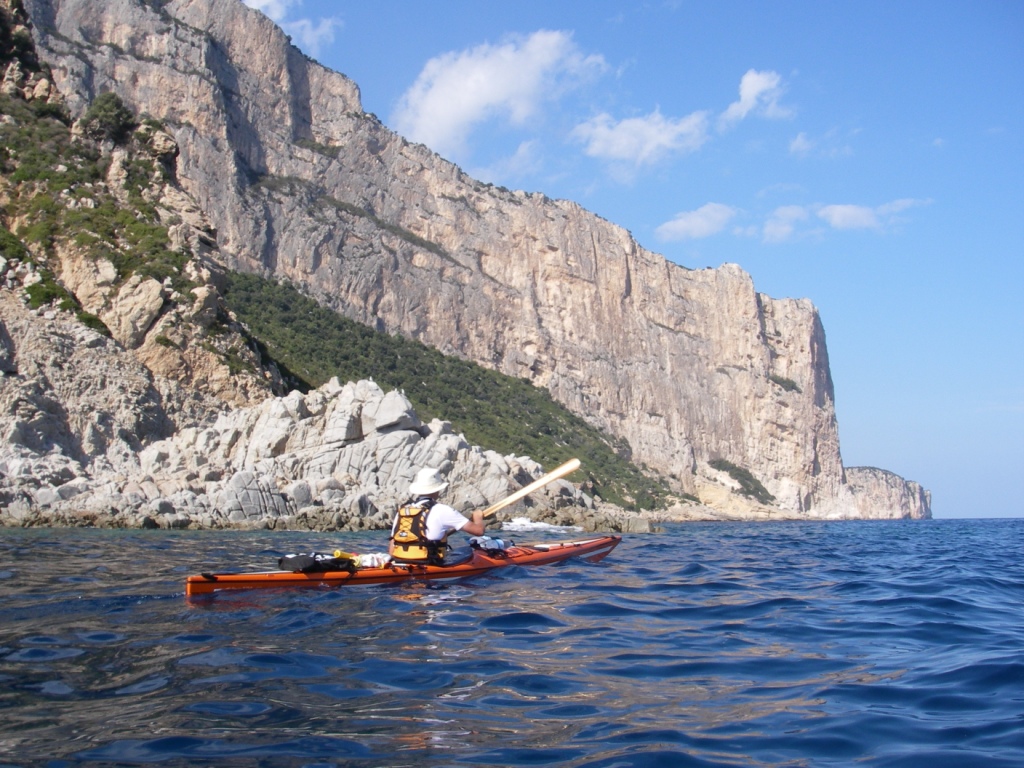
    I’ve paddled the Skim Distance in Sardinia for four weeks in different conditions, and it is a brilliant expedition kayak. It is stable, fast and spacious. I consider myself lucky to be able to finish my journey in such a boat.

    Weather conditions in Sardinia are very changeable, and in a couple of occasions I paddled in winds up to force 6 and waves of several meters, which is more than I have tried before, but I never felt unsafe or unstable in the Skim Distance.

    The speed of the Skim Distance is incredible. I’m not the racing type, and I was astonished to discover that I could get a fully loaded Skim Distance to go at 10-11 km/h, and at 7-8 km/h sustained. It would be very interesting to see what a competitive and dedicated race paddler could get out of a Skim Distance.

    The Skim Distance is also a surprisingly agile boat when unloaded. I’ve paddled it for two weeks in Venice in September, and in spite of its notable length it was very easy to get around, both in the smaller channels of the city, between the other boats and outside the city, in the lagoon.

    My thanks to Skim Kayaks and to Göran Pehrson for their continued trust in me.

  • Sea kayaking blog aggregator – Paddling Planet

    I’ve set up a web site which automatically collects news from sea kayaking related blogs through their RSS feeds.

    The site is at http://www.paddlingplanet.com/

    The idea is to collect all the sea kayaking related blogs in one shared news stream so you only have to look in one place.

    My hope is that it will make it easier for newcomers to the sea kayaking world to discover new kayaking blogs, and for old-timers to stay ajour with what is being written on the various blogs.

    The web site is updated each hour based on the contents of the RSS feeds of the included blogs. No content is copied or stored on my server for any longer than it appears in the blogs RSS feed. The web-site also presents the blog posts in aggregated news feed in several formats.

    If you like the idea I would like to ask all of you for a bit of help launching this site. Help could be:

    • posting on your blogs about it,
    • adding it to your blogroll,
    • telling other sea kayakers about it
    • or telling me of blogs to include in the subscription list.

    For you as bloggers, this can be yet another way of getting your posts out to a wider audience.

  • Rolling Santa

    Filmed at Escape Kajak Center in Göteborg, Sweden.

  • Team paddling experiences

    Team paddling experiences

    The four weeks I paddled in Sardinia is the longest kayak journey I have been on so far, and the first time I have travelled for so long with somebody I knew so little.

    Things went very wrong between Wendy and I, and I have quite naturally given it quite a bit of thought as to why. I’m not sure it necessarily had to end like that, had we been able to handle some problems and situations better during the time we travelled together.

    All interpersonal relations are inherently complex, and it doesn’t get less complex by placing those relations in a context of sea kayaking in unknown territory for long hours each day, occasionally in difficult weather conditions, while living primitively on beaches and the like. The physical and psychological stress induced further complicates matters.

    The following are my thoughts on some of the areas where I think Wendy and I didn’t do very well as a team.

    Please try to read this more as a “mea culpa” than as a “j’accuse“. Being the less experienced paddler of the two of us, I probably made more and graver mistakes than Wendy. Also, this is NOT an attempt to get into an online shouting match, but an attempt to share some difficult and at times painful experiences, and hopefully, hear about the experiences of others in the comments. I want to learn to be a better team paddler, so I can prevent similar unpleasant events in the future.

    Information for all

    It is very important that all team members know exactly where they are, where they’re going, how far there is and what conditions to expect. It sounds obvious when written like that, but we didn’t do it. I should have make sure I always had the necessary information each time we started, but I didn’t.

    We only had one map case which I usually left with Wendy, even though I was offered to carry it many times. I would often just have a quick glance at the map before we left in the morning, memorise the important parts and just paddle on that, relying on Wendy for all the details during the day.

    One day in particular was really bad, in large part because I had acquired too little information about our whereabouts before we started, and I was unable to get more information as we paddled on. We were on our way from Costa Paradiso along the coast. All was calm and we were tired of sitting still, so we left on a whim in spite of a forecast of F5-6 NW winds, that is from the side.

    We started, had a short break before Isola Rossa, and started again towards a headland down the coast. I had gotten the impression that it was about 5-6km away, an hours paddle, though it seemed further. I discarded that observation thinking it was just a bit of mist making it look more distant. We paddled for an hour, we got a bit more wind, Wendy paddled ahead as I slowed down because my back started to ache a bit. The headland seemed just as far away as when we started. I could only see an outline of the headland as I had the sun right in front of me.

    We paddled for another hour, the headland was still just an outline towards the sun and still distant. The wind grew stronger, at least F5 with average waves of 1-2m from the right, and as I had to work harder in the waves my back really started to ache.

    After about 3½ hours non-stop paddle the headland was closer, but I still couldn’t see anything on it because I was blinded by the sun, I didn’t really know where we were, if we were to land at the headland or not, the wind and waves kept pushing me around and I was in quite a bit of pain. At that point I gave up fighting the waves to keep the course, and let them carry me left towards the coast so I didn’t strain my back muscles so much, and then turned the boat up into the wind using the skeg, again so I could relax my back. That brought me far away from Wendy, who had been ahead of me all the time, and she had to return to look for me. We finally landed on a small beach just under the headland after almost 4 hours non-stop paddling in rough weather.

    The worst part of it wasn’t even the rough weather or my back aches, it was not knowing anything. My information on distance had been false, we paddled 16km in 4 hours, not 5-6km in one hour. I didn’t expect the wind and waves to changes dramatically in one hour, but they did in 4 hours. I had no idea about our destination. Were we to land on the headland or not? I had no possibility to acquire new information during the paddle. I was constantly blinded by the sun, so I couldn’t see a thing on the headland in front of me. Was it build up or not, was there a harbour or not? Wendy was ahead of me and as my back got sore I couldn’t catch up with her. The wind growing in strength, most communication between us was impossible anyway.

    Needless to say, it wasn’t a good day on the water.

    I tried in the following week to make sure I knew what was going on, and I didn’t have bad days like that again. I’d say I’ve learnt to stay informed.

    Follow the slowest

    A team will have to follow the slowest. If it doesn’t it won’t be a team for long.

    A corollary to this rule is that all team members must accept this without complaint. The slowest team member won’t be any faster by being corrected, coerced, left trailing the rest of the team or by any other means. It will only make that person feel miserable and therefore make the team function worse.

    Then, who says the slowest team member won’t one day be you.

    There are many possible reasons for being slow, and it doesn’t have to have anything to do with weakness. One can be slow because the clouds in the sky have interesting shapes, or because there are beautiful rocks to look at, or because one experiments with different paddling styles, or whatever happens to not propel one forward at maximum speed.

    In the little team of Wendy and I the role of the slowest paddler changed often, sometimes from day to day, sometimes from hour to hour. I was often the slowest in the days when I had back aches, but not necessarily. I did leave Wendy behind one of those days, simply because the pain was such that I wanted to get off the water as soon as possible. I just ate the pain and paddled as fast as I could. Wendy was many times the slowest because she wanted to look at rock formations and explore little coves along the coast. On a few occasions I was playing, trying to go as fast as possible, forgetting about team paddling, and I ended up several kilometres ahead of Wendy who couldn’t keep up.

    Being slow is not just a matter of paddling. I’m a slow starter in the morning. It takes me half an hour to wake up and get started. There’s nothing really I can do about it, at least not without inducing a completely unnecessary level of stress in my body. Wendy is off before her eyes are fully opened.

    No matter what the context, the team will have to follow the slowest or dissolve.

    Patience

    Following the slowest means waiting. We both discovered that waiting is an essential part of team paddling, frustrating as it may be. Different persons have different speeds, and some will always wait for somebody else.

    Waiting requires patience, and lots of it.

    Inability to wait patiently for the other team members to get ready or come along will cause all sorts of tensions and stress in the team. It is very, very unpleasant having to do something with others hanging over you, hurrying on you or moving your stuff around in some misguided attempt to get you to pack your boat faster. In the end things will just go slower for it.

    In that sense, patience is not a virtue in team paddling, it is a necessity. An constantly impatient person is inadequate as a team paddler.

    In any case, one day you’ll want the others to wait for you, so just learn to be patient.

    “Mock waiting”

    One particular nasty expression of impatience in team paddling is what I call “mock waiting”. I think most of us have tried it, most of us have probably done it too without thinking about the consequences.

    “Mock waiting” is when the faster paddler moves ahead at his/hers preferred speed, then waits until the slower paddler has almost caught up, just to start again immediately.

    Sounds innocuous, right? Let’s see what it does to the two paddlers.

    The faster paddler gets to paddle at a nice, pleasant pace of his/hers own choice, interrupted by occasional breaks. These breaks might be frustrating and annoying, they are after all interruptions and they do slow you down, but they’re nevertheless still breaks where muscles and mind can relax a bit.

    The slower paddler, who is always behind, experience a psychological pressure to paddle a little faster than he/she would otherwise do in the given conditions. The faster paddler exerts a pressure to move on by always being ahead. Whenever the slower paddler catches up to the waiting faster paddler, he/she starts immediately, leaving the slower paddler no time for a break and a rest. As a consequence, the slower paddler works harder for longer, without any breaks and without catching up. It is, to say it mildly, very unpleasant.

    It is so easy to do without thinking about it, but it is not so nice being the slower paddler who works hard to catch up just to be left behind again immediately.

    “Mock waiting” is very destructive behaviour in a team. It constantly underlines that “I’m faster and you’re slower”, while it wears the slower paddler down physically too. It can drive the slower paddler into the ground, physically and psychologically.

    Mutual respect

    Much of the above boils down to mutual respect between team members.

    If the team members respect each other and each other’s differences, much of the above won’t happen. Respect in my book means taking the other person seriously, letting the other person have his/hers say, listening to what the other says and expresses, and taking that into account when deciding what to do.

    Much of what I have written above are the results of an inability to listen to each other or an inability to let what is said influence one’s behaviour and decisions.

    The short conclusion of all these words can be: don’t paddle with persons you don’t respect and don’t paddle with persons you don’t believe respect you.

  • Pentax Optio W30

    Pentax Optio W30

    I have bought a new camera, a Pentax Optio W30. I’ve been very happy with my W10, and frankly, I’m amazed it has survived the abuse I’ve put it through for as long as it did, so I have no problem getting another Pentax Optio.

    optio-w30-big1.jpg optio-w30-big2.jpg

    Compared to the Optio W10, the Optio W30 has a slightly better resolution, its more waterproof (down to 3 m for 2 hours) and more dustproof. I’m a bit annoyed that it uses different batteries and different chargers, so my old spare batteries and chargers won’t work with it.
  • My Pentax Optio W10 is no more

    The last picture from my cameraMy camera is dead. It’s been a bit flaky for a while, the flash stopped working a while ago, and after my paddle with Francesco Ravasio on Friday it wouldn’t turn on anymore. I’ve tried everything, but no go. It’s been a good friend from some 1500km paddling in the last year or so, taking thousands of photos. I guess I’ll be looking for a replacement soon.
  • Leaving Sardinia

    Leaving Sardinia

    I’m in Palermo now.

    Fertilia

    I spent a couple of days in Fertilia, first to make up my mind, then to figure out what to do with all the gear I had there. The first night I slept in the open near the harbour where I had the kayak in sight. At that point I hadn’t decided to stop yet.

    Monday morning I made my decision to stop and started thinking about all the practical matters of it.

    The largest problem was the kayak. I had to be doubly sure about it because it isn’t really mine. It is on loan from Skim Kayaks in Sweden. It was sitting on a ramp in the little harbour of Fertilia and nobody complained about it. I made sure to go there regularly and be seen, so the people of the harbour had a chance to complain and so they could see it wasn’t just abandoned there.

    Francesco Muntoni

    I first tried to contact Costantino Lifrieri which we had met at Capo Falcone a few days earlier, but he was abroad. I then found the numbers for Francesco Muntoni, owner of Cardedu Kayaks which organises excursions on the east coast of Sardinia. Francesco came to to Fertilia the same evening to pick up the kayak. We loaded it on his car and had a pleasant evening over a pizza and a glass of wine.

    Should anybody want to paddle for some days in Sardinia, contact Francesco at cardedukayak@tiscali.it. He knows his coastline to the last underwater rock, and he has kayaks and equipment for groups up to ten persons, all you need to bring is your beach clothes.

    Alghero city walls towards the sea

    Since the ferry from Cagliari to Palermo only departs weekly, on Fridays, I had plenty of time. I therefore stayed one more day in Fertilia, packed and organised my gear without hurry, walked the 6 km to Alghero where I had a nice time. Alghero is a very nice little place, a Catalan city transplanted in Sardinia. Until about 100 years ago people still spoke a Catalan dialect, and the street signs are still bilingual.

    Wednesday I had everything ready for departure. It is amazing how much you can fit into a kayak. All packed up I had three big IKEA bags with camping gear, paddling gear, normal clothes, photo equipment and other electronics and all the loose stuff.

    Train from Alghero to Sassari

    I took a taxi from Fertilia to Alghero station, which was a very small place. So was the train. Fortunately, so was the ticket price too 🙂 The baby train took me to Sassari, from where I had to take another train to Cagliari. That train look more like a real train.

    I had expected to have the train almost for myself. Just how many people are supposed to travel from one end of Sardinia to the other on a Wednesday afternoon? Quite a few, I discovered. I had forgot about the dead.

    Thursday November 1st is the day of the dead. It is a holiday in Italy and most people will visit their family tombs. With Thursday off, everybody would then “fare il ponte”, meaning they would take Friday off too and have a nice long holiday. So, I traveled just before a four day weekend and of course the train was absolutely stuffed. Good thing I got on board early with all my stuff so I didn’t have to do my four hours in train with three full IKEA bags on my lap.

    Nuraghe seen from train at Marcomer

    I did have a nice ride, though. I chatted with an elderly lady who got off at San Gavino, and with a woman from San Domenico who got off a bit earlier. I also saw several Nuraghe along the way, especially around Marcomer where there are over 200 of them according to one person on the train.

    My phone died on the train. Costantino called me on the train, and the battery just went dead in the middle of our conversation. It did present me with a small problem. I was supposed to call Francesco Ravasio of Cagliari on my arrival. He would pick me up at the station, so I could get my motorcycle which was parked at his home. Without my phone I couldn’t contact him and he couldn’t contact me. We’d never met before and didn’t know how to recognise each other.

    On the station of Cagliari I stopped in the bar, had a beer with Tony and Tonino who had helped carry all my gear, and asked if I could recharge my phone there for a moment. “Eh beh, ma, sorry, but we cannot, no”. I went on the search for another place to nourish my phone. The station is rather small, but after a while I found the station chapel open, and there was an outlet just besides the altar, so I sat down in the chapel, charged my phone and wrote a bit in my diary. When the priest came to ready for mass at 8, I had a chat with him but left before mass to meet Francesco.

    Francesco came in his small BMW Smart. It is a very small car, my three IKEA bags hardly entered, and we had to drive with the rear door open because my Avatak paddles were too long to fit in. When we arrived at his home he just parked it across on half a parking space.

    Francesco Ravasio

    I had a very pleasant two days in Cagliari. I stayed in a hotel, my phone ran out of money and wouldn’t accept new payments and the hotels wifi-service was abysmal. I did, however, have a splendid time with Francesco. I had all my gear at his place, we had dinner together both evenings, once in the very good Trattoria del Porto, and we went paddling together at Poetto and Capo Sant’Elio. Wendy and I had passed there on the very first day of our trip, but in rougher weather. This day was completely calm and we could paddle right under the sandstone cliffs.

    Francesco Ravasio’s stripbuild P&H Sirius replica

    Francesco has been paddling for over 20 years, as one of the very first sea kayakers in Sardinia. He also has a knack for working wood, and he has made an exact replica of his P&H Sirius, strip built. It is quite a marvel, and it paddles very well 🙂 I was a bit amazed that he would let me paddle it, but he was glad to see it used, he insisted.

    My ferry departed on Friday evening. I packed up all my gear on the motorbike, except the paddles which Francesco drove to the harbour for me. We were just in time. I got my ticket less than an hour before departure (one of the advantages of driving a motorcycle – there’s always room for one more on the ferry), and embarked less than half an hour before.

    The ferry crossing was utterly boring and eventless.

  • My Sardinian journey ends here

    My Sardinian journey ends here

    I have decided stop my journey around Sardinia here in Fertilia.

    My primary reason for embarking on this trip was to recover from a depression I had after a marital crisis last year. I wanted to get away from everything, try something new, have fresh impulses in my life and hopefully come back a fitter person, in every sense of the word, ready to take on the challenges of a ‘normal’ life again.

    Over all the journey has fulfilled its purpose. I have seen new places, met new people, gotten new friends, learned much about kayaking and the sea, and about team paddling. It has been a very refreshing experience, and I’m very happy that I took on the challenge when the opportunity presented itself.

    Unfortunately, the paddling partnership between Wendy and I didn’t work out as expected. In the end, our relationship grew so sour that it became detrimental to my stated aim with the journey, to recover from my depression.

    As I continued on alone, walked the streets of Fertilia, had a coffee in a bar, ate in a restaurant, and slept under an open sky near the harbour, I had ample time to ponder what to do. My initial impulse was to just continue alone, following the path set out time ago, but as I thought things through and searched my feelings for an answer, I kept returning to the ‘why’ question.

    Why did I go? To get to feel better after a nasty crisis in my life. Does the thought of continuing along make me feel good? Not really. Then why continue?

    Now the decision has been taken, I do feel better. I take that as a confirmation that I have done right.

    Last day of paddling

    Impressions from Fertilia