Category: Living in Venice
About my experience of living in Venice
-
Death in Venice
Having made a living out of kayaking in Venice, whenever accidents happen on the water it always leaves an impression. This time so much more as the accident left an innocent tourist dead. The accident happened on August 17th just before noon, at the Rialto bridge, in a spot we very often use to take photos of the participants of our kayaking tour in the city. One of our tours had passed the exact spot half an hour earlier. -

Aliens in Venice
Venice has been a conspicuous absentee from Google Street view for a long time. It’s not really odd as the photos for street view are collected by special cars, and Venice is a mostly pedestrian city. Consequently, Google now relies on pedestrians for taking all the photos for street view in Venice.
Aliens in Venice 
Aliens in Venice 
Aliens in Venice 
Aliens in Venice -

S-ciopon
Ever since I moved to Venice I have wanted to do more rowing Venetian style, voga alla veneta, where you row standing up and looking forward while pushing the oar, basically like you see the gondolas being rowed around Venice. When I lived on the Lido a few years back, I went rowing at the Diadora rowing club, and learned the basics there, but for the last couple of years Venetian rowing sessions have been few and far between, not more than once or twice a year.
I’ve toyed with the idea of joining one of the many rowing clubs around Venice, but most of them have limited opening hours, managed by volunteers, and my working hours are too unpredictable and changeable for the two to meet regularly.
Now, a few weeks ago, a friend of mine posted on Facebook that he wanted to sell his old s-ciopon.
Venetian boats come in many shapes, sizes and types.
The gondola is the flagship model and by far the best known type of Venetian boat, but it is but one of many.
I’ve read somewhere that there was one at least two hundred different types of boats used in the lagoon of Venice, on the inland rivers and on the upper Adriatic Sea, but that at most one third of these are still in existence, and many of those are just a few surviving examples. The Venetian association Arzanà tries to salvage as much as possible of the quickly eroding heritage.
 Of the still common Venetian boats, the sandolo family is the largest, with maybe some fifteen still existing types, with names like sandolo buraneo, sanpierota, mascareta, pupparin, and s-ciopon. While varying a lot in size, from over ten metres in length to little more than five, they have much in common. Originating as lagoon working boats, they all have a low profile, a pointed horizontal bow, often decorated by an iron spear, and a cut stern mirror, varying from almost vertical to a steep angle under the boat. Some were originally used for transportation, like the large and spacious sandolo buraneo from Burano in the nothern lagoon, or for fishing, like the sanpierota from San Pietro in Volta on the Pellestrina island, or as show boats for the rich, like the elegant pupparin, the only sandolo with an asymmetric hull constructed specifically for a sole rower.
The s-ciopon is the smallest of the sandolo family, usually around 5-5½m long, 1.15 over the beam with a low board, and it was used for hunting ducks and geese in the lagoon. Armed with a huge shotgun, up to 3m long, which rested on the bow and the single cross board, the sole hunter would paddle the boat slowly through the reeves close to the birds, fire the gun into the flock and then standing up, row around picking up the dead and wounded birds.
 The initial approach to the prey was done crouching in the back of the boat, slowly paddling forward using a single blade paddle, much like a Canadian canoe paddle. After the shot, the hunter would revert to rowing standing up, using two oars alla valesana, to find and pick up the birds.
The shotgun was more like a small cannon. Three metres long, with a calibre of 7cm or more, it would be loaded with black gunpowder and pellets, shrapnel or gravel. When fired it would cover an area of several metres in width, wounding and killing dozens of birds, and the recoil, cushioned by a sack full of straw, would push the boat back as much as ten metres. I’ve never seen such a shotgun, but I’ve heard some restaurants have surviving examples on display as decorations. Neither have I ever seen one of the paddles.
 This kind of hunting was outlawed in the 1970s.
The s-ciopon we’ve bought will be used for shooting, but not for hunting. I’m very much looking forward to rowing around the lagoon with my camera, shooting at anything that moves.
This particular boat is some forty years old, made of wood (as opposed to marine plywood which is ever more common), and the previous owner has had it and cared for it for over twenty years. We have forcole (oarlocks) and oars suitable for rowing alone with one oar (like the gondolas), alone with two oars (alla valesana) or for rowing two persons with one oar each.

-

Redentore 2012
The Redentore feast is one of the main popular celebrations during the Venetian year. It is held on the third Sunday of July to celebrate the end of a devastating plague epidemic in the 16th century, which lead to the construction of the Redentore Church on the Giudecca island. On Satuday evening there is traditionally a huge display of fireworks, lasting almost three quarters of an hour. This year we went to an ad-hoc party on the Giudecca island, so we had prime seats on the shore front to enjoy the fireworks with the Salute Church and St. Mark’s as a backdrop.
Redentore 2012 
Redentore 2012 
Redentore 2012 
Redentore 2012 
Redentore 2012 
Redentore 2012 
Redentore 2012 
Redentore 2012 
Redentore 2012 
Redentore 2012 
Redentore 2012 
Redentore 2012 
Redentore 2012 
Redentore 2012 
Redentore 2012 
Redentore 2012 
Redentore 2012 
Redentore 2012 
Redentore 2012 
Redentore 2012 
Redentore 2012 
Redentore 2012 
Redentore 2012 
Redentore 2012 
Redentore 2012 
Redentore 2012 
Redentore 2012 
Redentore 2012 
Redentore 2012 
Redentore 2012 
Redentore 2012 
Redentore 2012 
Redentore 2012 
Redentore 2012 
Redentore 2012 
Redentore 2012 
Redentore 2012 
Redentore 2012 
Redentore 2012 
Redentore 2012 
Redentore 2012 
Redentore 2012 
Redentore 2012 
Redentore 2012 
Redentore 2012 
Redentore 2012 
Redentore 2012 
Redentore 2012 
Redentore 2012 
Redentore 2012 
Redentore 2012 
Redentore 2012 
Redentore 2012 
Redentore 2012 -
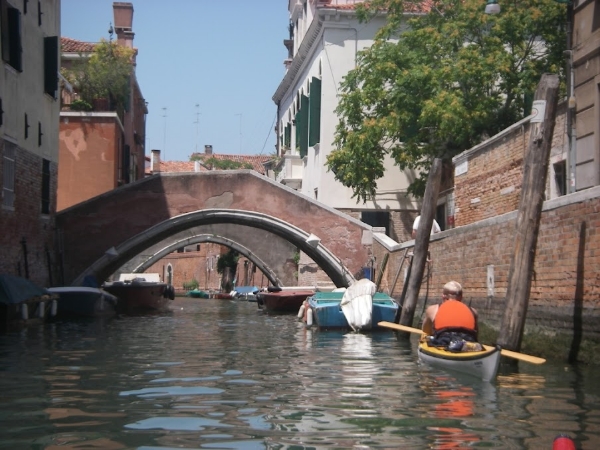
I Want Your Outdoor Job: René Seindal, Owner of Venice Kayak | paddlinginstructor.com
David H. Johnston of the Paddling Instructor blog have published an interview with me in the series “I Want Your Outdoor Job” series on the blog. I’m deeply honoured. via I Want Your Outdoor Job: René Seindal, Owner of Venice Kayak | paddlinginstructor.com. -
Home
In the five years I’ve lived in Venice, I haven’t had any one home for long. It’s been a lot of moving around, and basically camping out in the various places, hauling along a bare minimum of stuff to reduce the burden of the next move. Every time I thought I had found some kind of stability, something happened to mess up my plans.
I have lived for periods in a tent on a camp site, with a friend on the mainland, in a shared room in an apartment in Venice, in a small apartment on the Lido where the rain came in through the outer walls, and in a shared apartment where my flatmate suddenly left for whatever reasons, and left me with a double rent for the remainder of the contract duration.
A home is a basic thing in life, and living for prolonged periods without the stability and certainty of knowing where you’ll sleep the next night, or next week, or next month, can be very burdensome.
I have now, however, found a place I believe will be a home for the next years to come. At the very least I’ve signed a contract for a place I like, in a fantastic location, for a rent I can pay.
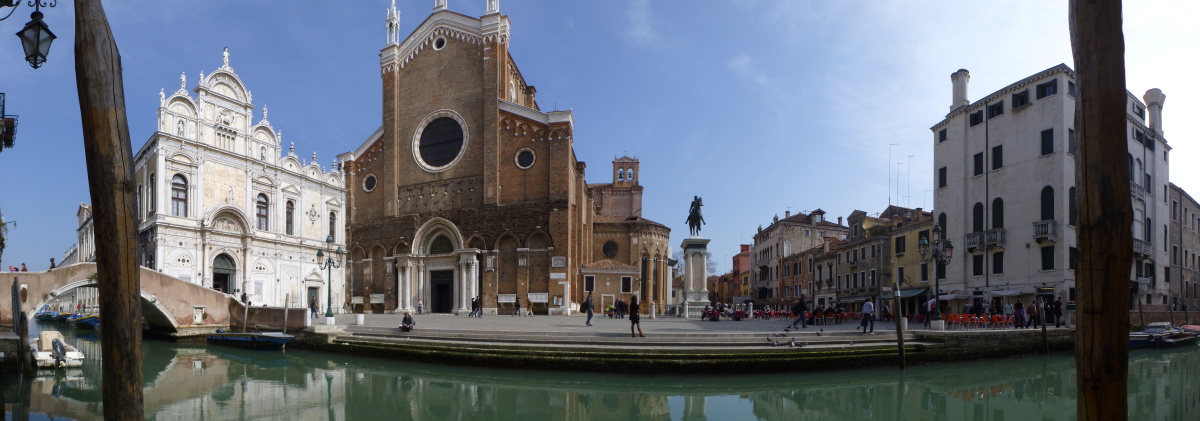
Panorama of the Campo S.S. Giovanni e Paolo The location is in the centre of Venice, on the Campo S.S. Giovanni e Paolo (shown in panorama above), which is one of the major squares in Venice, and one of the most beautiful too, in my opinion.
The apartment is small, but on the third and top floor, accessed from a courtyard on the main campo, with windows on an internal courtyard. That means light, air and little noise, all properties that are very hard to find in Venice, at least at an affordable price.
The previous place I lived was on the first floor, windows on a calle about 1 metre wide, where drunk tourists often roamed up and down, howling as they fought to find their way around the labyrinth of the calle, rughe and salizade of central Venice.
None of that here, though. The only noises in my new home are the nearby church bells a few hours a day, and my landlady across the courtyard singing along with the radio or trying to get her kids to do their homework.
The building itself is old, even by Venetian standards. It originates in the 14th century, and was originally the embassy and hostel for tradesmen from Brescia, hence the name Bressana of both the front courtyard and the adjacent calle.
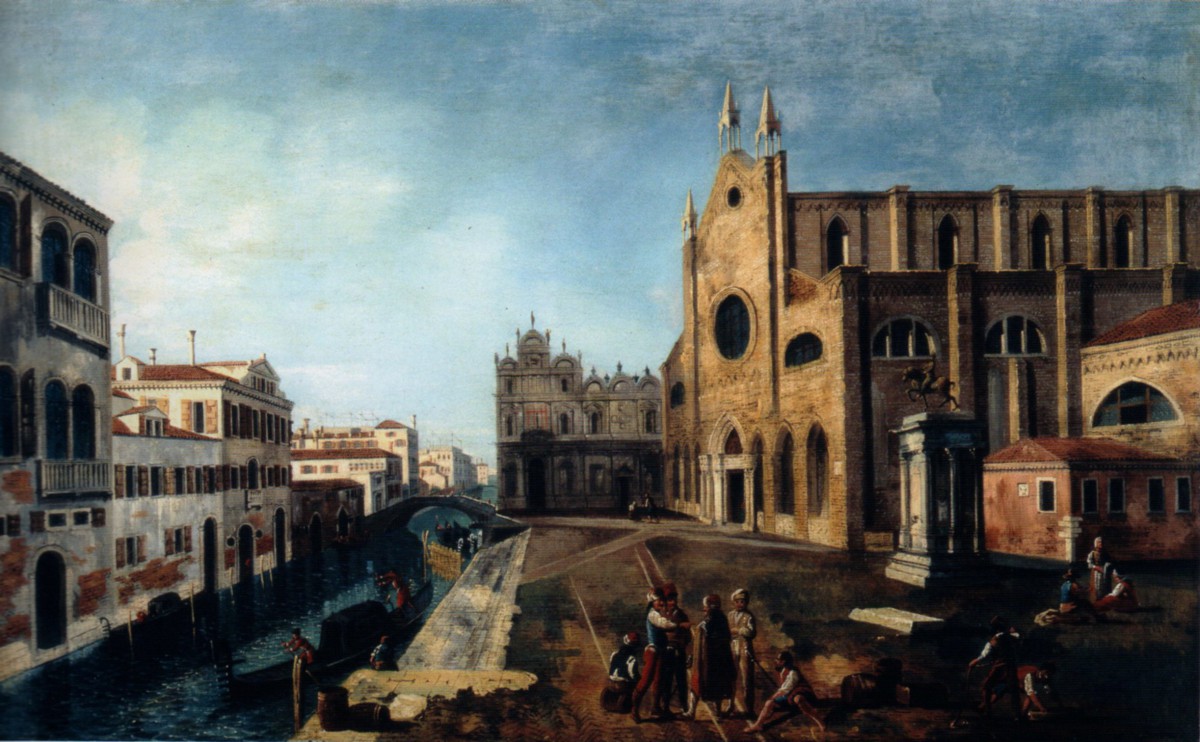
(this painting is from the mid 18th century – little has changed) Most important, I have a contract for at least two years, and extendible to four years.
Its good to have a home.


