 It’s the first time I’ve seen SUP boards on the Canal Grande. They seemed to do well when I saw them, but I’ve heard some of them ended on the water at the Rialto Bridge, which is often a busy spot.
Category: Living in Venice
About my experience of living in Venice
-
SUP in Venice
It’s the first time I’ve seen SUP boards on the Canal Grande. They seemed to do well when I saw them, but I’ve heard some of them ended on the water at the Rialto Bridge, which is often a busy spot. -

Camouflage, Burano style
On Burano orange, lime, lilac and pink are viable camouflage colours.
Burano is known for its brightly coloured houses, and its a fun pass time to search for houses matching people’s clothes.
You don’t need to stand out just because you’re wearing pink.
-

Redentore 2011
The Redentore Feast is one of the major annual celebrations in Venice, and one with a massive local participation. It takes place on the third Sunday of July, and on the evening before there is a huge display of fireworks just before midnight. It usually last around 45 minutes.
I went there with a bunch of friends in an old verigola belonging to the Arcobaleno association, and we got a place in front row, just in front of the Punta della Dogana, with only a few gondolas and sandolos in front of us, which proved a very nice spot for getting some photos of the fireworks.
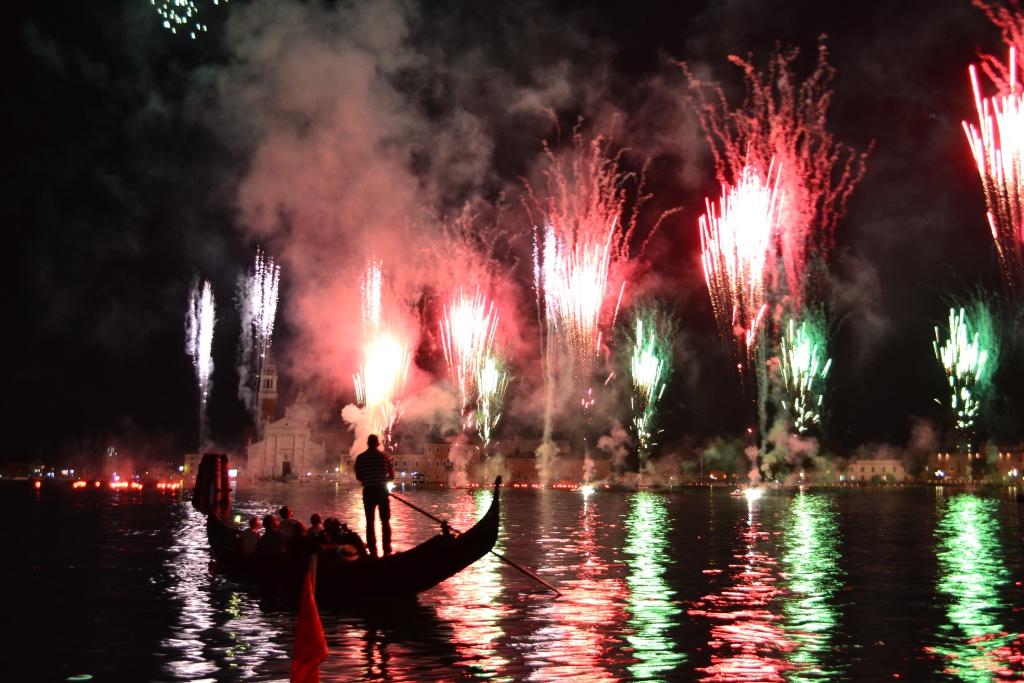
More photos after the fold ..
(more…) -

Training in the lagoon
 This guy just went up and down a short stretch of lagoon canal behind the Vignole, training in a little corner sheltered from the winds of the day.
-

Working boats
 Venetian boats at work. There’s a green grocer on a boat behind the gondola, and a topo to the right. Three different uses for boats in Venice.
-

Venetian Truck Drivers
 This boat is a “topo”, a Venetian truck, with a crew of two. One is steering, almost with the rudder up his behind, the other is sleeping soundly on the fore deck, while they pass a 14th century monastery building and a 17th century church.
-

The Naviglio di Brenta
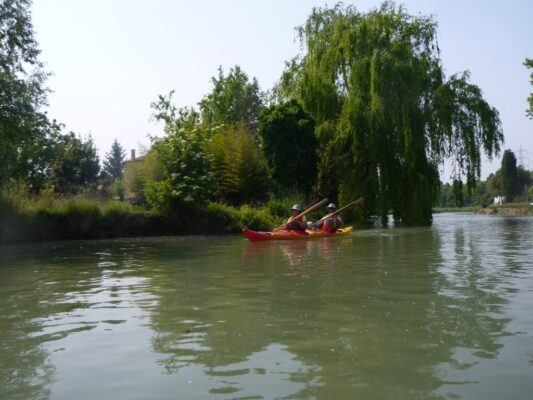 The Naviglio di Brenta is the old part of the river Brenta, which had its estuary in the Lagoon of Venice close to Fusina. After the demise of the city of Torcello in the 11th adn 12th century, the Venetian understood the cause. The river Sile had made a vast delta behind Torcello, causing the water to become more stagnant, more fresh and more mosquito friendly, hence malaria and the gradual depopulation of the once flourishing city of Torcello which is now all but gone, along with two other smaller cities of the northern lagoon.
The Brenta was making a similar delta just SW of Venice, so action was taken and in the 16th and 17th centuries the river was diverted several times, until it now runs directly into the Adriatic Sea near Chioggia. The original river bed was kept, controlled by several locks, so navigation on the route didn’t have to stop.
Last Sunday we took some kayaks to Mira, put them in close the the lock at Mira Porte, and paddled down the Naviglio to the next lock at Moranzani. It was a very quiet paddle, where we enjoyed the nature and the history along the canal.
(more…)
-

Reflections
At the end of the year we’re supposed to reflect on the year that passed. I have found that a bit hard this year, so I’ve decided to leave the reflections to the vaporetto (water bus) platforms of Venice. They do a good job at reflecting 🙂
Santa Maria della Salute

Santa Maria della Salute from the Giglio stop

Palaces on the lower Canal Grande from the Salute stop

San Giorgio Maggiore seen from the S.Marco stop

The Giudecca seen from S.Marco

The Lido seen from S.Zaccharia / S.Marco

San Giorgio Maggiore seen from S. Zaccharia / S. Marco

San Servolo seen from the Giardini stop

The Bacino San Marco seen from the Giardini stop
 Santa Maria della Salute from the Giglio stop
-

Lessico Veneto – Malamocco
I recently found some scanned books from Venice of times past. One of them is a kind of historical encyclopedia from the mid 19th century, and I must say it has its little oddities 🙂 The entry for Malamocco – a small hamlet on the Lido di Venezia with a glorious past – reads:Malamocco, Matemauco, Metemaucum. City which flourished in the first times of the Venetian society, located near the harbour, where the Madoacus, or Brenta (from where, perhaps, the name Matemauco) entered the sea. It was the capital on the Venetians, and seat of their doges (these had already abandoned Eraclea, or Eraclia) until the year 813 circa; it also had nine bishops, the last of whom were one Stefano Badoaro (see Bishops of Malamocco). By earthquake, or by horrible storm from the sea, it was destroyed between 1100 and 1102, and now nothing remains but well kept orchards and a poor hamlet. There, fleeing Austrian bullets (see san Giuliano del buon albergo), hunger, anarchy and the many other calamities that afflicted the illustrious and unfortunate Venice, in a few hours, by cholera, on the twentyfirst day of August of the year 1849, passed away serenely, because supremely pious, the woman of who writes. O reader, it will not hurt you to say a prayer for the peace of her soul.
Here’s the original:
“Lessico Veneto” by Fabio Mutinelli, published in Venice, 1849, p.238. -

Female Gondoliere
Until recently all gondoliere in Venice were men. This summer a Venetian woman, the daughter of a gondoliere, decided to try the exam, and she passed it as the first woman ever. New gondoliere will start to work as substitutes for the older gondoliere, taking their turns when they’re unable to do so. They also man the gondola ferries across the Canal Grande, which is where I first saw Giorgia at work earlier this autumn. It is not always easy to take photos on short notice in the Canal Grande, but as we had to wait for the ferry to pass, I got the chance. I later saw her again in a better position to get some photos. I’ve seen her a couple of other times, so it seems she works on the gondola ferry service at San Toma’.

 Some years ago a German woman, Alexandra Hai, decided to try to become a gondoliere, but she has failed the exam several times. Her claim is that they failed her on purpose because she’s a woman and a foreigner. Their claim is that she isn’t good enough.
She started to work anyway as a “gondoliere de casata” for a small group of hotels, which ended her in court, but she won and can still be seen rowing clients around the canals of Venice, dressed in white. She can, however, only accept clients staying in one of the hotels she’s working for since her legal status is that of a “house gondoliere”.
 I haven’t seen Alexandra much this year, and I think the photo above is from the only day where I’ve met her rowing. Her gondola is still there in the Rio de la Verona, so I assume she’s still around.


