
Category: Living in Venice
About my experience of living in Venice
-
The Elagoonephant revealed
The elephant sculpture in the lagoon now has a father too – the sculpture is made by the Dutch artist Serge Van de Put.
-

End of Season at the Diadora
Today we had the end of season event at the Diadora rowing club, where I should have spent a lot more time this summer. Most of the morning was taken up by ‘social’ regattas for each of the types of rowing practiced in the club, both ‘English’ rowing (backwards in various types of boats), and Venetian rowing, voga alla veneta (standing up looking forwards). The Venetian race was held in sandoli a quattro. The eight boats were same boats as are used in the official regattas throughout the summer. They’re all numbered and differently coloured, so they’re easier to distinguish at a distance. I was in the violet boat, number 3, with Silvia, Rollo and Alessandro. Silvia is an accomplished rower, who have participated in races many times, so she knew exactly what to do and when. The rest of us were all more or less beginners, so Silvia’s coaching was much needed. I was a prua, in the front.Getting ready
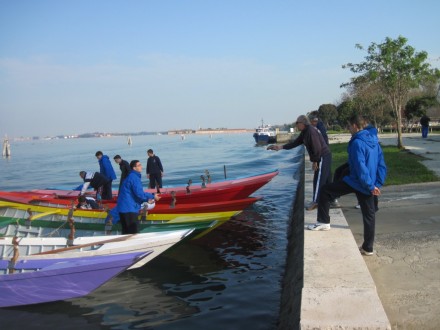 Fitting the forcolas on the boats.
 Wading around on the boats.
 Launching
 Getting everybody on board
Waiting
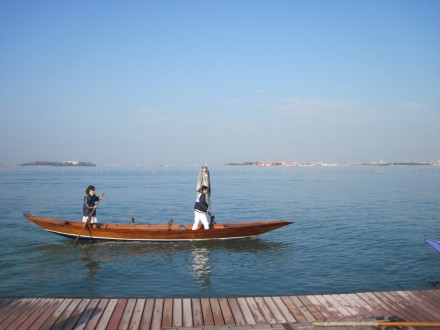 Getting the hang of the boat
 Spectators
 Waiting for the start
 Milling about …
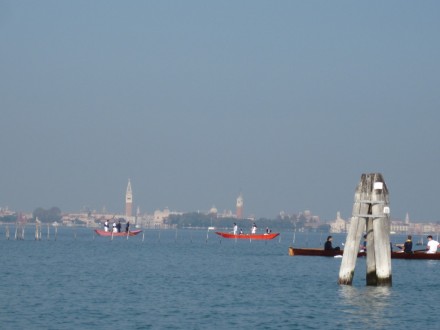 in one of the most beautiful spots on this globe
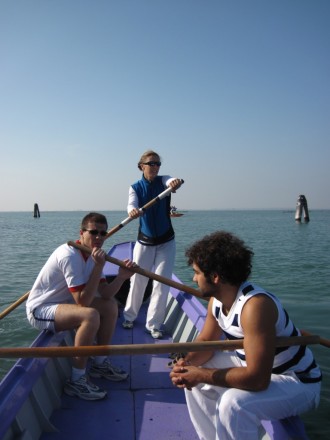 Still waiting for the start
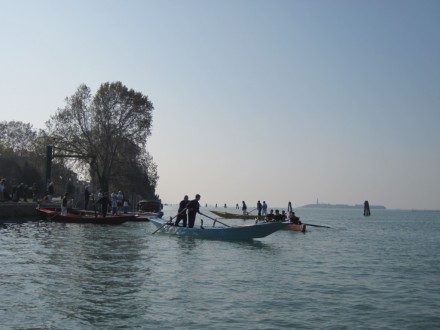 The last boats are coming out
Racing
Well, no photos, as I was rowing like a madman having Silvia in the back shouting orders at us continuously 🙂 The start didn’t come off perfectly, but we managed to keep up with the leading boats, and after the first 500m we rounded the buoy second. Silvia was shrewd enough to move us into the canal along the Lido, as the tidal flow there would help us. At that time we were second, so I don’t know what the boats behind us did. I assume they did the same. As we reached the finishing line I was completely out of breath and my legs were shaking, but Silvia paced us on mercilessly, and we finished the race in good order between the firsts.Pulcini in kayak
My friend Marco teaches kayaking to a handful of small children, and they participated in the day’s events too. What better place can there be in the world for learning to kayak?
 Marco needs to confer with the judges.
 The race has begun
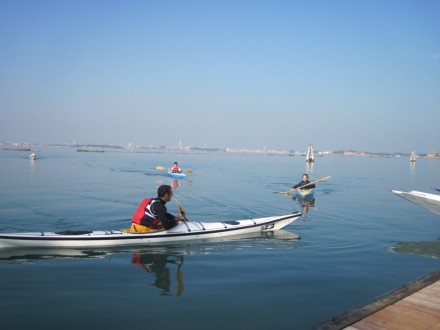 and the winner arrives triumphant.
Awards
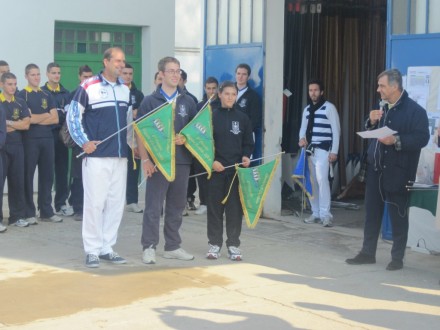 Green flags for third place
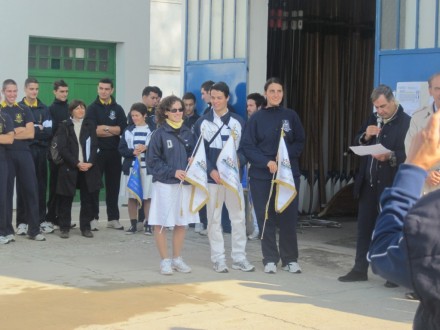 White flags for second place
 Red flags for first place
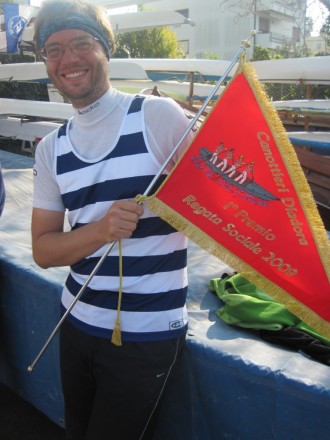 Your’s truly got a red flag 🙂
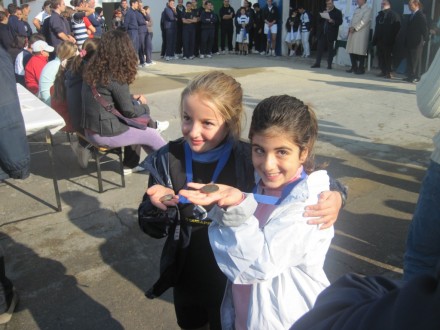 The kayak chicks got a medal each.
 The entire youth lineup of the Diadora
Socialising
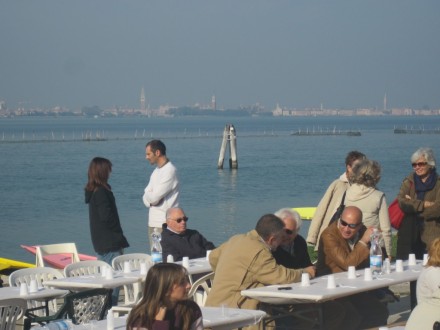 Could there possibly be a more stupendous place to hang out after a race?
Clearing up
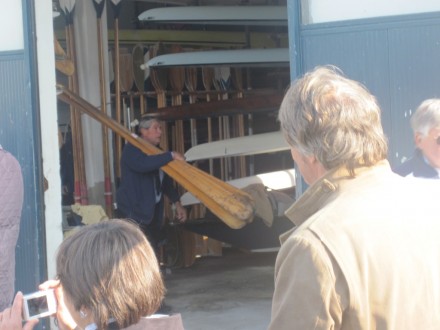 Chief coach Lino Farnea didn’t like his oars in disorder.
-

Vogando di nuovo
Last year I started rowing Venetian style, voga alla veneta, where you stand up in the boat, looking forward, pushing on the oar to move forward. I continued Venetian rowing when I returned to Venice this spring, but then work took over, and I haven’t been rowing for several months now.
Yesterday I finally went rowing again at the Canottieri Diadora. My friend Enzo, who has an orchard neighbouring the camp site where I start my kayaking tours from, had asked me to go rowing Friday morning. When I went to the club, I met Krystyna, an Austrian girl who has been rowing at the Diadora for three years.
Consequently, we went all three of us in a sandalo for three, towards Venice. Enzo, the more experienced rower, a poppa (in the back); Krystyna, the smallest of us, a prua (in the front); and me in the middle.
It took a little while before I quite got the hang of it again, as we crossed the lagoon south of Venice. The waves weren’t much, maybe half a foot, but still enough to make me feel unstable stading up in a rather narrow boat in the middle of nowhere.
Conditions were calmer when we arrived at the Giudecca island, but then we had to cross the Canale Giudecca, one of the busiest and most wavy places in Venice. It was definitely difficult, but we got across safe and sound, passed though one of the smaller canals on the other side, and entered the lower part of the Canal Grande, between the Accademia bridge and the Madonna della Salute church.
The Canal Grande was quite calm and rowing was easy. We got in a bit of a squeeze between some gondolas near the Rialto Bridge, but nothing serious. Its always a busy place, not matter what kind of boat you’re taking there.
We moored illegally on a private mooring near the Rialto Markets and went for a snack. Enzo knew a good little place, and on the way we passed the fish markets. I’ve never really spent any time there in the morning before, always just rushed past on my way to work, so I took some quick photos on the way, without losing sight of the other two, who were clearly a lot more attracted to the prospect of vino and cicchetti.


The little place Enzo took us to were completely devoid of tourists, which is quite rare in Venice, the only other guests being a handful of elderly men drinking wine and reading newspapers.

A door in a nearby calle had a forcola for a handle.

We returned the same way we came. First under the Rialto Bridge, then down the Canale Grande, through the Rio San Trovaso, across the Canale Giudecca, through the Giudecca and across the lagoon to the club at Ca’ Bianca on the Lido.
The trip down the Canale Grande wasn’t that difficult, except for a bit of traffic. There was plenty of space for the oars most of the time. In the smaller canals its more difficult, as we had to be alert and pull in the oar each time we passed a moored boat, a stair, a pole or something else restricting our space. The Canale Giudecca was as difficult on the return journey as on the way out, but we made it across anyway. Crossing there is quite an exercise in balance, and the conditions weren’t even bad, compared to what I’ve seen there while kayaking.
The return across the lagoon was the most challenging part. The wind had picked up a bit, so we had it from the front left, and Enzo moved me to the the back position, a poppa, but as I had to push hard to keep the boat on track, I soon managed to dislodge the oarlock, the forcola. As we were entering a canal near S.Clemente the time was not for shifting positions, and I continued with a still more wobbly forcola until we were safe across the canal. Then Enzo moved back a poppa and we rowed rather slowly back to the Diadora, as the forcola would no longer stay put if put under pressure.

Back at the club eight very colourful sandoli were moored. They are eight of the ten sandoli the city of Venice has for the official regattas during the summer. When not in use for the regattas, the various rowing clubs of Venice and surroundings can borrow them for training or use in unofficial regattas.


The boats are at the Diadora for the end of season event, which includes a club regatta in sandoli for four.
-

Vogata with VIVA
Last Sunday I was supposed to meet with Angela Nickerson, an American travel writer I’ve met via the social networking site Twitter, to talk about Venice and kayaking and much else. Two other ‘Tweeps’ were invited too, Nan McElroy and Monica Ceserato. Nan McElroy is an American travel author who lives in Venice for some years. Venetian rowing, Voga alla Veneta, has become her great passion, and she is very active in promoting Voga alla Veneta in Venice. Her latest endeavour is the cultural association VIVA which has the aim promoting Voga alla Veneta and ameliorating the conditions for traditional rowing boats in Venice, where motorised traffic have made rowing much more difficult. Monica Ceserato is Venetian from the mainland, where she runs a B&B in the small town of Malcontenta, 15 minutes by bus from Venice, and does Italian classes for foreigners and English classes for locals. Monica came along with her British husband Chris and their son Pasquale. When I arrived at the meeting point, the bar Al Timon in Cannaregio, I found a message on my phone that Angela had been taken ill so the meeting was cancelled. However, both Monica and I had made the journey, so we decided to meet anyway to chat and get to know each other. Nan had promised Angela a tour in a new boat VIVA had acquired, a beautiful sandolo buraneo. The sandoli forms a whole family of traditional Venetian boats, mostly from around the northern lagoon, and the sandolo buraneo – or rather the sandolo grando da buranèi – was used around the island of Burano, some 8km north of Venice, for fishing and transportation of goods and persons. Now it is mostly used, painted black and decorated beyond recognition with seats and figurines, for a gondola-like tourist service in the city of Venice. The sandolisti sit at their stations throughout the city centre, calling out ‘gondola, gondola’ at passing tourists, though their boat is nothing like a gondola to even an untrained eye. Nan decided to do the boat ride anyway, without Angela, so she went to find a rowing mate and fetch the boat. After a while she returned with Amelia in the boat.
 There was quite a bit of current in the canal, due to the changing tide, and the two girls rowing had to work hard. They rowed us through the Cannaregio area, down the Rio della Misericordia and the Rio Noale to the Canal Grande.


 From there we continued towards the Rialto Bridge.

 Even though I haven’t rowed much this summer, Nan let me have a go at rowing a bit down the Canal Grande. I’m in no way an expert rower, but it worked OK and it was good fun.
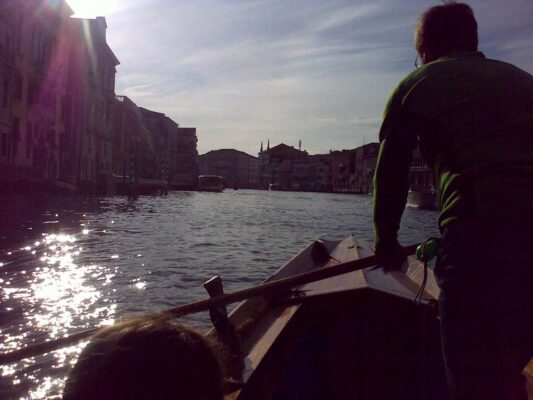
 With Amelia back at the front oar we went up the Rio S. Polo, Rio S. Agostino, Rio S. Giacomo dell’Orio and Rio S. Zan Degolà to Canal Grande, across and down the Rio S. Maddalena where the current played games with the boat again.
We stopped at S. Maddalena for cicchetti and a drink.


 Monica, husband and son said goodbye here and walked to Piazzale Roma to catch a bus back to the mainland where they live. I continued with Nan and Amelia to moor the boat at its spot in the Rio della Madonna dell’Orto.
Unfortunately a motorboat had usurped the boat’s mooring. While we waited for the owner of the motorboat to return, the girls spend a bit of time finding an place to unload the stuff on board. Just as we had given up waiting and had started to move the motorboat to another mooring, the owner appeared to remove his boat.


 Amazingly, the tour was a first for Monica and her family. Though Monica is Venetian by birth, she’s from the mainland, and none of them had ever toured Venice in a boat before.
That part of the experience wasn’t new to me, as I spend more time in Venice in a boat than on land, but the tour was a first for me too. It is the first time ever I have rowed Venetian style in the city of Venice and on the Canal Grande.
Links
Angela Nickerson: Nan McElroy: Monica Ceserato:- Faronhof B&B
- Tutor of English and Italian
Monica Cesarato – tutor of Italian and English
Italian native speaker, tutor of Italian and English. -
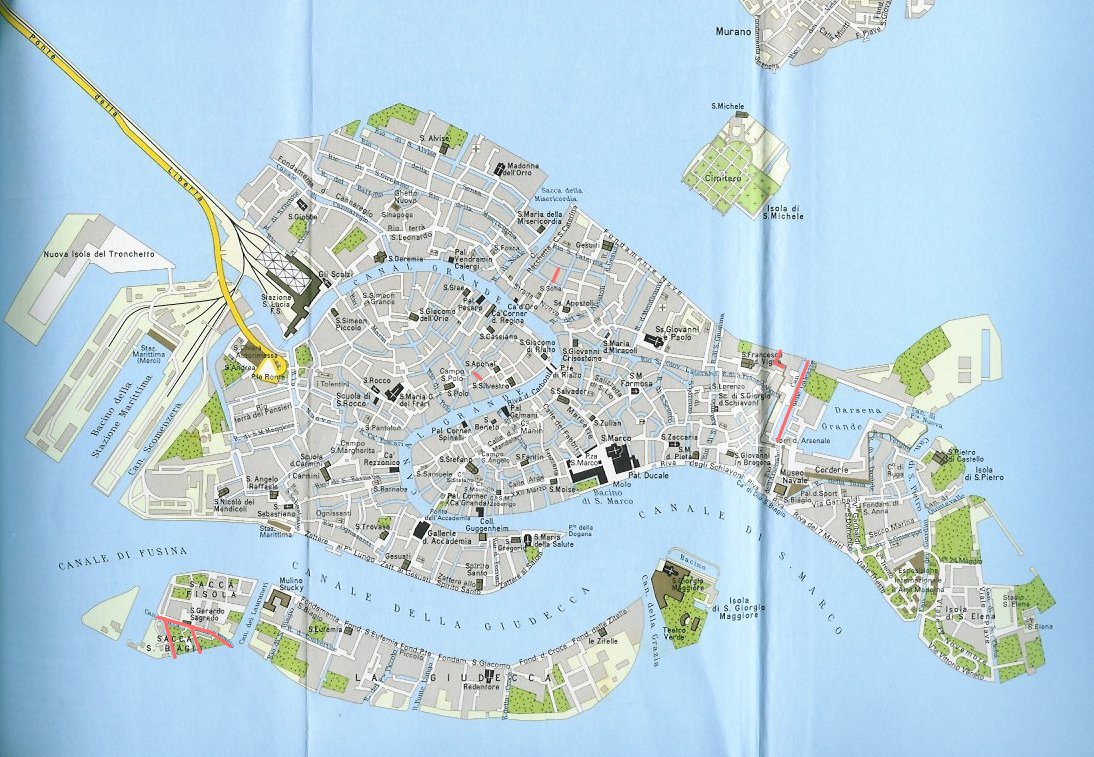
Uncharted Venice – part II
A couple of weeks ago I made a map of the rii of Venice where I had never been paddling – I had made a few mistakes which I have updated on the original post. Since then I have looked for occasions to paddle through some of the few remaining rii, and the list has been shortened considerably, as of this map.
The remaining un-paddled rii are:
- Rio dei Meloni, S.Polo (N part only, there’s an unpassable bridge in the middle)
- Riello S.Sofia, Cannaregio (dead end)
- Rio dell’Arsenale, Castello (dead end at the Celestia vaporetto stop)
- Canale delle Galeazze, Castello (inside the Arsenale – navy area)
- Darsena Arsenale Vecchio, Castello (inside the Arsenale – navy area)
- Canale Sacca Fisola (Giudecca)
- two nameless canals on Sacca Fisola and Sacca S.Biagio.
- Rio di S.Giobbe, Cannaregio
- Rio S. Maria Maggiore, Dorsoduro (both parts)
- Rio delle Burchielle, Dorsoduro
- Rio della Cazziola, Dorsoduro (only kayaks can get through)
- Rio Briati, Dorsoduro
- Rio delle Erbe, S.Polo
- Rio S.Michiel, S.Marco
-

High Water Gondola Rowing
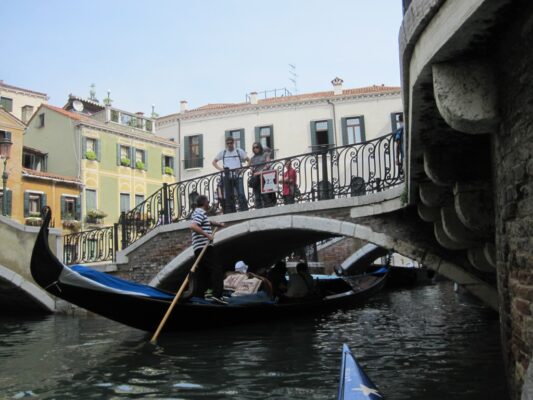
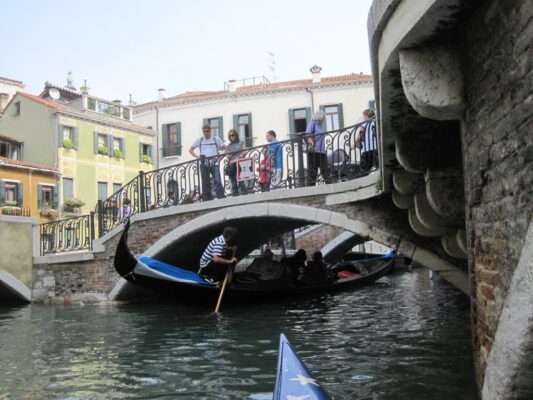
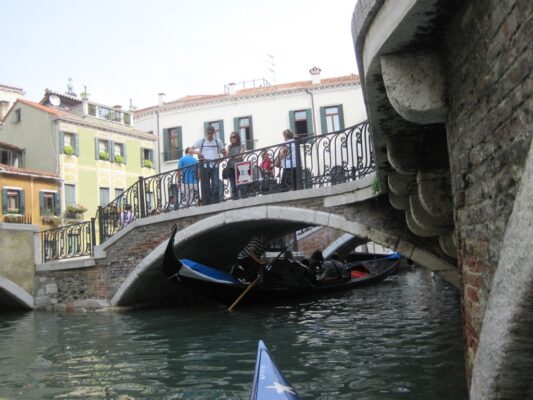
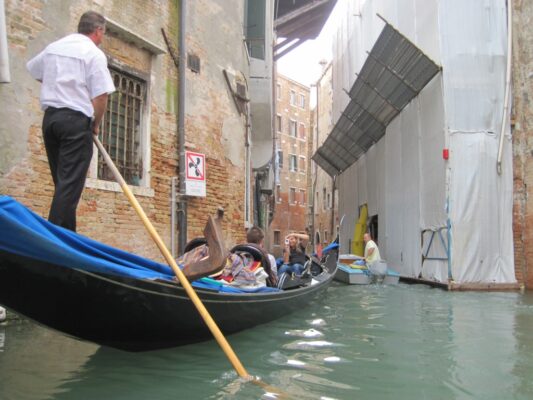
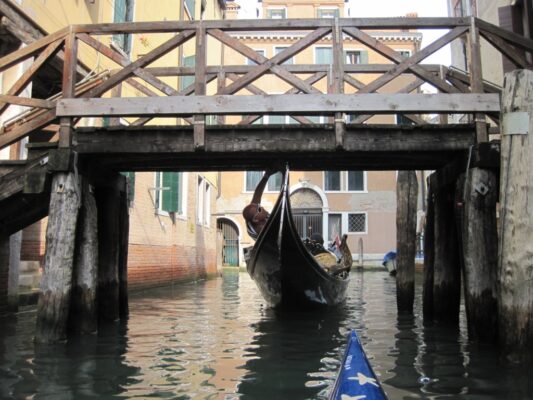
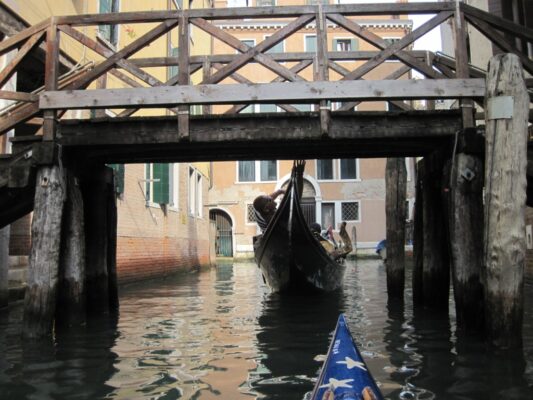
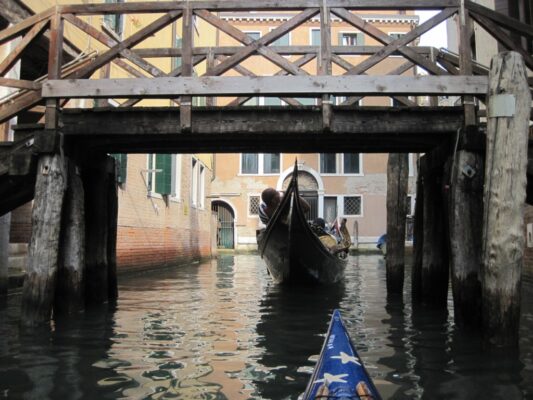
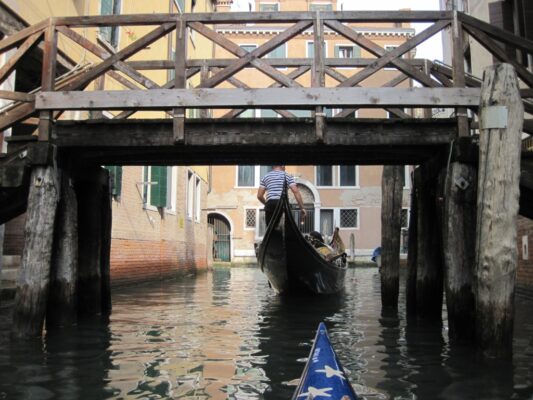
Rowing a gondola at high tide requires some special skills. The higher water makes for lower bridges, and a gondola is not a low profile boat that’ll just go under anyway. The gondoliere have to do all sorts of weird manoeuvres to get the boat under the lowest of the bridges.Crouching
The simplest way of lowering the height of the gondola is for the gondoliere to crouch on the back deck, while he keeps the oar straight backwards, propelling the boat with a sculling movement. The forcola, or oarlock, has a bend exactly to allow the operation where the oar is almost parallel to the boat.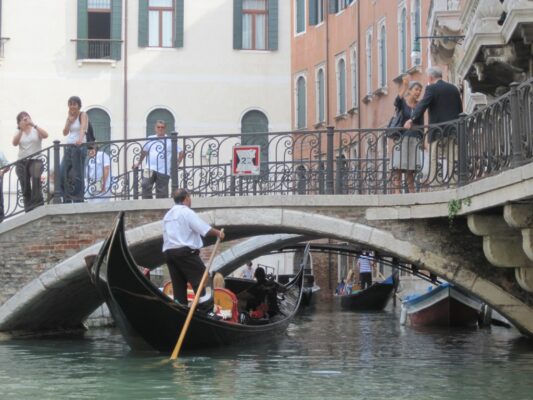
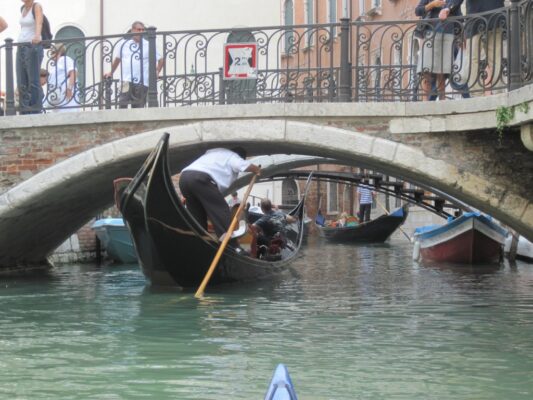
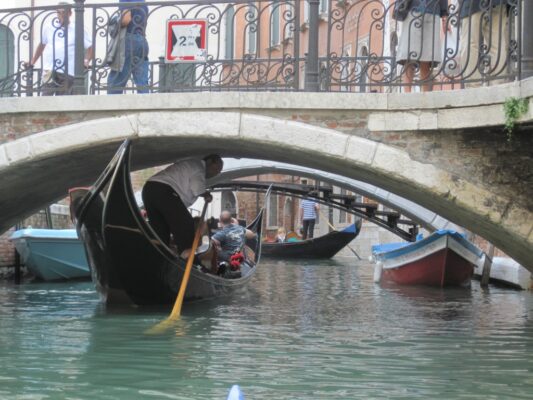 Another example of the crouching gondoliere, same place near Santa Maria Formosa:
Edging
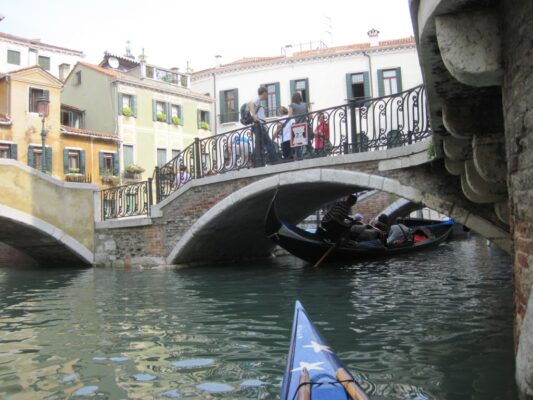
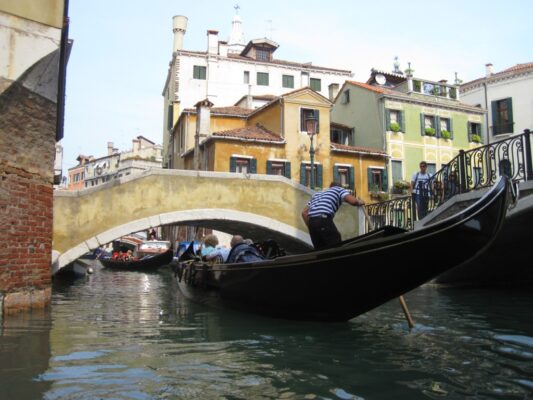
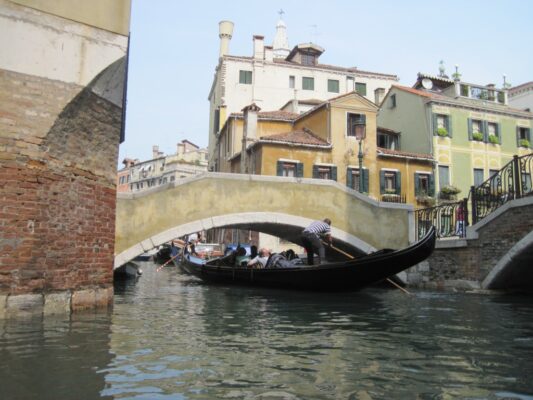
If the bridge is very low, the gondoliere might have to edge to boat to lower the stern ferro, which is the highest point of a gondola. He will do so by stepping over to the right side of the boat, in front of the forcola. From that position he will scull the boat forwards. On many gondolas the stern ferro is on hinges, so it can be flipped down. If the bridge is too low for even the bow ferro the pass, he will have to edge the boat even more, by telling the passengers to all sit on the right side of the boat. From Rio del Mondo Nuovo, near Santa Maria Formosa: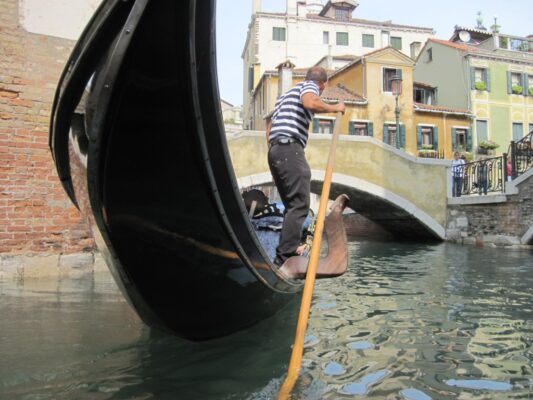
Lying down
At times the gondoliere will have to pass a bridge where there’s just only enough space to squeeze through, and to make sure that he will not get stuck, with ferri scraping the underside of the bridge, he will lie down on the back deck of the gondola, and push it along with his hands until the stern ferro is well through the passage. From Rio San Provolo, S.Marco: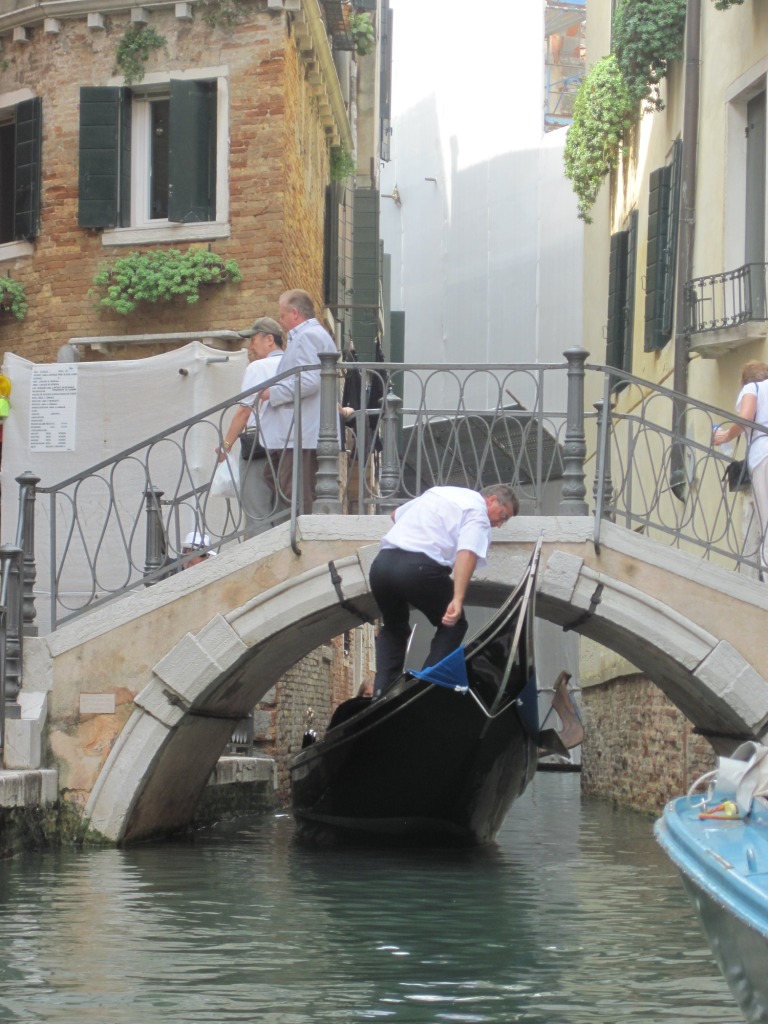
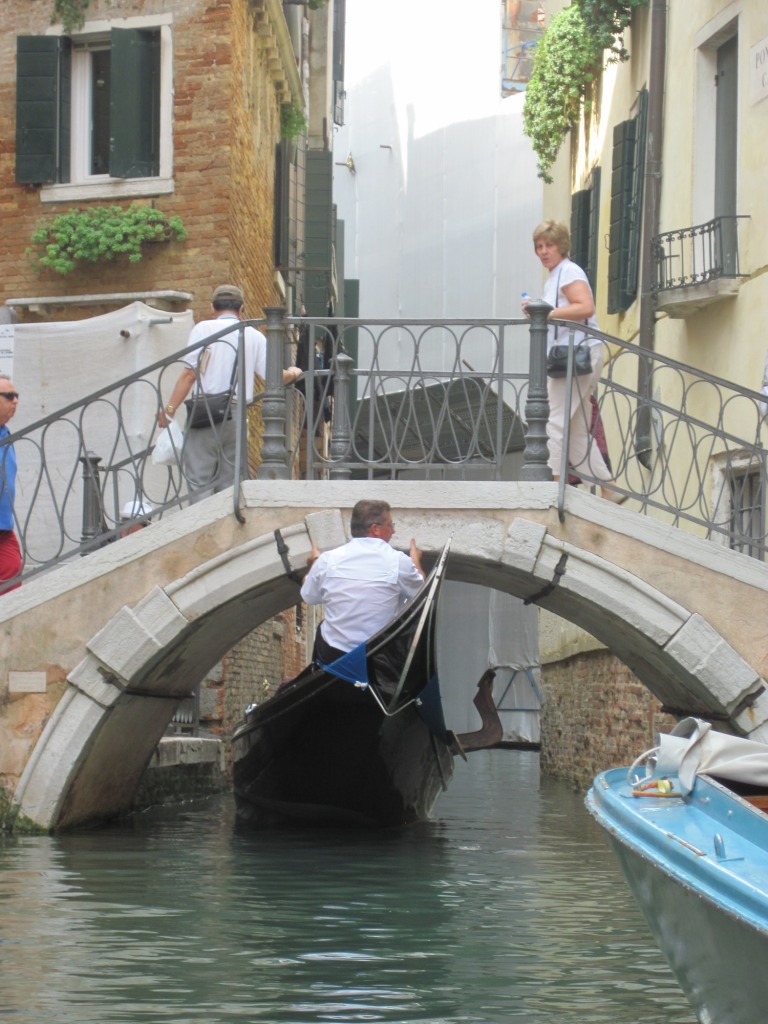
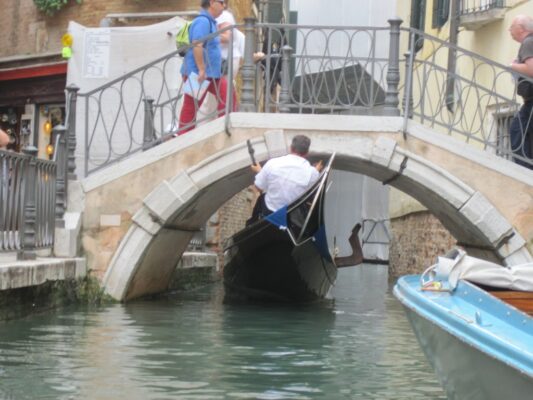
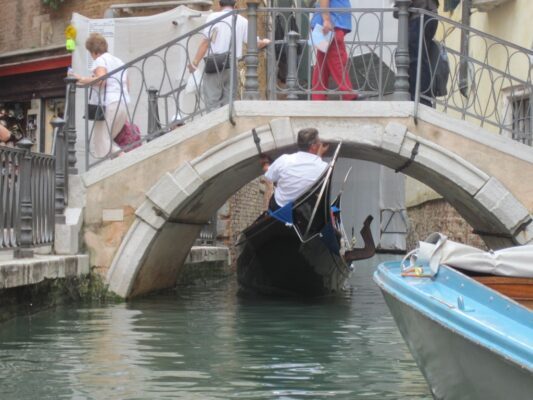
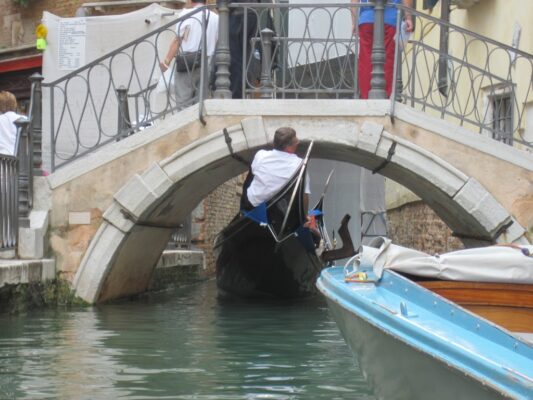
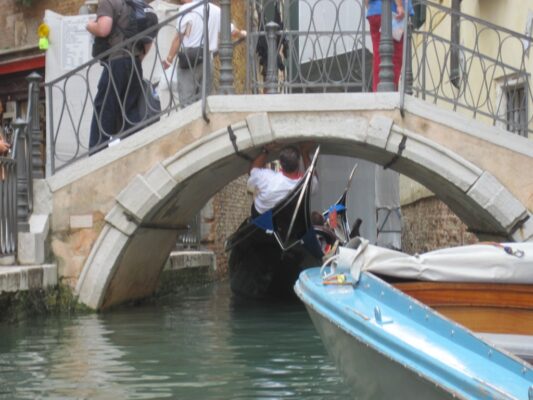
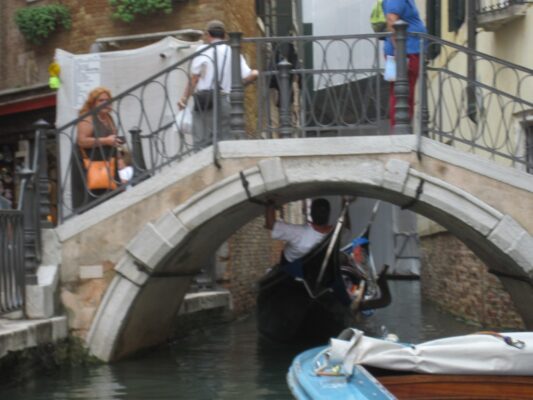
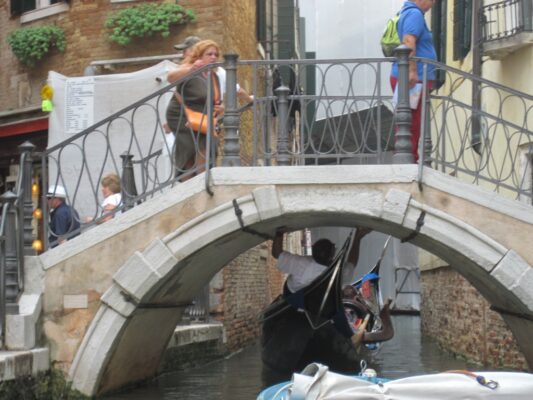
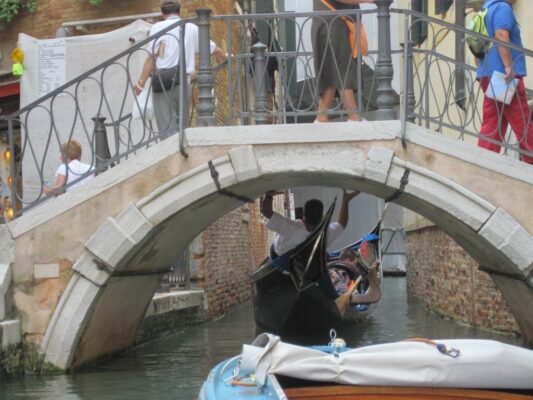
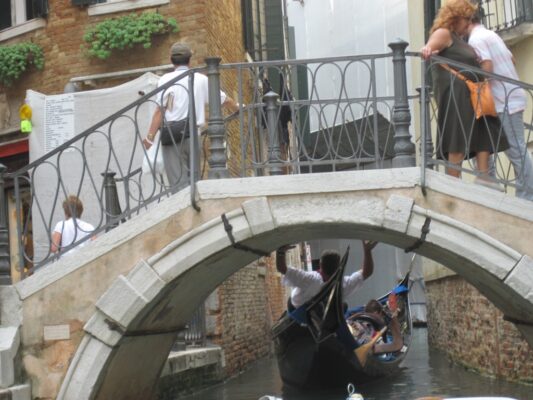
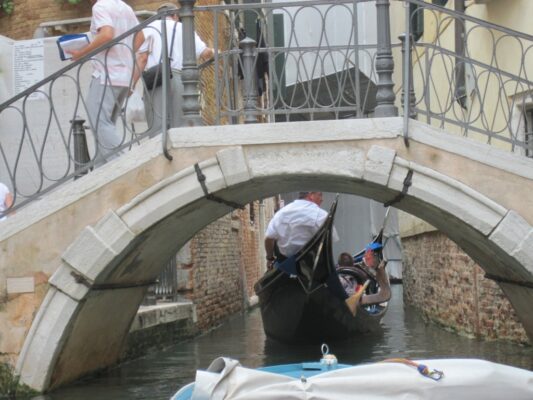
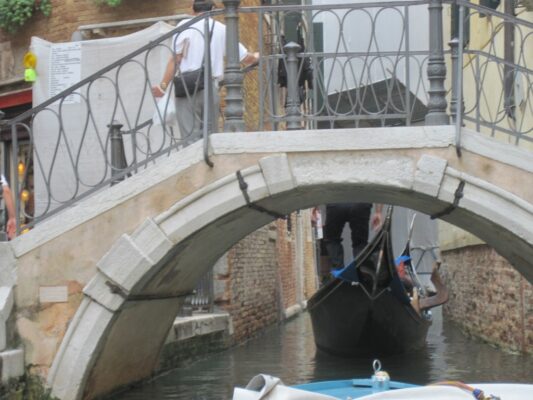

 And another case from Rio della Maddalena, Cannaregio:
-
Uncharted Venice
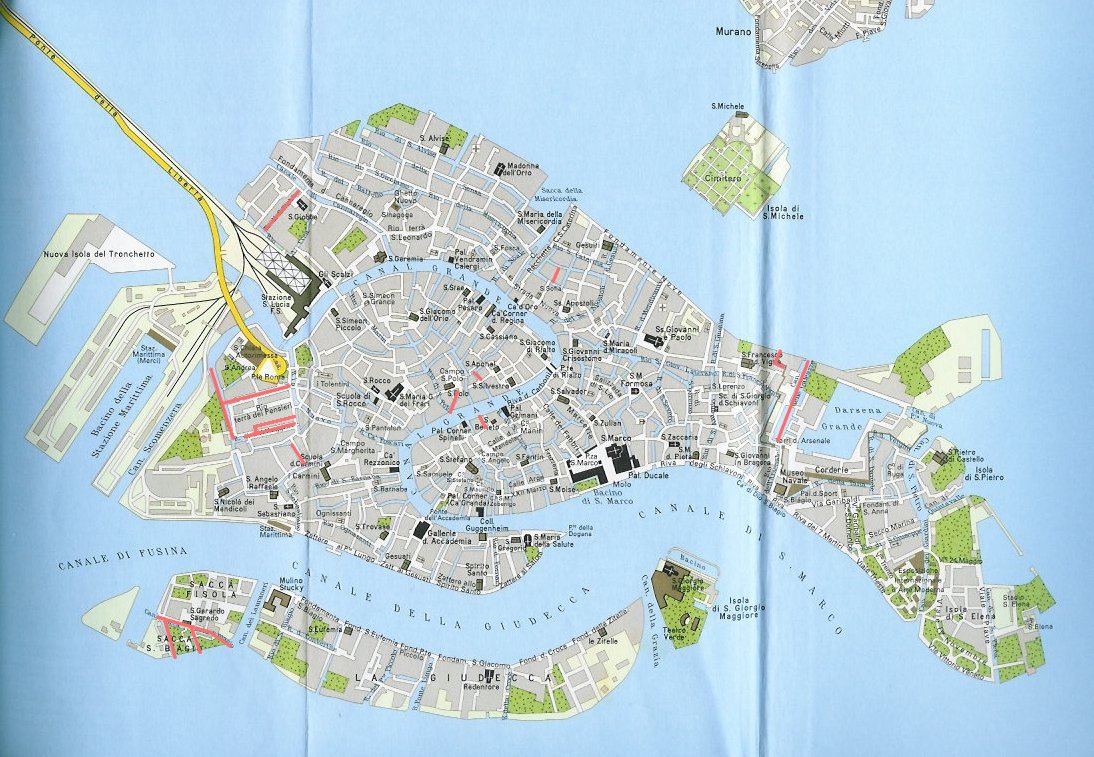
Venice is said to have some 150 canals, and on top of that a lot of canals were interred in the 19th century for various reasons. I was recently asked if I had paddled all the canals of Venice, and I haven’t. There are parts of Venice with unpleasant traffic or just run down places where you don’t go unless you have to, and even if I have been to many of those places too, there’s still a handful of canals I haven’t paddled through yet. To get an idea of how much of Venice I’ve paddled I’ve marked in light red the waterways where I haven’t been, on this map.
Maybe half the unexplored canals are dead ends where you’d have to back out again because there’s no room to turn around. One is military and has a chain across to keep boats out. The canals near Piazzale Roma and Canale Scomenzera are places where I would never take anybody unless I was really certain of their paddling skills, because of the heavy traffic there. Those are the places where goods are loaded from trucks to cargo boats and vice versa. -

The Buddhist Gondoliere
In July this year, I saw this gondola stopping to let clients disembark at Campo San Barbaba in the Dorsoduro sestiere, and it immediately caught my eye as different. Watch the foredeck, and in particular the little figure often placed there.
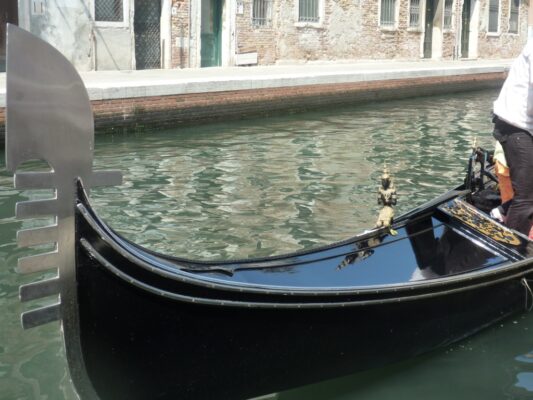 No an angel, not a little soldier, not a little holder for a few flowers, but a Buddha.
 I had a chat with the gondoliere, and when I asked why he had a Buddha and not an angle like most others, he just replied that “that was his religion”.
Here’s another photo of the figure taken the gondola station at Santa Maria Gloriosa dei Frari.
 I have talked to a few other gondolieri about it, and they have told me that there is another Buddhist gondoliere around, who has a Ganesh (the Elephant god) on the foredeck, but that he’s working off San Marco where it is harder to spot little details like that on the boats. In any case, I’ve never noticed that boat around.
-

The Angry Elagoonephant
The local above average size lagoon mammal can have a bad day. If the weather is foul, he is foul too.

-

Rainy Day in Gondola
Some people won’t renounce their gondola ride, not even if its raining cats, dogs and medium sized lagoon elephants.

 Photos from Rio di Santa Marina, on September 14th, 2009 – a fairly humid day in Venice.
-

Doing the Lagoon Walk
The average depth of the Lagoon of Venice is not much, about 1.2m when the tide is at the historical zero mark, but much of the lagoon is a lot more shallow than that. The tidal difference can be up to 1.5m, from about 0.5m below the historical zero mark to 1m above, so it is not always easy to know if you can actually pass a certain spot in the lagoon at a given level of tide. Sometimes we make mistakes and we’ll have to do the lagoon walk:


