 Good thing they have road signs in the middle of nowhere.
Category: Living in Venice
About my experience of living in Venice
-

Pussy Boat
One wonders what they were thinking. Spotted on Burano along the Fondamenta Pescheria on September 28th, 2009.
-

Bello e tranquillo
There’s a lot of dogs in Venice, and many are seen in boats, often up at the bow where they can see and smell everything. This one particularly caught my attention: bello e tranquillo.

-

Book: Barche del Golfo di Venezia
A dear friend of mine recently gave me a beautiful gift – the book Barche del Golfo di Venezia – an illustrated description of most of the traditional boats of the Venetian lagoon and the upper Adriatic Sea.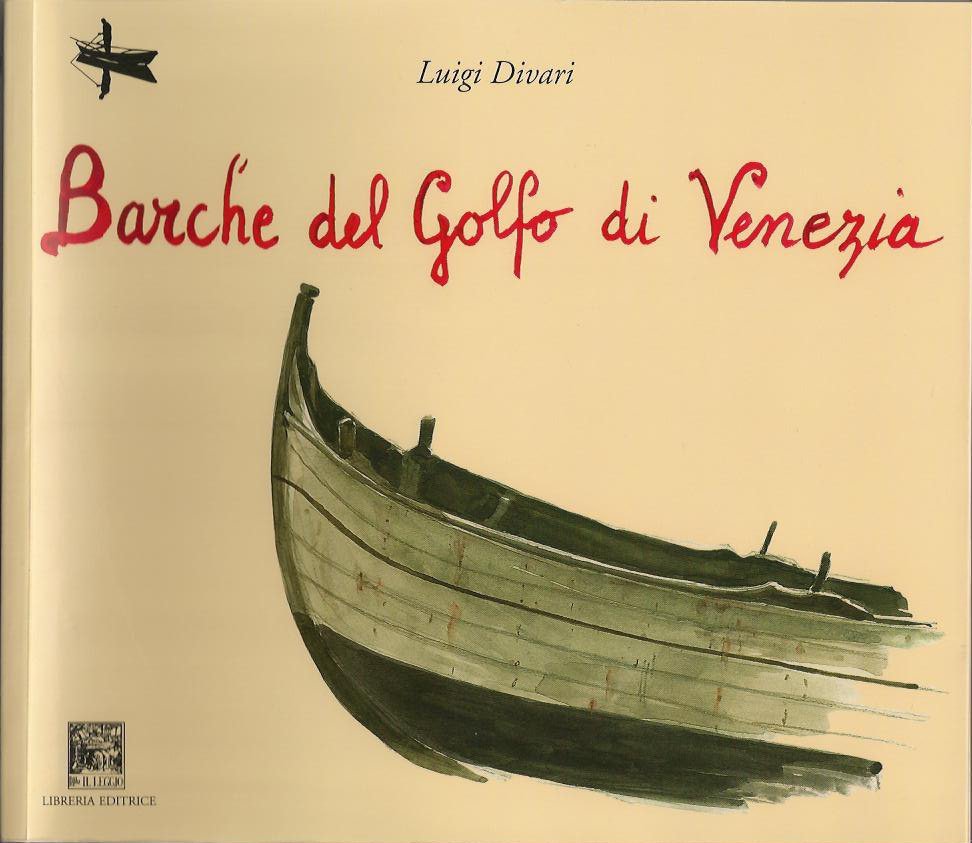 The various chapters describe not only the different types and classes of boats, both rowed and sailed, but also many of the now disappearing crafts associated with boats and sea faring in the lagoon area, and quite a bit of the practical, social and cultural context in which the boats were made and used. Many of the vessels are no longer used, and of some not even a single complete hull has survived.
The entire book is generously illustrated with beautiful water colours made by the author.
The text is in Italian with words, phrases and quotations in Venetian.

 Luigi Divari, Barche del Golfo di Venezia, 2009, ISBN 9788883200878, Il Leggio Libreria Editrice, Sottomarina di Chioggia (VE), Italy.
-

Lagoon turtle
There aren’t many reptile species in the lagoon of Venice. The lucertole are all over,there are snakes on some islands, and apparently one species of pond turtle, though I’ve never seen one of the those. Yesterday, however, I saw what looked like a different kind of turtle. We were paddling across the Canale delle Navi, between the Arsenale, Murano and le Vignole, which is a place with a lot of traffic, when I spotted something different in the water. It didn’t move but it had a too weird shape to ignore, so I returned back into the canal to find it again.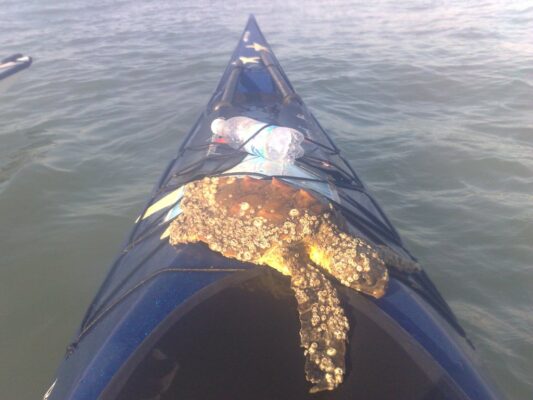
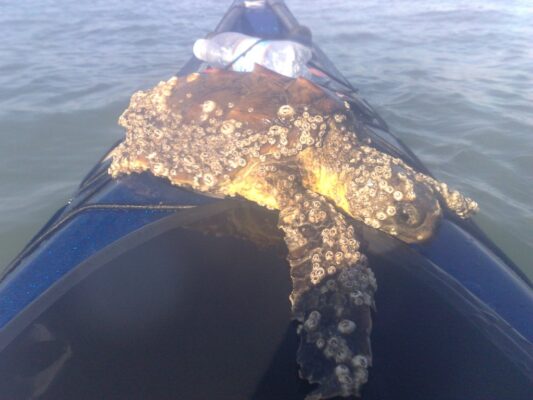 It looked barely alive when I picked it up, it hardly moved, but I took it to a more sheltered and shallower place and let it go, and it started swimming again.
I have no idea which species it is. The size matches the European pond turtle, but I have never seen one of those with spines on the back like the one has.
-

Pied a terre – Venetian style
One day as I was paddling through some of the smaller canals in the sestiere S.Marco, close to the Fenice, I spotted this little sign in a window directly on the canal:
The sign reads: “Pied a terre of 50 mq, completely restored with high quality details”.
Even though I was looking for a place to live at the time, it probably wasn’t just that pied a terre I was looking for 🙂
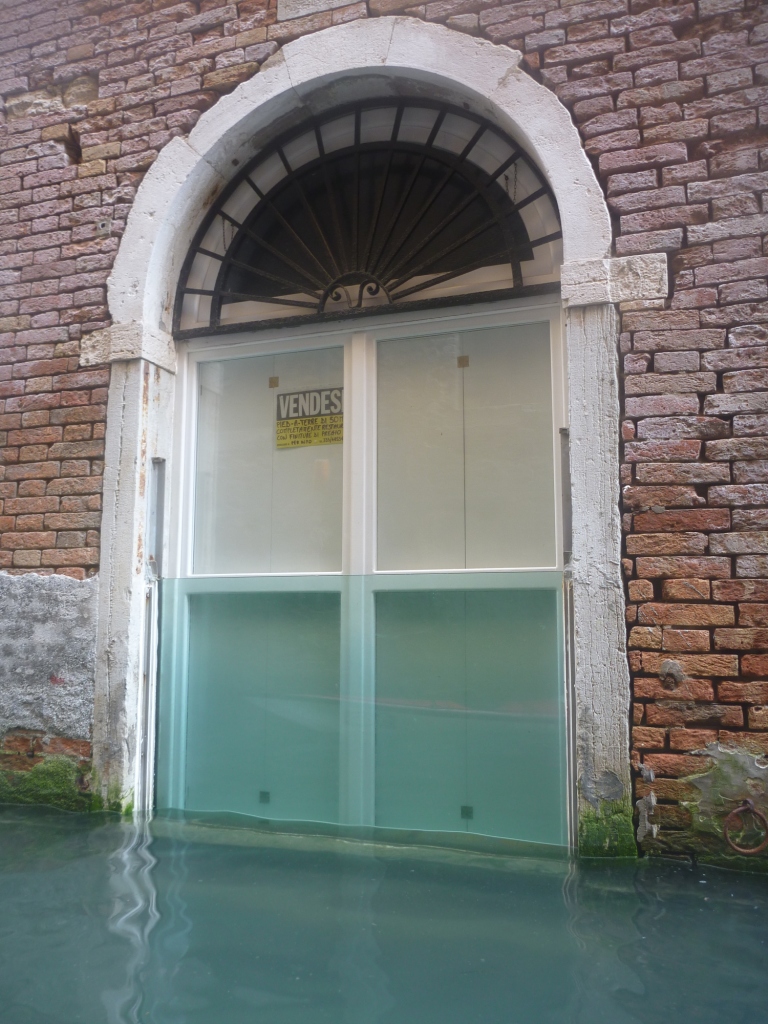 Pied a terre or pied dans l’eau ?
The spot is on the Rio de Verona on a little used stretch between the Fenice and the Rio Malatin / Rio Sant’Angelo.
-

The Abandoned Islands of the Venetian lagoon
In 1978 two Venetian men in their mid twenties rowed around the lagoon of Venice, photographing all the abandoned islands there. The result was a book with photographic documentation of the state of abandonment of each island. Recently, some thirty years after, the book has been republished, now with a English parallel text and some recent pictures of some of the islands. Some islands are in a better state, but others are much worse.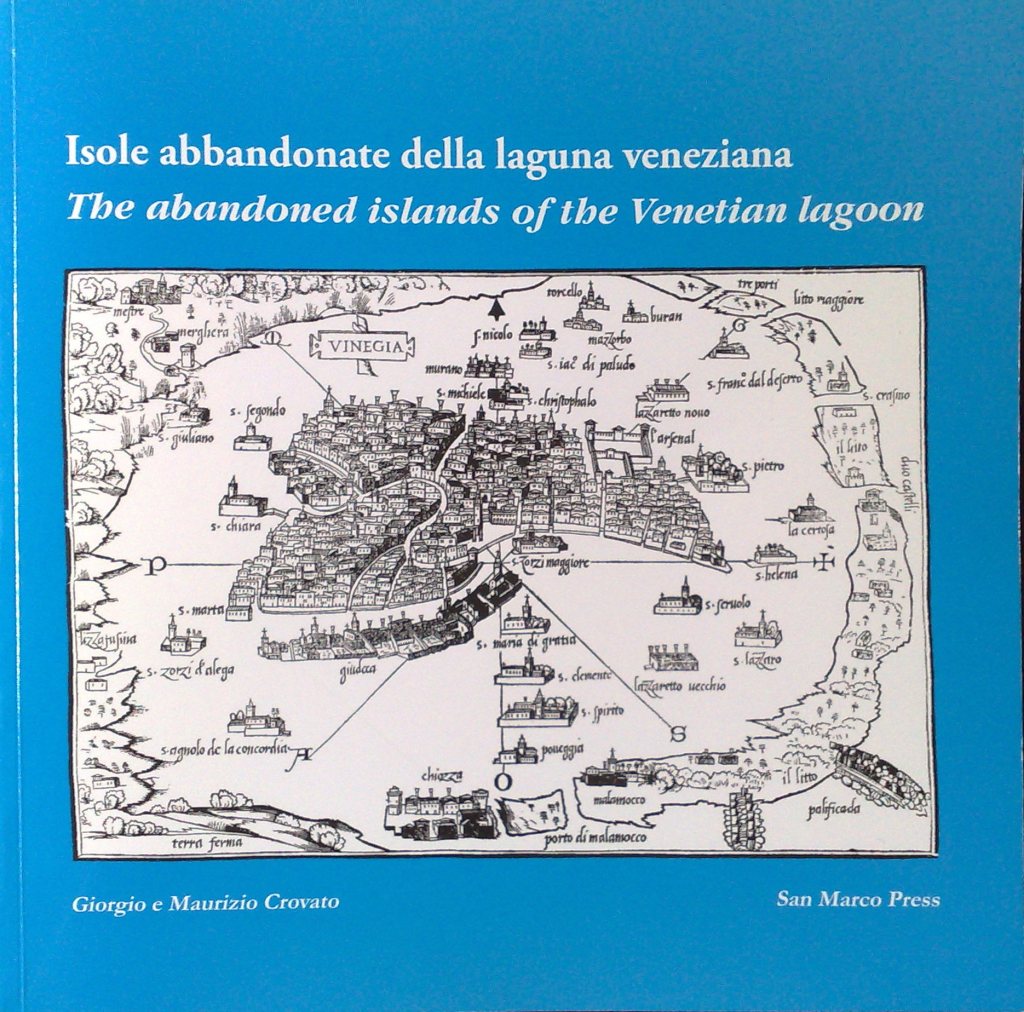 As a frequent traveller in the lagoon this book was a must have, and I bought it a few days ago.
Many of the islands in the book are places I have been many times, and as recently as this week I have been to S.Giacomo in Palude, Lazzaretto Novo, Sant’Ariano and La Cura, taking my own photos of the state of disrepair or recovery of each. As a historian it is very hard not to be intrigued and curious about the ruins and the past of these islands, and this book is a great help in understanding why the islands are like the are now.
Here are a few picture I’ve taken in the last week from some of the islands (left to right: S.Giacomo in Palude, La Cura and Sant’Ariano):
I still haven’t read it all. Many of the texts are reproduced from old descriptions of the lagoon islands, mostly 19th century texts, and the Italian is quite hard to read. The English text is a lot easier, but it feels almost like cheating 🙂 The book is:


Isole abbandonate della laguna veneta The Abandoned Islands of the Venetian Lagoon by Giorgio and Maurizio Crovato, London (San Marco Press Ltd), 2009 (orig. 1978) ISBN 0955813867 Ten percent of the price will go a Venice related charity, depending on where in the world the book is bought. In Italy the money goes to the association that takes care of the Lazzaretto Novo island, which has been recuperated and restored since the first edition of the book.
-

Regata di Mestre
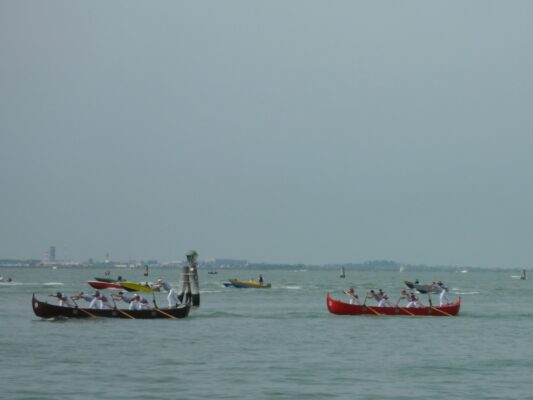
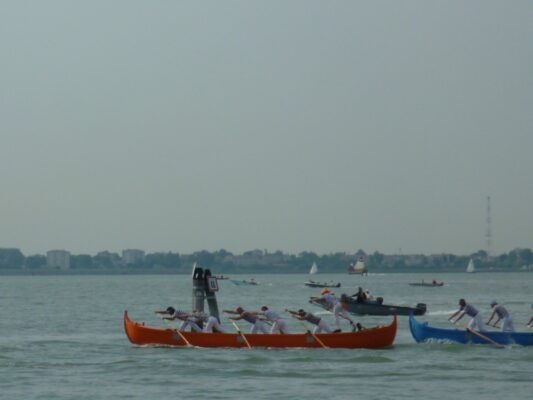
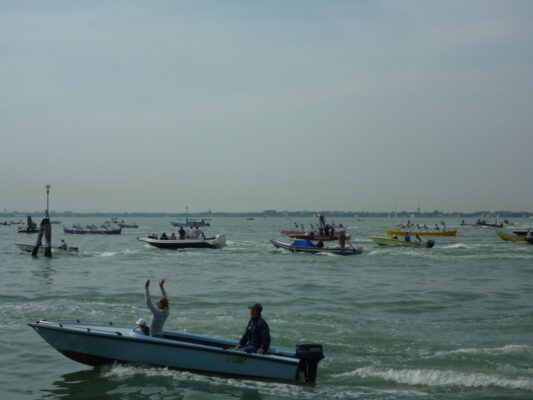
There are many rowing regattas in and around Venice during the summer, with various kinds of boats participating. The Regata di Mestre is the first of the season, and it was held last Sunday, May 10th. My initial plans were to watch it from a kayak, but Mother’s Day intervened causing friends to stay home, so in the end I walked to Sacca San Girolamo in the Cannaregio area, from where I had a good view of the canal where the race had to pass.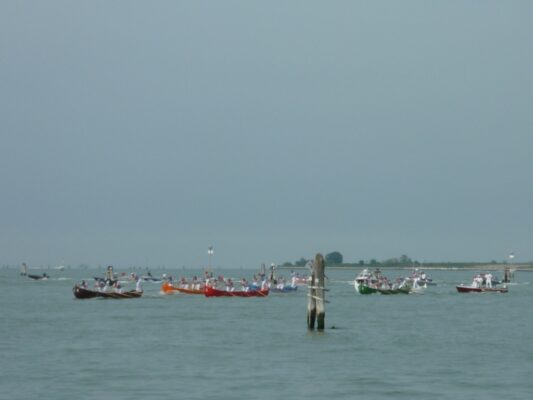 Mestre is a city on the mainland, but the race started from Murano north of Venice, touched the NW corner of the city in the Cannaregio area, before heading towards towards San Giuliano on the mainland, on the outskirts of Mestre.
I was watching at the mid point, so I didn’t get to see the finish, and I still don’t know who won.
-

Theme park Venice
Venice used to be a big city. Actually, it used to be a small empire, but that’s a few centuries ago now. Venice grew slowly from 130,000 in 1861 to almost 175,000 persons in 1951, but since then the city has almost collapsed, with an exodus from the city on water to the city on land, Mestre and Marghera. In 1961 Venice had lost 20% of the population just a decade before, and another 20% ten years later. In 1981 the population was just over half of the 1951 level, and now the population is just around 60,000, about 1/3 of the 1951 population. If the current trend continues the last Venetian will move away in 2040. Most Venetians have moved to the mainland nearby, the towns of Mestre and Marghera,where you can live a “normal” life, with a house, a car, shopping malls and all the other modern amenities you don’t have so easily in the lagoon. The population of Mestre and Marghera has grown even faster than the decline in Venice, with a recent drop. The population in the rest of the lagoon, on the Lido and the smaller islands, is mostly stable. The population of the entire municipality of Venice, lagoon and mainland was 316,000 in 1951, (Venice: blue; Lido and islands: red; mainland: yellow – source: Venice city council)
As the Venetians flee, the tourists move in.
It is hard quantify tourism in Venice. The graph below show the number of night spent in hotels, B&Bs, camp site etc, in Venice, in the lagoon and on the mainland in the last sixty year. This is one measure, but it excludes all the day tourists who come in just for a day, by car, pullman, train or cruiseship, but there really isn’t any reliable way to count them.
 In 1951 less than half a million tourists spent just over 1,129,000 nights in hotels in the city of Venice, with another 60,000 tourists on the Lido and 49,000 on the mainland.
In 2007 there were 2,2 million tourists in Venice for 5,9 million nights, with 188,000 tourists on the Lido and 1,3 million on the mainland. In all there were 3,6 million tourists for almost 9 million nights.
There is no reliable way of measuring the total number of tourists in Venice, but most estimates are between 15 and 20 millions tourists every year.
This means that currently, on an average day in Venice, there are more tourists than inhabitants, and on a busy day there are probably twice as many.
Venice is now in a situation where it is economically dependent on the high number of tourists, and as a consequence many of the few remaining residents of the city are feeling that the city administration care more for the needs of the tourists than for the needs of the people who actually live there and who make the city live in return.
Many old traditions, such as the ancient feasts of the city, are now almost abandoned by the city dwellers and mostly attended by tourists, to an such an extent that at this years carnival groups of residents had staged their own counter carnival celebration, with an American Indian theme, to protest they way they feel they’re living in a reservation, almost as strangers in their own city.
(young Venetian indians – photo by Massimo Fadalti – venessia.ning.com)
If the Venetians continue to vote with their feet as they have for over half a century now, the city of Venice will become little more than a fancy theme park.
-
Poor gondolieri
The gondolieri of Venice are a poor bunch, working day and night and hardly managing to scrape a living out of their business. There are only about 400 professional gondolieri prowling the canals of the city with tourists. The official rate is €80 for 40 minutes, and a further €40 for 20 minutes more. This is, still officially, for the boat, not per passenger. The rate is higher in the evening.
Even at these prices, and even though we all see gondolas working all the time, sometimes so many they block the canals, they still cannot make ends meet.
According to the 2005 data (the most recent available) from the Italian tax agency a gondoliere in Venice on the average only make €16,000 a year. That means that the averange gondoliere only has one paying customer a day, for 200 days a year, provided they don’t do evening tours or anything longer than 40 minutes.
In fact, being a gondoliere is such a poor business that the municipality has to subsidise the Ente Gondola – the association of gondolieri in Venice – to the sum of €1,000,000 each year.
A gondola is an expensive boat, between €20,000 and €50,000 as new, and they do require some maintenance, but high costs of acquisition and maintenance is not the cause of gondoliere poverty.
The real reason for gondoliere poverty is that the Italian law explicitly does not require them to give the client a receipt.
Venezia. Gondolieri, scatta l’indagine sui beni: una decina di “pope” nel mirino
-
Venice frozen 80 years ago
On Febraury 18, 1929, 80 years ago tomorrow, the lagoon of Venice froze over during a very harsh winter. It was possible to walk from Venice to Murano and people could go skating on Canal Grande.
Here’s a video with pictures from back then:
-

Drunk sailing to be banned in Venice
 It has been illegal to drive under influence in Italy for ages, but not in Venice. In Venice they don’t drive, they sail, and in Italy is hasn’t been illegal to sail a boat while drunk or under the influence of drugs.
This is about to change now.
An amendment to a law called “Milleproroghe” (“A thousand deferments”) will make it illegal to sail a recreational boat while under the influence of alcohol or drugs, for the first time ever. Offenders can lose their license to sail and be fined up to €8000.
The senator who proposed the amendment, said:
Finally there will be controls and sanctions to avoid that those who sail any kind of vessel, from a zodiac of a few metres to a large recreational ship, do so in a state of drunkenness or under the effect of intoxicating substances or drugs. … It is unusual but in our country, in spite of the many and tragic events we read about each summer in the newspapers, until today there hasn’t been any law prohibiting the skipper of a recreational boat to sail in a state of drunkenness or under the influence of drugs.
In most of Italy this is mostly an issue of safety around the many recreational ports, but in Venice boats are a central part of everyday life for a large part of the population, and the impact of the law will probably be felt more there. Also, enforcement of the law will probably be a lot stricter in Venice than elsewhere.
(none of the people on the photos were under the influence of alcohol or drugs).


