 S.Marco reflected in the side of a yacht
 Myself and two others with S.Giorgio Maggiore in the background, reflected in the same yatch.


 As an exception to an otherwise firm rule, Venice Kayak rents kayaks for the day of the Vogalonga, so we were a bunch of people launching from the camp site, in addition to the maybe 50 or more other kayaks, canoes, inflatables and other boats starting from there too.
Marco and I had to get everybody off safely, so we launched last, at about 8.30, with the prospect of not getting to the start on time, as the paddle to St. Mark’s normally takes about 40 minutes.
The weather gave us a hand, though, for which we paid dearly later. The forecast was for a NE wind, turning ENE later, of force 4 to 5 for most of the day. The sky was ominous, dark and menacing, but we were spared any rain during the day. The only trial would be the wind.
With a F4-5 tail wind and waves of ½m we half paddled, half surfed down the Canale San Nicolò and around Sant’Elena to St. Mark’s, where we arrived in less the 20 minutes, well before the cannon blast and the start of the Vogalonga.


 The start was as chaotic as ever. One thousand five hundred boats or more, assembled without any order or system, all starting at the same time, is bound to create some disorder. Being in a small vessel you need to be careful and look over your shoulder every once in a while. A gondolone with twelve, fourteen or eighteen oarsmen cannot turn or stop in a jiffy, and the many backwards rowers often have little idea of where they’re going or what they’re hitting.
The first critical point was when we turned left at Sant’Elena, straight into the wind. Many rowers weren’t prepared for the wind that suddenly hit them, and had difficulties turning the corner. A caorlina just in front of me completely cost control and veered to the right, straight across the path of many other boats struggling to turn left. Much shouting ensued, but being behind and left of the fight I didn’t get involved.
The next 15km was one long hard slug into the headwind. Initially, the canals there were narrow and the field still close together, so there was little choice but to keep up with the speed of the others. The average speed of the many Venetian boats with four, six, eight or more oarsmen was around 5km/h in spite of the headwind, so we just had to push harder and keep up with them.

 After a while I spotted Marco maybe 200m ahead of me, paddling in a leisurely pace just in the wake of an eight oarsmen gondolone, shielded from the wind by the much higher Venetian boat, and I started paddling even harder to catch up with him. I didn’t gain one metre on him, but I did succeed in geting very tired way too soon during the Vogalonga. After a while I gave up and found a similar place in the wake of a caorlina, where I could relax a bit. There were still over 20km left of the trip, and I had no intention of pushing myself out of the race.

 I followed other boats like that for a good part of the northward part of the itinerary, breaking away every once in a while to try to take some photos. It was almost impossible to photograph anything. As soon as I stopped paddling, even for the few seconds it took to pull the camera out of the pocket to turn it on and drop it on the spraydeck, the wind would cause me to lose speed and turn sideways across the path of the others. The few photos I did manage to take were almost all shaken because I had to lower the camera before the autofocus has finished.
As we turned left around San Francesco del Desterto towards Burano I made a small mistake. Most other boats kept a course more to the left, downwind, which seemed to take them south of Burano, not north of the island as the official itinerary said. I assumed they had been blown a bit off course by the strong winds, so I kept more to the right towards the northern side of Burano. As a consequence I ended in secca, in shallow waters due to the low tide, and for about 1-2km I had to fight the winds from my right with only 10-15cm under the keel. Had the tide been just a little bit lower, I would have been stuck.
 As I approached Burano and finally got enough water under the boat to paddle faster, a completely devastated Marco pulled up besides me. He had ended up behind me earlier because he wanted to take some pictures, and had had to paddle like a madman to catch up.
We agreed on taking a break after we had rounded Burano, in the canal at Mazzorba, where the wind would be in our favour. We picked up some drinks and bananas at a service boat in the canal, and as I ate my bananas and drank the sugary greenish stuff they had give us, Marco paddled across the canal to say hello to a friend. I drifted along, leaving Mazzorba towards the island of Madonna del Monte, while I took photos of the passing boats.


 Each year in the Vogalonga there seems to be a boat that attracts more attention than the others, and it usually involves female rowers for some unknown reason. Last year it was a beautiful wooden sandolo with a couple dress in white with golden scarfs, and this year it was a smaller sandolo or mascareta rowed by four women from the Remiera Querini in Venice. The boat was adorned with blue flowers and the girls dressed in matching colours.

 Most rowers were relieved of having turned the corner and now having a good strong tail wind, but for some the problems seemed to get worse. Many of the backwards rowers seemed to have problems with the following waves, and many went way off course. A black gondola, the only one I saw doing the Vogalonga, also went off course at times, but they definitely made it, as I saw them later in the city.
The strong winds and the open landscape in the middle of the lagoon gave more and larger waves than I have ever seen in the lagoon. As I approached Murano, especially after I had passed the island of San Giacomo in Palude, the waves were between ½m and 1m, which is a lot in a shallow lagoon. It was definitely enough for me to catch a wave and surf a little. I had loads of fun, until a backwards boat almost rammed me from behind as I was waiting for a wave.


 I was full of energy as I entered Murano and continued towards S. Alvise on the NW side of Venice. The official route was towards S. Alvise then right to the start if the Canale Cannaregio where we were to enter the city canals.
The waves were building up as I came closer to S. Alvise, and they were now mostly around 1m from the back slightly on the right side. When I was almost at the Canale Cannaregio, I had to do a detour because a large area was closed off by a floating barrier. As I paddled around the area, I noticed a sunk dragonboat and two or more backwards boats in the water, in a mess of oars and other stuff from the capsized and sunken boats. A couple of persons were swimming inside the area, apparently trying to collect oars and other floating items.
(Press photo)
The Canale Cannaregio, especially at the Ponte Tre Archi, is another critical point where boats often pile up. This time is wasn’t that bad, but the backwards people still caused problems as they had problems getting through, even hitting the central arch with getting too close to the sides.
 Once I was through the Canale Cannaregio and into the Canal Grande everything eased up and traffic flowed without problems. There were no vaporetti or taxis, and very few gondolas. It was a fantastic experience paddling slowly down the completely quiet Canal Grande which hardly had a ripple on the surface.


 At the finish I got my diploma and medal, and moved over to the side to watch the others coming in. Marco arrived soon after, as did the gondolone from the rowing club Diadora (where I’m a member now) with Lino Farnea a poppa, and the splendid red peata from the Remiera del Brenta.


 Tony from the UK was the only one of ‘our’ paddlers who came in at that time, and the three of us started our return paddle towards the Lido. To avoid having to fight the wind again around Sant’Elena, we went through the inner city canals until we came out at San Pietro in Castello, which is little more then 1 km from the camp site.
 We returned very tired, with the expectation of finding several of our guests there, as it was clear that a substantial number of participants had dropped out of this year’s Vogalonga. To our surprise there was nobody.
They all came back in ones and twos during the afternoon, and everybody who started made it through to the finish. Most were completely exhausted after many hours fighting the headwind, but also content.
According to what I’ve heard and read afterwards, the Vogalonga 2009 was the hardest ever. Over 100 boats left the race shortly after the start when they got hit by the headwinds at Sant’Elena, many others were blown on ground in too shallow waters, and some 30 boats sank or capsized at the Canale Cannaregio. About 80 rowers ended in the water there, and 20 in hospital with minor injuries.
Press coverage:

 At least I thought I missed it. When I zoomed in a bit I found that I had caught the crab in mid jump 🙂

This evening I felt I had deserved another ice cream, since I had been very productive at the computer. I had been down for one in the afternoon, but why not two on a warm and sunny day.
I go down to the Gelateria S. Stae, 50m down the salizada, I say hi to the girl behind the counter, who remembers me from the afternoon, so I tell her that I’d been working hard all day and that I feel I’ve deserved a second ice cream of the day. She asks what I’m doing for work. I answer “kayaking in Venice”. She starts jumping up and down, screaming “It’s you. It’s you”. I no doubt looked rather baffled, but she was delighted with her discovery, so I just waited for the explanation.
They had realised that in this modern world, if you don’t have a web site, you don’t exist, so they have started making a web site. In preparation of that, they entered “Gelateria San Stae” in Google, and found the above photo, which I had taken and uploaded to Flickr a while ago, to express my delight that I had a quality ice cream place near my new home. Via my Flickr profile they arrived at Venice Kayak, where there’s a photo of me, hence the “Its you. Its you” cry 🙂
I was then forced to leave a stack of my cards for their clients, and to accept an ice cream on the house, which I reluctantly accepted 🙂 Their zabaglione, called Venexiana, and an ice cream with pear grappa are really good.
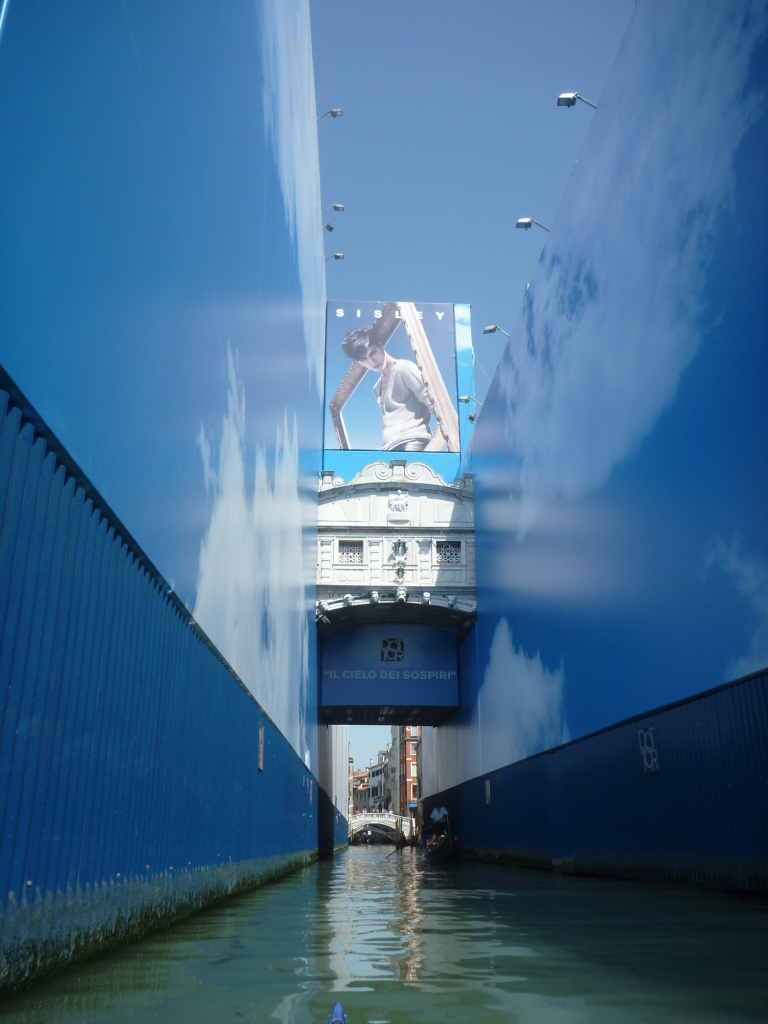
 Most mooring places in Venice are given in concession to private or commercial users by the Magistrato delle Acque, the magistrate of the waters, and they’re not supposed to be used by any others. This is not always respected, and the concessionary of this space have had enough of free riders.
The sign reads: “Don’t moor (here), or at my return I will untie your boats, leaving it to its destiny. Tired of moving boats. Concession N. XXXX”
Seen in Rio di S. Severo, May 17th, 2009.


 (view out, view left, view right)

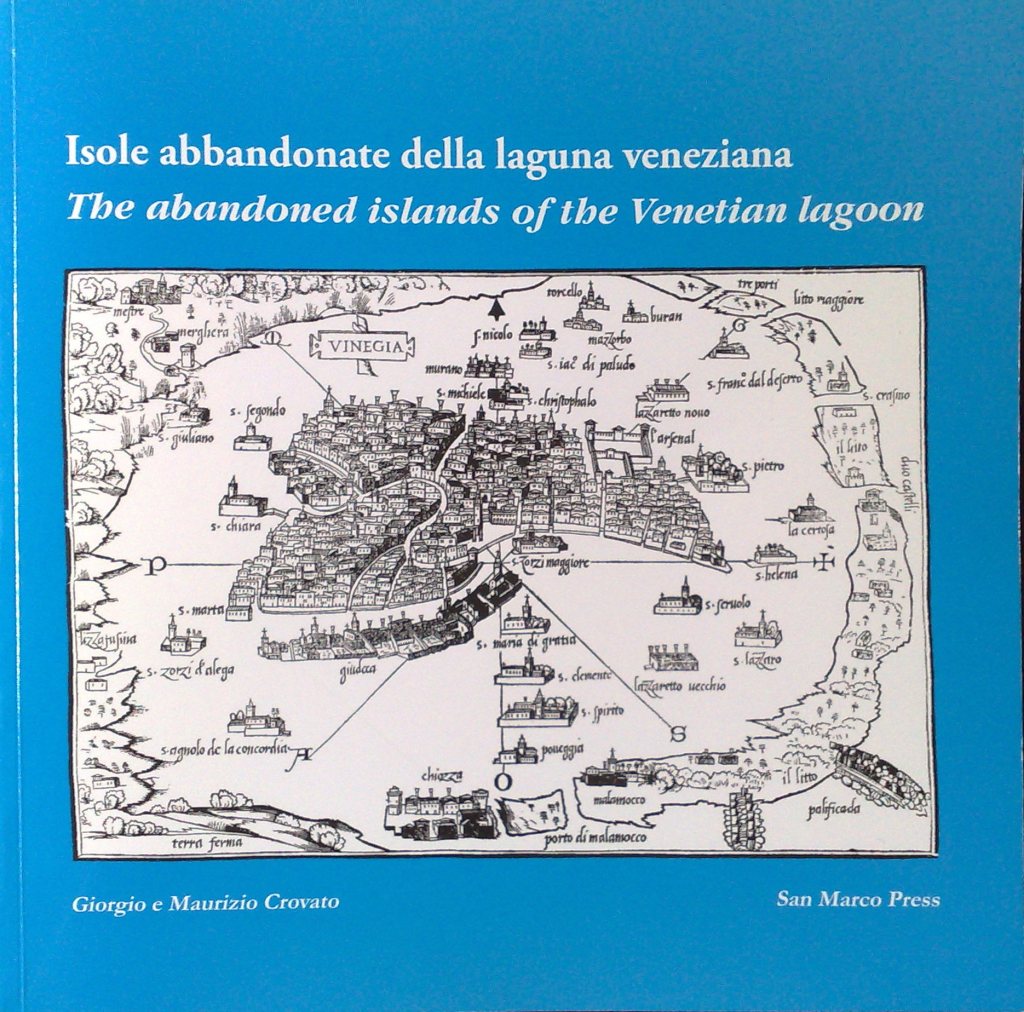 As a frequent traveller in the lagoon this book was a must have, and I bought it a few days ago.
Many of the islands in the book are places I have been many times, and as recently as this week I have been to S.Giacomo in Palude, Lazzaretto Novo, Sant’Ariano and La Cura, taking my own photos of the state of disrepair or recovery of each. As a historian it is very hard not to be intrigued and curious about the ruins and the past of these islands, and this book is a great help in understanding why the islands are like the are now.
Here are a few picture I’ve taken in the last week from some of the islands (left to right: S.Giacomo in Palude, La Cura and Sant’Ariano):


Isole abbandonate della laguna veneta The Abandoned Islands of the Venetian Lagoon by Giorgio and Maurizio Crovato, London (San Marco Press Ltd), 2009 (orig. 1978) ISBN 0955813867 Ten percent of the price will go a Venice related charity, depending on where in the world the book is bought. In Italy the money goes to the association that takes care of the Lazzaretto Novo island, which has been recuperated and restored since the first edition of the book.

 We met this rather violent viking lorry somewhere in Germany – every surface was covered with painting of savage vikings murdering and pillaging. Notice the monk being attacked on the beach.
 Its a bit tiring driving long hours, so I had a nap on a lawn somewhere in France.
 Fancy a nap with your head on this pillow? We spotted it in a parked car in Port de la Selva in Spain.
 At the symposium dinner they prepared a special Catalan drink which had to burn for a while before being drunk.
 Paella is good – we shared this wiith a bunch of Sicilian friends, Nigel Dennis and one of his coaches.
 This is a patisserie in Carcassonne, in the city below the walls.
 This fellow we met at the markets in Nîmes. I smiled back and walked on 🙂
 The Pont du Gard just outside Nîmes.
 In Venice I found a place to stay in the city, and here is all my stuff in two Ikea bags as I wait for the vaporetto at Piazzale Rome.
 The apartment is close to Campo S. Giacomo dell’Orio, which is a very cozy place.
 There’s a small supermarket at S. Giacomo dell’Orio, and one day I found this fellow tied to the old well outside the shop.
 There’s a small war going on Riva degli Schiavoni. The area is full of tourists, and therefore also of illegal immigrants selling counterfeit goods, like designer bags and belts. The local shop keepers have put out signs warning people not to buy the counterfeit products, and complain loudly that the police don’t do anything. The other day there were some policemen on the bridges, and the immigrants had moved somewhere else.
 This is an Italian monument, but still with a fiece lion of St. Mark’s.
 I know this guy who’s having and ice cream on the steps at Campo S. Stae. There’s a very nice gelateria in the Salizada S. Stae about 100m behind the church.
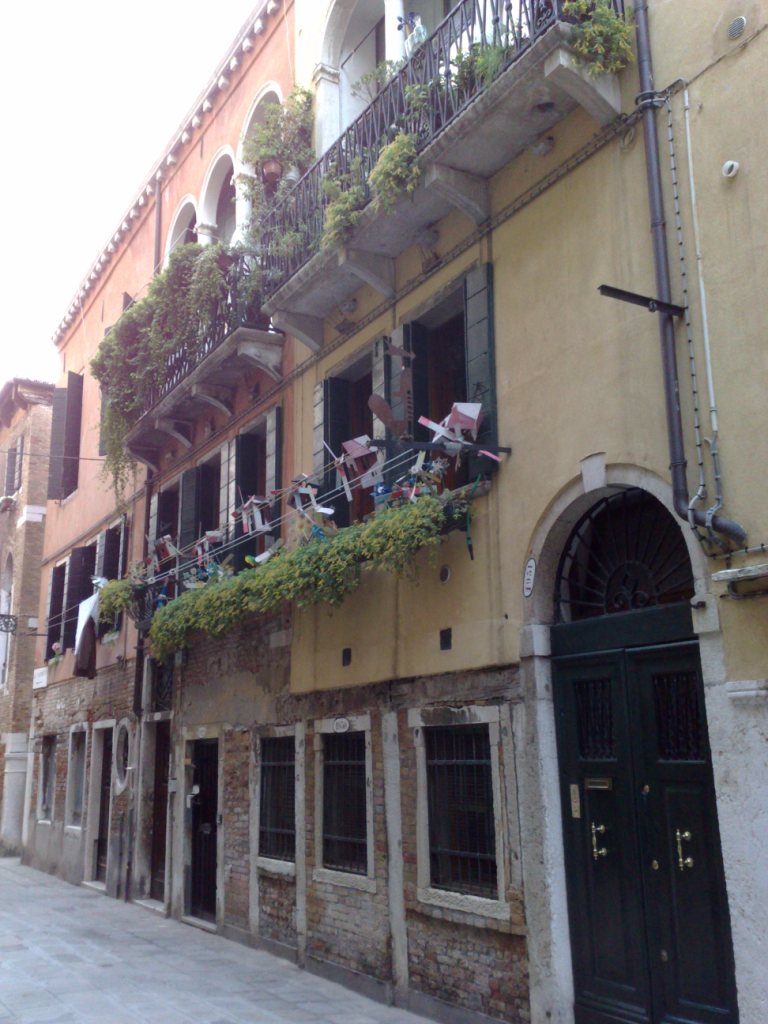 In the Salizada S. Stae there’s a house with model wind mills on all of the first floor. I have no idea why.
 One day on the vaporetto stop returning from the Lido to Riva degli Schiavoni they had these huge water bags lying on a platform. It wasn’t clear why, but it might be a stress test of a new vaporetto platform.
 I saw this beagle at St. Mark’s. He’s French, thirteen years old and in fine health.
Walking down the Salizada S. Stae you hardly notice the campanile towering over your head.

 Mestre is a city on the mainland, but the race started from Murano north of Venice, touched the NW corner of the city in the Cannaregio area, before heading towards towards San Giuliano on the mainland, on the outskirts of Mestre.
I was watching at the mid point, so I didn’t get to see the finish, and I still don’t know who won.


 The boat looks like one of the municipal racing boats, but the rowers didn’t look very expert. They had loads of problems with the waves you often find in the Canale Giudecca.
From the Lido we headed for the island of Sant’Erasmo, often called the vegetable garden of Venice. There are some 70 small farms on the island, and only a few hundred residents. The island also have a few canals between the fields and gardens, though they’re well hidden. We had to paddle through a lock to paddle into the island.
It is a very green places 🙂

 We found this abandoned sandolo in one of the canals. It looked like it had been a beautiful boat, but it might be beyord salvaging now.
 The canals were full of life, like small fish, transparent prawns and loads of crabs. Here’s one taking a stroll on my spraydeck.
 We also happened on this old gondola in front of a couple of farm houses.
 From the canals of Sant’Erasmo we paddled around the Lazaretto Nuovo, to a corner of the lagoon I hadn’t visited before. Behind the Lazaretto Nuovo are the defensive walls of the island. We had to paddle through some very small canals in the marshlands to follow the wall, but we got through and were spared having to back out again, through all the hairpin turns.

 From Lazaretto Nuovo we continued towards the island of Burano, our chosen lunch island. We were getting hungry but still had a few kilometres to paddle. Burano is my faviourite island in the lagoon. Its quite small, about 3500 inhabitants, and really cosy.
Here’s the leaning campanile of their main church.
 This is the abandoned island of Madonna del Monte. It use to be a monastery, but it was abandoned in the late 18th century, maybe as a consequence of Napoleons conquest of the Republic of Venice. He did close down a lot of monasteries.
 The leaning tower of Murano again.
 Marco paddling towards a nice lunch, with the skyline of Venice in the background.
 On Burano we saw this little boy walking a rather large dog.
 The coloured houses of Burano are fantastic. There’s every possible colour there, its like paddling on a painters palette. Notice the man taking a photo of us. Natural selection has provided him with optimal camouflage 🙂
 They were doing some maintenance on the canals on Burano, and several passages were closed. They weren’t closed well enough, though.
 When I get rich I want an orange house on Burano. It doesn’t have to be big, just orange 🙂
 Marco paddling passed the pale corner of Burano.
 Just behind Burano is the island Torcello, the site of an abandoned medieval city. Now only two churches are left. They’re repairing the campanile, it seems. It almost looks like a modern high rise building in the lagoon.
 At the entry of another canal on Burano we saw this little gem. It is a traditional boat of the area, a Batèla Buranela. Its an old type of freight boat used in the lagoon, for example by the farmers on Sant’Erasmo for bringing their produce to market in Venice. Very few examples exist now, they can probably be counted on one hand. One of the rowing clubs in Mestre has a Betela a coa de gambaro of recent construction, I saw it there last year.
A beautiful boat full of beautiful people 🙂


 It was five in the afternoon when we left Burano, and the tide was very low. Many of the passages we’ve used the last years were now too shallow for passage, even in a kayak, and we had to ‘seal’ our way for a while, and in the end we just got out and pulled the kayaks across until we had enought water for another stretch of slow paddling.
 The shallow sandy bottom was absolutely crawling with small crabs. When we walked across the shallowest places they would stand down in the 5cm of water, waving their little fists at our feet, and if we got too close they would either scuttle away or dig themselves into the sand.
There were so many we had to be careful where we put our feet. This one seemed to find the camera rather intimidating and decided to dig in.
 Somehow its impossible to go paddling with Marco without him getting all giddy and silly at some point.

 It might look like a very dramatic capsize, but the truth is we only had about 20cm of water there. An actual capsize there would be quite a feat.
 Another crab taking a walk on my front hatch.
 We returned to the Lido shortly before sunset, under this sky.
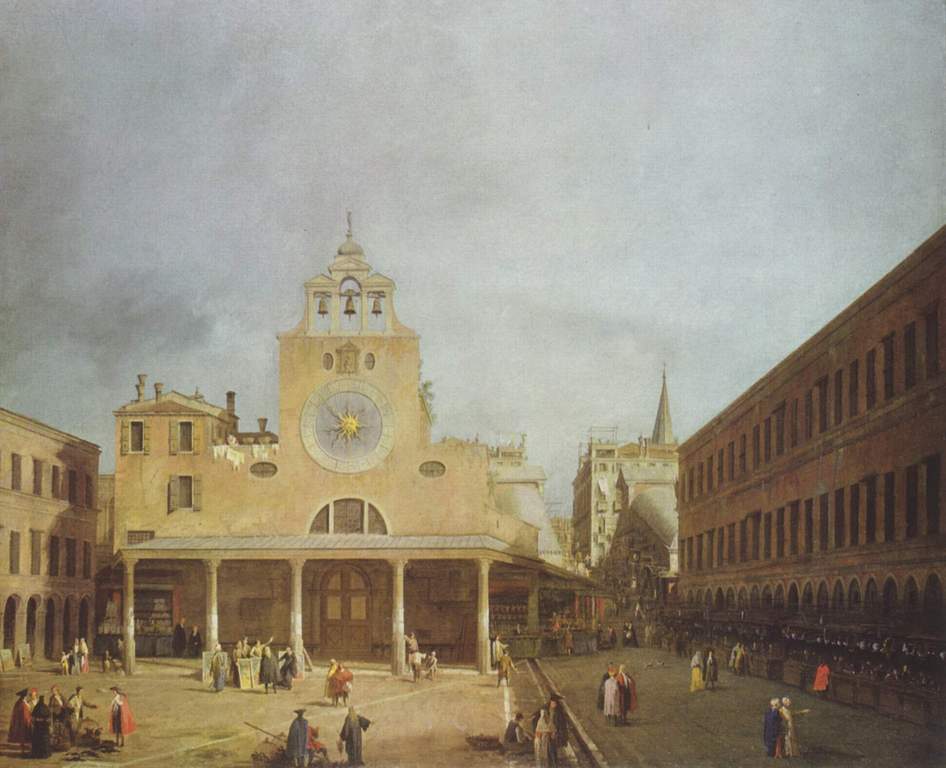 On Annunciation Day in AD 421, on the 25th of March, three Roman tribunes from the nearby Roman city of Padova participated in the consecration of the St. Giacometo church at Rivus Altus in the Venetian lagoon, thus formally founding the city of Venice.
In the years that followed the Roman Empire broke down and Italy was invaded by barbarians, and many inhabitants of the city of Padova moved to Rivus Altus in the lagoon to escape the unrest and pillaging following the invasions, giving rise to the first city nucleus of Venice.
The Rivus Altus means the tall brink, probably because the islands around there were just that little bit higher so the high tide didn’t flood them very often. With time the name Rivus Altus bacame the shorter “Rialto” which has been the commercial centre of Venice ever since.
This much is firmly founded in ancient legend.
While legends usually aren’t all real, the effects of legends can be very real, and the 25th of March has been considered the birthday of Venice since time immemorial.
Today is then the 1588th birthday of the beautiful city of Venice. Happy Birthday.