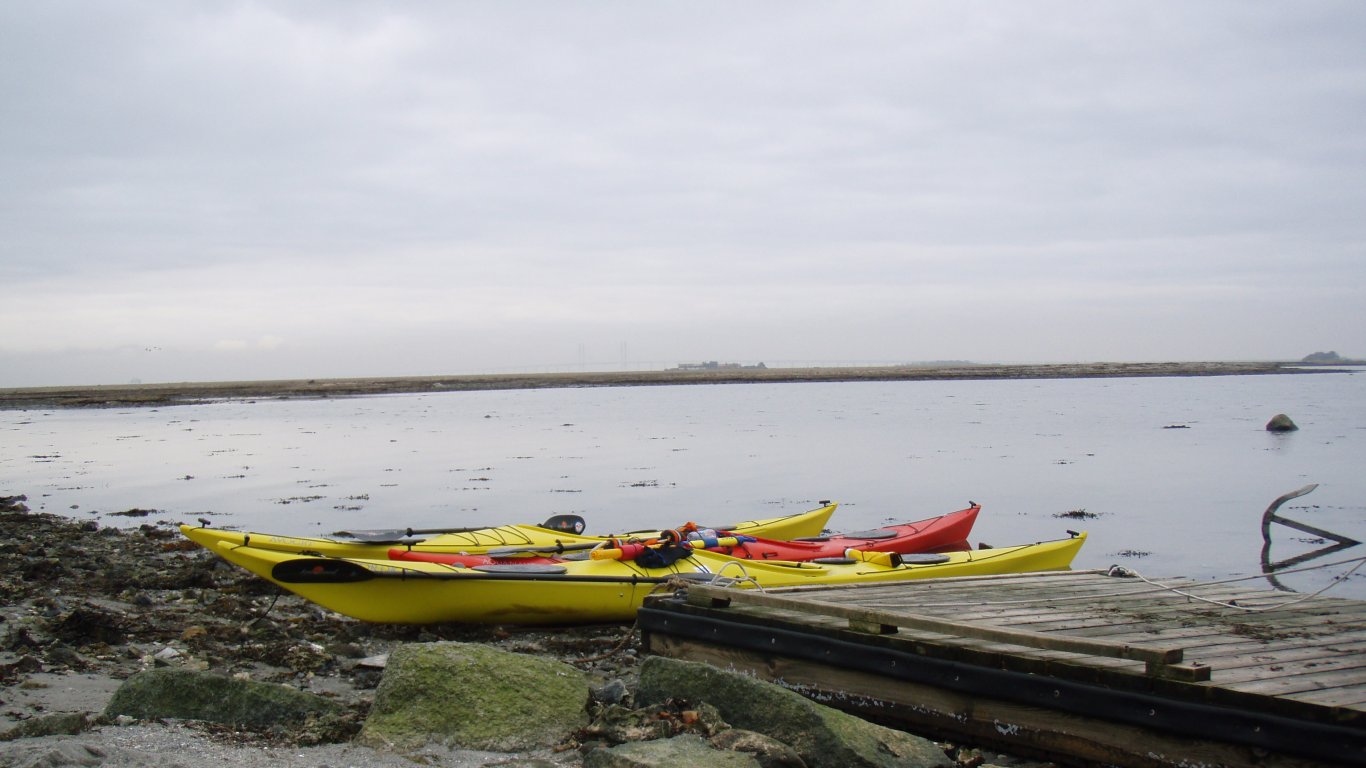
Today I paddled home from the beach park. Almost as usual, somebody had taken my kayak for use in a beginners course at Kajakhotellet, so I had to settle for something else. First I laid my greedy eyes on a Skim Distance which I haven’t tried yet, but then someone pretending to be a buying customer showed up, and I had to give it back. I don’t know why we free riders must always suffer this discrimination in front of paying clients. It not fair.
The Skim Dex was in use too, and so was the Nigel Foster Legend, and the NDK Romany, and the NDK Explorer had the skeg in disorder, and being a free rider I didn’t fix it, so in the end I had to settle for a Nigel Foster Silhouette, which I have tried before. Life is hard sometimes.
It is a good kayak, though, but it doesn’t fit me very well. It has a very low foredeck which forces me to sit with my legs too stretched for my taste, and the two huge pieces of ham I call my thighs has to be stuffed under the thigh braces. The cramped position gave me an uneasy feeling, and though the boat has good primary stability and very good secondary stability, I didn’t quite feel good in it. I feel I have more lateral control when I sit in a position with my knees a bit raised.
Its a pity with Nigel Fosters designs. I have tried both the Legend and the Silhouette, and both are good boats, but neither fit me. In the Legend I feel like I’m sitting in a deep hole, because it has a rather high cockpit rim. I don’t like it when my ribs touches the cockpit sides when I edge or roll. The Silhouette is much lower around the cockpit, but the foredeck is too low for me and my legs.
Anyway, this was about my paddle home from the beach. The beach park is on the eastern side of the island of Amager, and I live at Islands Brygge on the western side, so I have to paddle some 5-6 km north along the Øresund coast, enter the harbour and paddle another 5-6 km south inside the harbour before I’m home. Well, almost home. I still have a 500m walk from the water.
The first part in the lagoon of the beach park and behind the island of Prøvestenen was quite nice and quiet. It was a bit cloudy, and bit windy, but nothing extreme. There weren’t too many people at the beach, since there was little sun.
I saw a funny wading bird with a long red beak, at the beach. I’ve never seen that kind before, so I’ll have to look it up. I also saw two ducks of a new type, maybe pintails because they has a little loose feather on the back of their heads. I’ll have to look them up too. Of course, they might just have been the few punk ducks that didn’t fit in the with the rest 🙂 Later I saw a flying Grey Heron. They’re very graceful in flight, though less so when they take a shit and almost hits you, as it happened the other day when I walked the dog.
Up at the wind farm at Lynetten, at the entrance to Magretheholm leisure harbour, there are usually a bit of waves. Today they were few and small, but the swells did give a bit of speed. Too bad I didn’t feel at ease in the boat. It did take a bit of the fun away.
When I do this trip, I usually stop halfway to drink and each some chocolate. So I did today, only to discover two tugboats steaming towards me with something that resembled a piece of an offshore oil platform. I had to leave my chocolate on the spraydeck and paddle like a maniac to the other side of the harbour, where the big cruise ships are moored, to get out of the way.
Actually, I think I had the right of way because they approached on my left, but it didn’t quite seem like the occasion to insist.
Instead I had the pleasure of eating my now slightly salty chocolate just in front of the statue of The Little Mermaid, so all the tourists got a bright red kayak in the background of their holiday shots.
The rest of the trip was utterly eventless, like I’ve done it many times now.
The trolley I use for the final 500m home is this: Eckla Sea Kayak Cart
Today’s paddle took me a bit around the strait of Øresund. I started at the shop, Kajakhotellet.dk, and first I just planned to do on of the usual tours in the vicinity, but the sea was so calm and the sun was shining from a clear sky, so I changed plans and paddled to Saltholm, an islands about 6km east of the beach park, at Barakkebro, the only allowed approach on Saltholm at this time of year. Most of the island is a nature reserve for birds and seals, and all access to that area is restricted in the breeding season.
The leisure harbour at Flakfortet
I then paddled north to Flakfortet, where I have never been before. I spent some time exploring the small island which is now a leisure harbour, and it was fairly crowded due the good weather.
Flakfortet is an artificial island made just before the first world war, as a part of the defences of Copenhagen. It is shaped like a horse shoe with an inner moat, so it can be circumnavigated both on the outside and on the inside. It was almost lost to looting and nature when the military left in the 60s, but survived when it was turned into a leisure harbour. Now there are a restaurant and a kiosk there, and it is a popular stop for leisure boaters.
The wind farm at Middelgrunden
From there I went back towards Copenhagen, to the wind farm at Middelgrunden. I zig-zagged down the line of wind turbines, listening to their different sounds. The sea was so calm you could see the reflection of the wind turbines in the water. It was actually quite fun to paddle in the middle of a modern power plant.
From the southernmost wind turbine I crossed back down to the entrance of the beach park and the shop, seeing nothing more exciting than an empty beer can floating in the water.
All in all, my little trip lasted three and a half hour and I paddled 24km. Below are the trip as rendered on Google Earth and the double circumnavigation of the huge island of Flakfortet 🙂
The trip shown on Google EarthThe double circumnavigation of Flakfortet
One of the disadvantages of keeping one’s kayak at a shop is that it can be mistaken for a rental kayak. I have a bright yellow Valley Nordkapp PE, and most of the rental stuff at Kajakhotellet are Valley PE boats: Avocets, Aquanauts and some Nordkapps. As I was helping in the shop before my trip, a group mistook my boat for a rental kayak, and I let them do it. People come to the beach and rent kayaks to have a good time, not to have someone make them feel miserable because they took the wrong boat when there was so little left on the racks. I even helped them in the water.
One of the advantages of paddling from a kayak shop is that when someone mistakes you private kayak for rental gear, you can borrow some really great stuff instead. They have Valley, NDK, Skim Kayaks, Nigel Foster Design, Wilderness and much more. I grabbed a Skim Dex (with a keyhole cockpit) from the racks and had a great time.
The Skim Dex
The Skim Dex is mostly a playboat. It is really responsive and very manoeuvrable, but it’s tracking is lousy unless you deploy the skeg. Then it tracks OK. If you forget the skeg, you’ll waste a lot of effort trying to go straight, especially if there’s a bit of waves. This is very different from my Nordkapp, which tracks reasonably well even without the skeg, but then, the Nordkapp is not quite as lively as the Dex.
The Skim boats have some really neat little details. The bulkhead behind the seat is slanted a bit so it is easier to empty the boat of water and it gives a little more room in the day hatch. It has two strong straps on the sides for paddle float rescues with handles for easy detachment of the paddle. Just behind the cockpit is has a recessed metal axel which can be used to locking the kayak to something, and with the rope clutch on the side it gives a central point of drag when towing, and a quick release mechanism for the rope.
Miraculously, I did not forget my sunscreen this time, so The Pink Paddler did not return, except for an odd shaped patch on my back. Apparently, my arms are too short.
I have very fair skin and must always be careful when exposing myself to the sun, but if I want to go kayaking I will expose myself to a lot of sun, so I try to get some sun, especially on my torso. The project is, so to say, to get rid of The Pale Paddler without inviting in The Pink Paddler 🙂
Every Thursday my local kayak shop has a come-along paddle, just for a few hours after work. It is free for all, but yesterday we were only five, two coaches, two aspirant coaches and a girl that helps in the shop.
We took one of the common trips, to the local lighthouse and back, which ended at 7 km. Quite eventless, really, no wind and no waves, but a nice social occasion. The only thing that happened was that a group had set up an ad-hoc race track just in front of the exit from the beach park, so we immediately ended up in the middle of a bunch of sailing boats, and we had to creep along the coast towards the airport to get out on open water.
I did get to try two kayaks I haven’t paddled before: the Nigel Foster Silhouette and the Skim Dex.
The Silhouette was a bit small for me. It has a very low foredeck and I could hardly squeeze my thighs under the thigh braces. It was a really tight fit for somebody my size. It left me sitting in a position with more stretched legs than I’m used to, and initially I felt I had less control over edging and turning than I wanted. After a while and a bit of paddling I got used to the boat and became more relaxed.
It is a fast kayak. With my “normal” paddling style it did at least a few extra kilometres per hour than I do in my Valley Nordkapp, which is normally considered a reasonably fast boat.
The Silhouette is very responsive, which I believe is what Nigel Foster intended. It edges well, very well once I got used to the cramped leg space, and it responds immediately to even a small edge. It tracks OK with the skeg deployed. I would have loved it if it had had a little more room for my legs and thighs, but the conclusion is that it is not a kayak for anybody of my size.
At the lighthouse I swapped kayak with one of the others, and I got over in a Skim Dex. Its the first time I try one of the Skim boats, and it immediately felt very nice, but that might have been because I had too little room for my legs in the Silhouette.
The Skim Dex is a brilliant kayak. It is the shorter of the Skim models, and it is very manoeuvrable. It has absolutely no rocker, but put on edge it turns on a dime. It too tracks well enough with the skeg down, but neither of these boats are for expeditions. They are for playing and day trips.
Yesterday I went back to Varberg in Sweden to try the Rockpool Menai 18. I had made an appointment with Sara from Escape Kajakcenter in Gothenborg, Sweden, that they would bring a Menai 18 and an Alaw Bach to Varberg for trying.
Rockpool Menai 18 on the beach at Varberg
The famous surfing beach at Varberg was just as waveless as the last time, but the kayaks were there and that’s all that mattered.
The Menai 18 is different than the Alaw and the Alaw Bach. They are more play boats while the Menai is an expedition boat. As such it is equipped differently, but it maintains much of the easy handling of the Alaw and the Alaw Bach and the overall lines are very similar.
The Menai is 18’2″ long (554cm),which is a foot more than the Alaw and Alaw Bach, but has the same overall width.
Its hull has the same hard chines at the centre, rounding off halfway towards the ends and ending in a sharp V-shape at bow and stern. The hull stays wider for longer towards the stern, giving the boat a distinctive line from the keel to the stern. It also has two groves along the bottom for better tracking. The Manai comes with a skeg as default.
The cockpit of the Rockpool Menai 18
The deck is somewhere in between the Alaw, which has a very high foredeck, and the Alaw Back which has a low deck both fore and aft. The Menai has a higher foredeck than the Alaw Bach but noticeably lower than the Alaw, and much of that space is due to a separate lunch box hatch (6 litres) just in front of the cockpit. In the front the Menai has two groves under the deck lines which makes it a lot easier to put in a split spare paddle, and it has a flat area in the middle for a compass.
Seat and footrest are just as in the other two Rockpool boats. When I tried the Alaw Bach, it had an almost perfect fit for me, but the Menai I tried was much loser around the hips, even though the sides had more padding than were in the Alaw Bach. Rockpool can deliver two sizes of seats. The Alaw Bach defaults to the small seat and the Menai to the large. The small seat is definitely better for me.
The Rockpool Menai 18
I also had some problems with the thigh braces. It was hot and I paddled in neopren shorts, and when I pushed my legs up for a tighter grip on the boat, the sharp edges of the thigh braces would cut into my leg in a rather painful way. The braces definitely needs some foam padding, and on later inspection I noticed that the Alaw Bach I liked so much, had the braces carefully padded.
The Menai 18 paddles extremely well, just like it’s sisters.
It is very responsive to edging, turning swiftly as you move, and it can be edged to extremes I haven’t dared in any other kayak. It’ll edge further than I can twist my ageing body. The Menai will respond even to a slight edge and it will turn on a dime if you edge it until the keel is out of the water, and it’ll do that just as the Alaw and the Alaw Bach.
It tracks better than the Alaw Bach, probably due to the longer waterline and the groves in the hull, and with the skeg deployed it tracks very well, while still responding well to edging.
I paddled the Menai for a couple of hours, but in placid waters with very little wind, and unloaded. I have little doubt it’ll be great in rough waters and windy conditions, but I haven’t tried. During my test paddle of the boat I only had two small grievances: the sharp edge of the thigh brace and the too wide seat, and both can be easily remedied.
I have made up my mind now. I’ll be getting a Rockpool Menai 18.
I went to Sweden last week to try the Rockpool Alaw and the Alaw Bach at the Escape Kajakcenter in Göteborg. At that point I didn’t know that the Menai 18 was in production, so I didn’t try it.
Now I have to go back, either to Varberg or Göteborg, to try that out, before deciding whether it’ll be the Alaw Bach or the Menai 18 for me.
This photo shows the Alaw Bach (two boats above) and the Menai 18 (below) together. Click on it for a larger view.
So I have managed to spend a whole day from 7am to 8pm just to get a few hours on the water in two Rockpool kayaks: the Alaw and the Alaw Bach.
They are only sold in a few places, one of which is Escape Kajakcenter in Göteborg, Sweden. They had a course that day in Varberg where there are often good waves, and they had kindly offered to bring some extra kayaks for me to play with.
The train trip was over three hours but in compensation I was picked up at the train station.
On the beach there wasn’t a single honest wave in sight, but there was a Rockpook Alaw waiting for me. It was an early model, according to Sara from Escape Kajakcenter one of the first five ever made.
The Alaw is recognisable on the characteristic tall fore deck which distinguishes it from most other sea kayaks. Both Rockpool kayaks have an ergonomic cockpit, designed so you can have your legs and feet in many different positions. The most important part of this is the foot plate which replaces the normal separate foot rests. Thanks to this plate you have support on your whole foot and you can sit with your feet and knees in many positions without losing contact with the kayak.
The Alaw has hard chines mid-hull, so it has a sharp edge on the side of the hull rather than a more round shape. It gives it a very good secondary stability, so it can be edged a lot with feeling insecure. The Alaw can be edged to something like 45° and still feel quite stable and controllable.
Edging the Alaw to the limit will bring the keel out of the water both fore and aft, and the kayak can turn almost on the spot.
The kayak is very sensitive to edging and can be manoeuvred easily with a little bit of skill.
The one I tried had no rudder or skeg. It would probably gain some directional stability if equipped with a skeg, but wasn’t bad either, mostly because it was so easy to adjust course by just a sleight edge. Rockpool does deliver kayaks with skegs on order.
The only thing negative I have to say about the Alaw, is that I feel the cockpit rim is too high. It is probably a question of taste and habit, but I prefer kayaks with a low cockpit rim so I can lean over the sides more easily. Especially when rolling it, I felt a bit uneasy because I felt restricted in my movements by the high cockpit rim.
The high cockpit rim must suit somebody. For example, the Nigel Foster Legend has the same feature. I didn’t like it much for the same reason, even though it is a really nice kayak in most other ways.
When the others went to lunch, I stole the Alaw Bach one of them had used. It has less volume than the Alaw, and doesn’t have the high fore deck, but otherwise they are much alike. There isn’t quite the same flexibility in changing leg position, since you can’t lift your knees as much due to the lower fore deck, but the foot plate still offers some possibilities of changing and varying you paddling position in the kayak.
In the beginning I felt really bad in the Alaw Bach. There was a stupid edge on the seat, and the cockpit was really tight around the hips. I had read that the Alaw Bach was for small and mid-size paddler, and I’m 188cm and 90 kg which is not so small or mid-size, so I was about forget about it. Maybe the Alaw Bach just wasn’t made for me.
Now, there is a touch of stubbornness in my character, and I hadn’t done three hours in train to another country and not try one last time, so back to the beach, out the boat, examine the seat. I discovered that each side of the seat was padded with three thick pieces of foam, and that the back support wasn’t tightened properly so it slid behind an edge on the plastic seat. Off with the padding, tighten the back support and back on the water.
It was a revelation. Suddenly the kayak was as if made to measure. It followed my slightest movement, turned left and right as easy as nothing obeying the smallest stroke, and it tracked quite well too. The missing skeg was easily compensated by the high sensibility to even light edging. I was very comfortable in the seat.
It is the best kayak I have ever paddled, and I have tried a few thanks to the confidence of my local kayak dealer.
Now I have a small problem. I have such an itch to buy an Alaw Bach, and if I want to decide colours and design I have to make up my mind within a few days. Escape Kajakcenter has pre-ordered several Rockpool kayaks and must send over colour specification within the 1st of June. I can just imagine it. It is such a marvellous kayak and it’ll look just as good.
On the other hand, I do have an OK kayak, actually quite a good kayak, and there’s so much else I could spend the money on, and many will probably think I’m being silly, but I am a little bit in love.
I guess the coming days will show if reason or feelings get the upper hand.
Nigel Foster visited my local kayak dealer, Kajakhotellet.dk, on May 17th and 18th. I participated on the 18th.
Nigel Foster is a very soft spoken man. He explains a thing, demonstrates it and sends us of to try it. At first this exercises were very simple, like edging the kayak to make it turn, but then he build more things on top of that, like leaning over the kayak while edging to edge further, adding bow rudders and stern draws to turn faster and so on.
In the end the movements became really complicated and few really managed to do it. Some exercises took a while to settle in, like moving in zig-zag patterns by an combination of edging left and right while making coordinated bow rudders, side draws and stern draws. It was so incredible elegant when Nigel Foster did it, but I suspect the most of us must have looked rather fumbling, going here and there with little control.
At the end of the course I was exhausted 🙂 I had been in my kayak, edging it left and right, for hours, and the muscles in my hips and sides were rather sore. When at the end I wanted to practice my roll a bit, I had absolutely no hip flick and always had to revert to the sweep roll to get up.
(foto by Anette Kjær)
I’ve finally learned to roll solidly so it is now the exception that it fails rather than the other way around.
The roll that works best for me is a standard Greenland roll, or sweep roll. Until now I’ve only done it with my Greenland paddle, but I can do it to both sides, with and without the paddle extended. Tomorrow I have to try with the euro-paddle.
Until now I have mostly tried the C-to-C roll I have been taught here in Denmark, but it never got really solid. I succeeded maybe one time in two, and my second attempts were invariably worse than my first.
I’ve experimented a bit too with the floating technique Freya Hoffmeister taught in Spain, the balanced or static brace, but without much success. I can get down into the water and feel at bit of buoyancy but I inevitably sink. I’m probably doing something wrong, but fortunately it is only the beginning of spring so I have loads to time to practice alle these things in 🙂
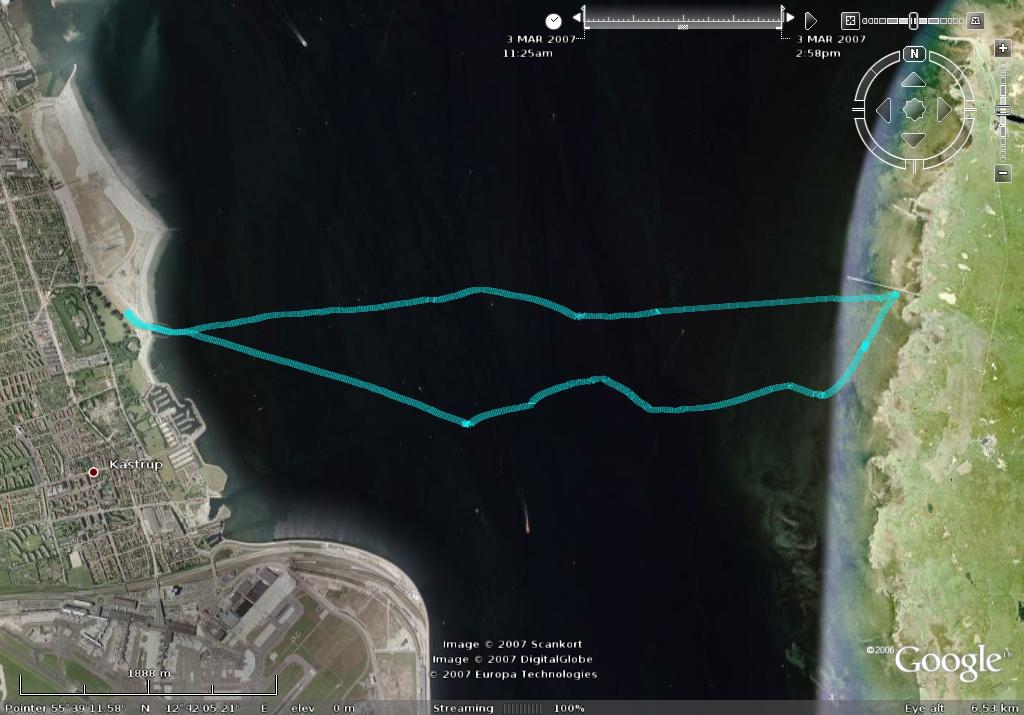
A few weeks ago we got our Reed Paddle Suits, and we had to try them immediately. The weather was nice and calm – there wasn’t a wind blowing and wave height were to be measured in centimeters – so we decided to skip over the island of Saltholm a few kilometres off the coast of Amager.
Saltholm is so close by, but since it is so flat (highest point is 3m above sea level) and it is a few kilometres distant, you can’t really see from the beach. And yet, it is just over there.
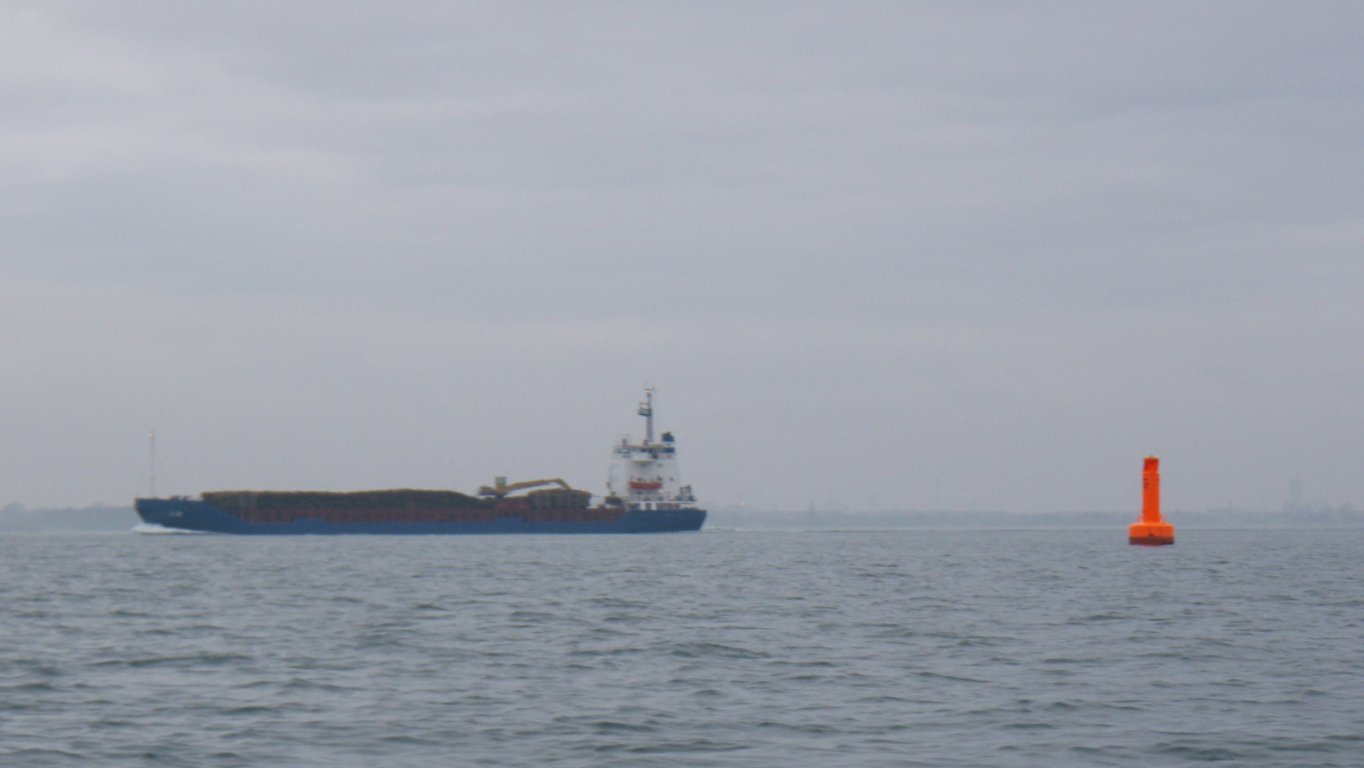
The trip over there was almost eventless. No wind, no waves so we just paddled and chatted along. At the edge of the sea lane we halted. Some fairly large commercial freighters pass there, and they’re far faster then us, so its important not to overestimate the distance and believe you can pass in front of them. Often you cannot.
In a kayak you’ll normally paddle 5-10 km/h, the equivalent of 3-6 knots, but the ships out there can often do 20-30 knots. They’re a lot faster than you’d expect, and the speed seems even less when they’re heading directly towards you.
We waited for the ship we could see up north at the wind turbines at Middelgrunden. When it was in front of us we moved forward and passed a few hundred meters behind it, where we caught a little ride on the swells it made. They must have been about 1.5m.
The waters around Saltholm are very shallow. There are less then 2m water in a wide area all around the island, and once we had entered that area there were no other traffic than a few speedboats. Since there are many huge boulders just under the surface most boats keeps a modest speed.
We paddled to a low bridge straight east of Amager Beach Park, called “lusebro”, the Lice Bridge 🙂 We had to drag the boats in the last 15-20m because the water became too shallow for paddling. The bridge was stoney and rough but we found a platform to sit on, and we took out our storm kitchen to make hot coffee and chocolate, which we enjoyed with biscuits and chocolate.
Saltholm really is flat. You could see Malmoe in Sweden straight across the island and the only visible feature are some low hills with trees. There are a few houses over there, and a real boat bridge named Barakkebro further north. It is the only place on the island where larger boats can legally approach.
In the sping and summer Saltholm is mostly closed to visitors. It is a breeding ground for a lot of sea birds, one of the major breeding grounds in the Øresund area, and it is illegal to land on the island from first in April to mid June, so the birds won’t be disturbed. In that period only Barrakkebro and the northernmost part of the island can be approached.
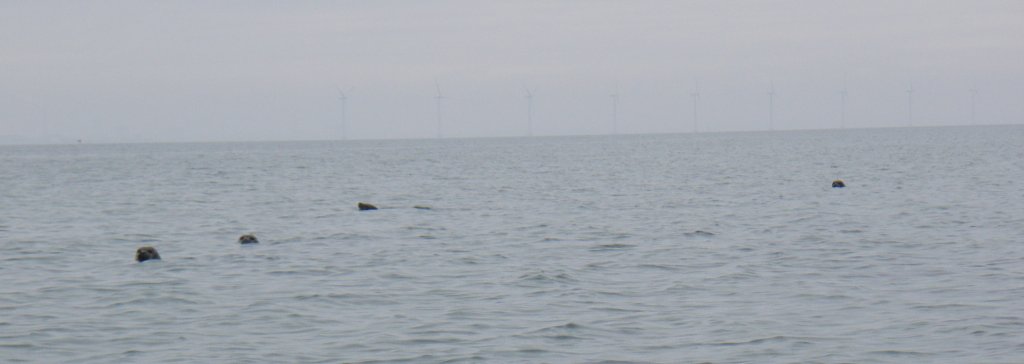
On our way back we noticed at lot of stones in the water, but strangely they moved around. Some changed shape, some grew and others diminished. Many smaller stones would appear, only to disappear after a while and reappear elsewhere.
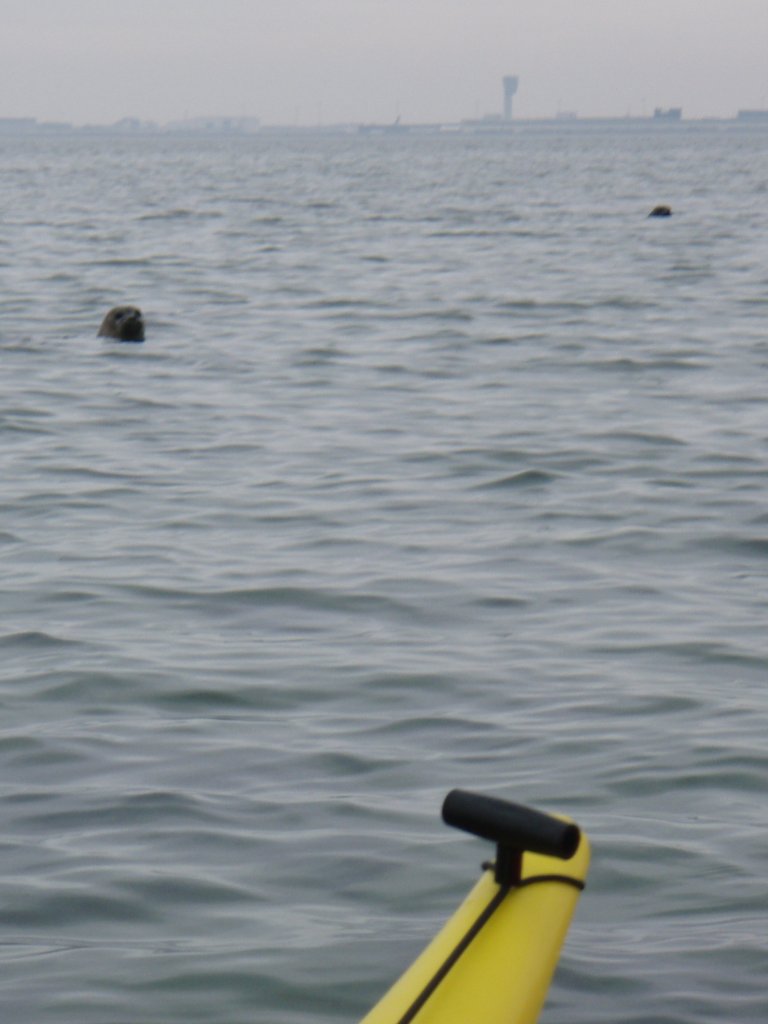
As we came close we discovered that they weren’t stones, but boulders with seals on top. They were sun bathing until we disturbed them. The smaller movable stones were seal heads keeping a keen eye on all our movements. We gathered and stopped paddling, and the seals came a bit closer to inspect us, and more joined them. At last we had 8-10 seals around us, but they always kept a safe distance. They watched us and we watched them.
It was a fantastic surprise to meet so many seals there. I had read that there were seals at Saltholm, but I expected them to be on the other side, away from the coast, where they would be more secluded.
After a while we had to say goodbye to the seals. We were drifting and got too close to the sea lane again with the risk of unpleasant close encounters with huger boats.
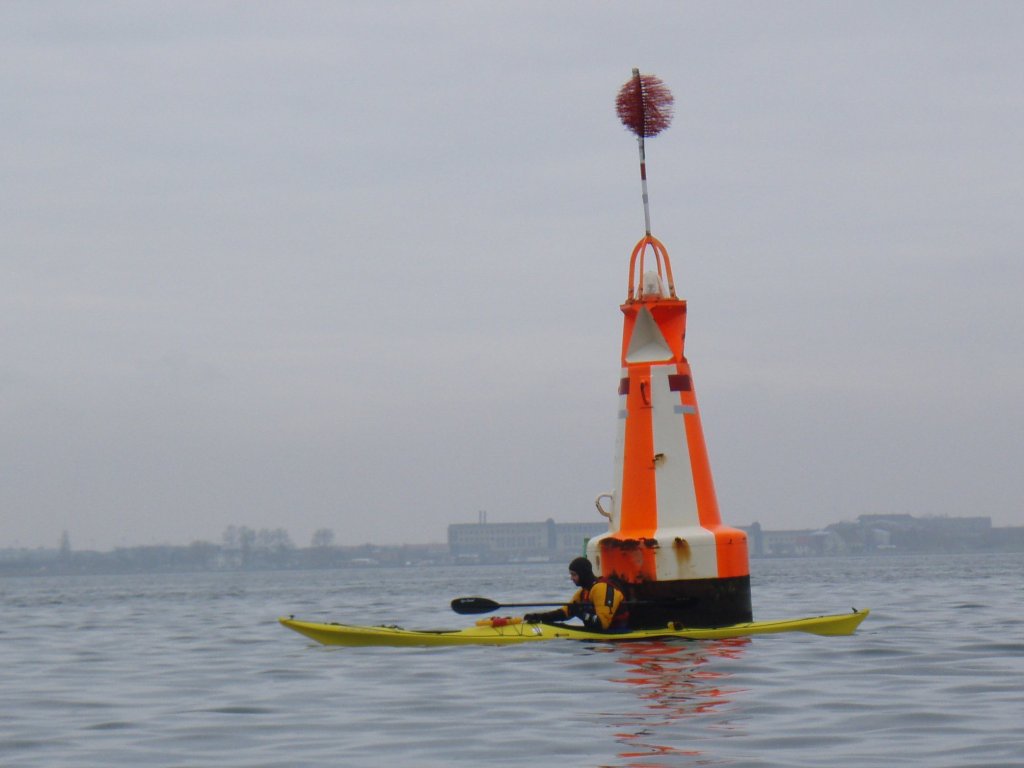
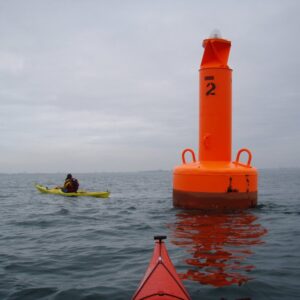
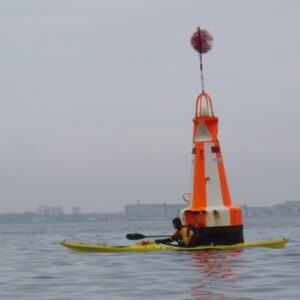
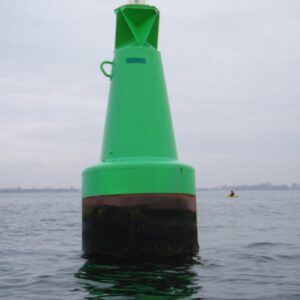
The sea lane is, where we passed it, marked with large coloured buoys. They must be some 3m in diameter and some 5-6m in height. Closest to Amager they are green, in the middle orange and white and towards Saltholm red. Southbound traffic moves in the rightward lane, closest to Amanger, between the green and white/orange buoys, while northbound traffic moves on the Saltholm side, between the red and white/orange buoys.
The buoys are so big they can be seen on the satelite images of Google Maps. Here are the red, the white/orange and the green buoy which we passed on our return across the sea lane
OLYMPUS DIGITAL CAMERA
OLYMPUS DIGITAL CAMERA
OLYMPUS DIGITAL CAMERA
Saltholm is close and it is not hard to getthere, but we have to respect that it is not our island and that it is a natural reserve. You can read about the rules for visiting Saltholm at the site of Skov- og naturstyrelsen (Danish). In brief, you can go there most of the year, except April-June, and you have to maintain a safe distance from the southern end of the island, the areas called Koklapperne and Svaneklapperne.
I brought a GPS unit. Here is our trip as rendered on Google Earth.
We started paddling mid August, and have since been kayaking two or three times a week, and we’ve logged almost 200 km each in less than three months.
Rental kayak costs are mounting and the economy starting pointing towards buying our own kayaks and gear.
Fortunately, we have had very good possibilities to try various brands and models of kayaks at the shop, and my preferences quickly centered on three different kayaks: Aquanaut from Valley Sea Kayaks; Nordkapp also from Valley; og Tempest 170 from Wilderness Systems.
In the end my choice fell on the Nordkapp. I’ve always enjoyed it when I could get hold of the rental Nordkapp, and I have at times been irritated that the coaches would always pick that for themselves, so I couldn’t use it.
It has often been a challenge since it is the least stable of my favourites but on the other hand it is more slender and faster, and very manoeuvrable. Lets hope the challenge will make me improve my skill faster 🙂
Now I have my kayak, I’m getting frustrated that it is so bloody cold and rainy so we can’t get on the water as often as I’d like.
 It is a good kayak, though, but it doesn’t fit me very well. It has a very low foredeck which forces me to sit with my legs too stretched for my taste, and the two huge pieces of ham I call my thighs has to be stuffed under the thigh braces. The cramped position gave me an uneasy feeling, and though the boat has good primary stability and very good secondary stability, I didn’t quite feel good in it. I feel I have more lateral control when I sit in a position with my knees a bit raised.
Its a pity with Nigel Fosters designs. I have tried both the Legend and the Silhouette, and both are good boats, but neither fit me. In the Legend I feel like I’m sitting in a deep hole, because it has a rather high cockpit rim. I don’t like it when my ribs touches the cockpit sides when I edge or roll. The Silhouette is much lower around the cockpit, but the foredeck is too low for me and my legs.
Anyway, this was about my paddle home from the beach. The beach park is on the eastern side of the island of Amager, and I live at Islands Brygge on the western side, so I have to paddle some 5-6 km north along the Øresund coast, enter the harbour and paddle another 5-6 km south inside the harbour before I’m home. Well, almost home. I still have a 500m walk from the water.
The first part in the lagoon of the beach park and behind the island of Prøvestenen was quite nice and quiet. It was a bit cloudy, and bit windy, but nothing extreme. There weren’t too many people at the beach, since there was little sun.
I saw a funny wading bird with a long red beak, at the beach. I’ve never seen that kind before, so I’ll have to look it up. I also saw two ducks of a new type, maybe pintails because they has a little loose feather on the back of their heads. I’ll have to look them up too. Of course, they might just have been the few punk ducks that didn’t fit in the with the rest 🙂 Later I saw a flying Grey Heron. They’re very graceful in flight, though less so when they take a shit and almost hits you, as it happened the other day when I walked the dog.
Up at the wind farm at Lynetten, at the entrance to Magretheholm leisure harbour, there are usually a bit of waves. Today they were few and small, but the swells did give a bit of speed. Too bad I didn’t feel at ease in the boat. It did take a bit of the fun away.
 When I do this trip, I usually stop halfway to drink and each some chocolate. So I did today, only to discover two tugboats steaming towards me with something that resembled a piece of an offshore oil platform. I had to leave my chocolate on the spraydeck and paddle like a maniac to the other side of the harbour, where the big cruise ships are moored, to get out of the way.
Actually, I think I had the right of way because they approached on my left, but it didn’t quite seem like the occasion to insist.
Instead I had the pleasure of eating my now slightly salty chocolate just in front of the statue of The Little Mermaid, so all the tourists got a bright red kayak in the background of their holiday shots.
The rest of the trip was utterly eventless, like I’ve done it many times now.
The trolley I use for the final 500m home is this: Eckla Sea Kayak Cart